© Yossi Zamir (GPO)
New U.S.-Israel Pact Accelerates AI and Critical Tech
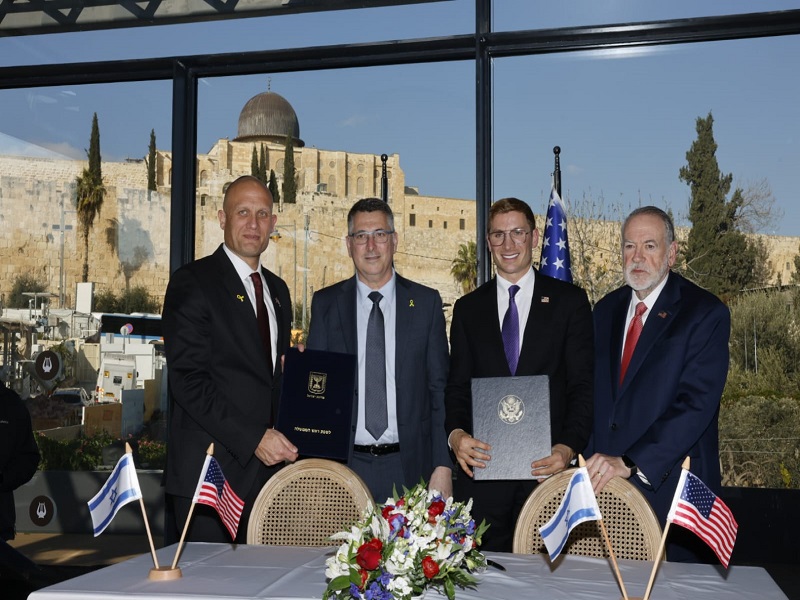
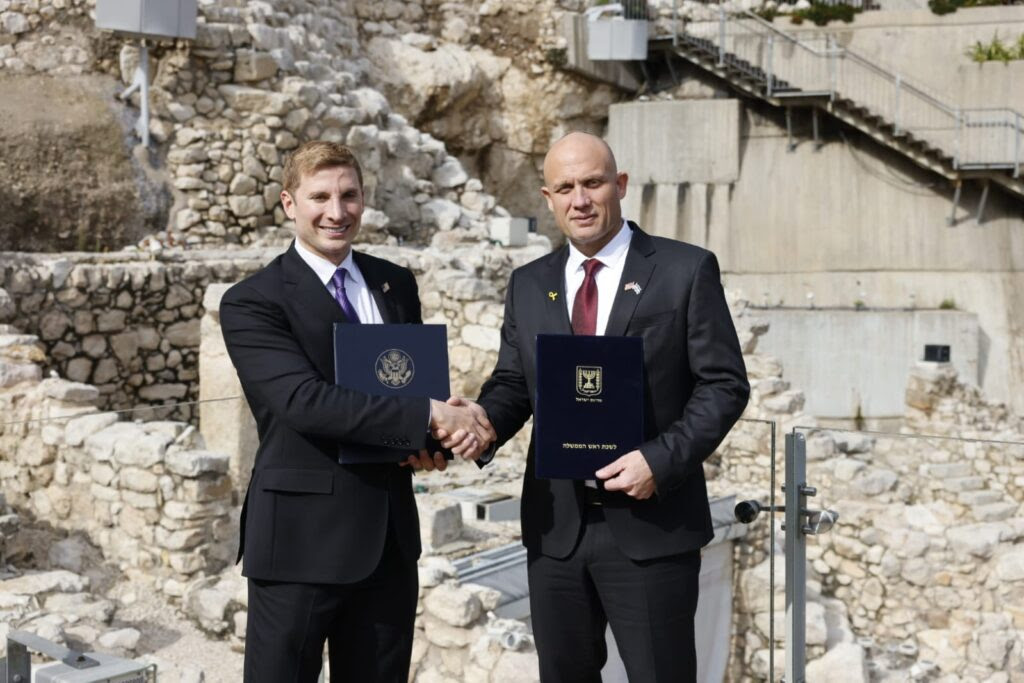
Jerusalem: The United States and Israel formally launched a Strategic Partnership on Artificial Intelligence, Research, and Critical Technologies on January 16, 2026, through a joint statement issued by the U.S. Department of State and the Government of Israel. The signing ceremony took place at the City of David in Jerusalem, where the memorandum was signed by the Head of Israel’s National AI Directorate, Brig.-Gen. (Res.) Erez Eskel and the U.S. Under Secretary of State for Economic Affairs Jacob Helberg, in the presence of Foreign Minister Gideon Sa’ar and U.S. Ambassador to Israel Mike Huckabee. Israel became the first of the nine leading nations in the Pax Silica initiative (which it joined in December 2025) to sign such a bilateral joint statement with the United States, marking a milestone in advancing Israel’s global leadership in artificial intelligence—a flagship priority of Prime Minister Benjamin Netanyahu.
This agreement deepens an already robust bilateral relationship in advanced science and technology by establishing a structured framework for sustained collaboration across several high-priority domains. It positions joint efforts in research, development, investment, and commercialisation as essential drivers of economic expansion, job creation, and long-term security advantages derived from technological edge.
The partnership centres on a Strategic Framework for Cooperation that consolidates work in artificial intelligence, semiconductors, space exploration, advanced computing, robotics, material sciences, and emerging energy solutions. A strong emphasis is placed on safeguarding sensitive research environments through enhanced protocols for protecting intellectual property, data, and critical innovations. In artificial intelligence, the two countries intend to pursue shared machine-learning projects with practical applications in healthcare, cybersecurity, and autonomous systems, while investing in human-capital development through joint training initiatives and platforms dedicated to both fundamental and applied research. Space cooperation will build on existing commitments under the Artemis Accords and related scientific endeavours. Semiconductor efforts will expand ongoing industry and institutional collaborations, robotics will see new bilateral programmes to speed automation and system resilience, material sciences will target next-generation substances for demanding high-tech uses, and energy research will focus on advanced battery storage, smarter grid systems, and other innovative power technologies. Israel’s vibrant innovation ecosystem will function as a dedicated secure node within the broader Pax Silica initiative, a U.S.-led multilateral arrangement designed to foster resilient supply chains in silicon-based technologies among aligned partners.
Oversight of the partnership falls to the Joint Economic Development Group, which will provide strategic guidance and coordinate implementation. The entire framework remains non-binding, carries no automatic funding commitments, and is fully subject to each nation’s domestic laws, legislative processes, and international obligations, ensuring flexibility and respect for existing legal boundaries.
Israel is already a major node in AI, cybersecurity, and defence-linked innovation. By formally integrating its ecosystem into a U.S.-anchored strategic framework, the partnership effectively accelerates innovation inside a closed loop. Other countries now face an officially endorsed acceleration gap: either invest heavily to keep pace independently, align with similar blocs, or risk falling behind in areas that directly affect economic competitiveness, military capability, and energy transition technologies.
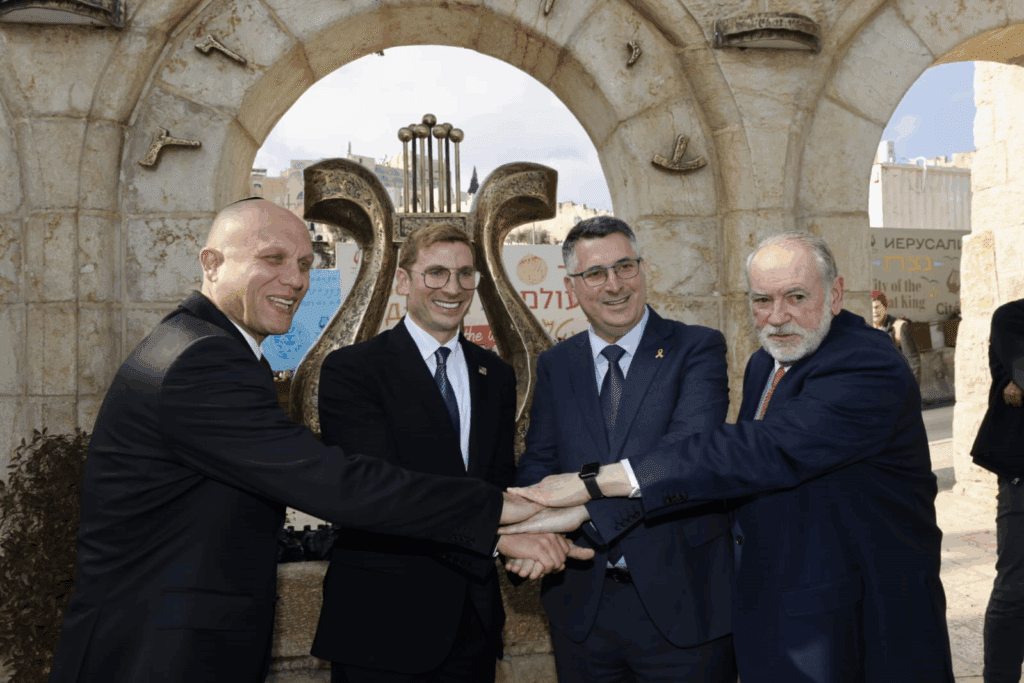
Under Secretary Helberg, speaking at the ceremony amid the ancient stones of the City of David, framed the moment as a declaration that “the future belongs to those with the courage to build and rebuild.” He highlighted Israel’s “asymmetric outcomes” despite its small size—economically, technologically, militarily—and tied the partnership to a broader Pax Silica vision where resilience fuels innovation, innovation produces strength, and strength produces peace. Helberg invoked Benjamin Disraeli’s words—”Man is not the creature of circumstances. Circumstances are the creatures of men”—to underscore the choice: shape the future or be shaped by it. He praised the decisiveness of leaders like President Trump and Prime Minister Netanyahu, and thanked Erez Eskel for moving the agreement “at the speed of necessity.”
Foreign Minister Gideon Sa’ar described the event as “another milestone in our unbreakable alliance,” noting that under President Trump’s leadership, relations are at historic heights, and praising Netanyahu for establishing the National AI Directorate. He emphasised: “Just as the United States is indispensable for Israel, Israel is an indispensable asset for America and its National Security interests.” Eskel highlighted vigorous efforts to partner with leading AI nations, thanking the Prime Minister for recognising that AI leadership will determine Israel’s national security. Ambassador Huckabee called Israel America’s “one true partner” in tackling critical minerals, supply-chain resilience, AI, quantum computing, and next-generation technologies that will benefit both countries and change the world.
The joint statement’s repeated focus on protecting sensitive technologies and building trusted research settings underscores a wider movement toward organising advanced innovation within selective, values-aligned groups rather than relying on unrestricted global sharing. Although the partnership avoids creating legal obligations or immediate large-scale expenditures, its launch nonetheless formalises a trend in which critical technologies are increasingly viewed as strategic national assets integral to alliance structures and power balances.
Ultimately, this initiative reorients the U.S.-Israel relationship toward an era shaped by artificial intelligence dominance, semiconductor supply-chain control, and the strategic management of innovation itself. As parallel frameworks take shape among other leading powers and coalitions, the contours of global technological access, economic hierarchies, and security alignments will likely be redrawn in the years ahead.
– global bihari bureau