China Cites One-China Policy After US–Taiwan Deal
Washington/Beijing: The United States and Taiwan have signed a wide-ranging trade and investment agreement aimed at expanding semiconductor manufacturing in the United States and strengthening supply chain resilience in a sector considered critical to economic and national security. The agreement was signed on January 15, 2026, by the American Institute in Taiwan and the Taipei Economic and Cultural Representative Office in the United States, according to a fact sheet released by the U.S. Department of Commerce.
U.S. officials described the agreement as a strategic economic partnership designed to reinforce domestic semiconductor production capacity and position the United States as a global centre for advanced manufacturing and technological innovation. Under the terms of the agreement, Taiwanese semiconductor and technology companies are expected to make new direct investments totalling at least $250 billion to build and expand advanced semiconductor fabrication, energy-related projects, and artificial intelligence research and production facilities in the United States. In addition, Taiwan will provide credit guarantees of at least $250 billion to facilitate further investment by Taiwanese enterprises across the semiconductor supply chain, including supporting industries and infrastructure.
The agreement also envisages the establishment of large-scale industrial parks in the United States, intended to host integrated clusters combining chip fabrication, advanced manufacturing, and innovation. U.S. officials said these industrial parks would strengthen domestic industrial infrastructure and support long-term job creation while reducing reliance on overseas production.
Alongside inbound investment, Taiwan has committed to facilitating increased U.S. investment in its own semiconductor, artificial intelligence, defence technology, telecommunications, and biotechnology sectors. The stated objective is to expand market access for American companies, deepen technological cooperation, and strengthen collaboration in critical and emerging industries.
Trade provisions form a central component of the agreement. A predictable tariff framework has been outlined to support more balanced trade while incentivising investment in U.S.-based manufacturing. Under the arrangement, reciprocal U.S. tariffs on Taiwanese goods will not exceed 15 per cent. Section 232 duties applied by the United States to Taiwanese auto parts, timber, lumber, and wood-derived products will also be capped at 15 per cent. At the same time, the United States will apply a zero per cent reciprocal tariff to certain categories of goods, including generic pharmaceuticals and their ingredients, aircraft components, and natural resources that are not available domestically.
Special provisions apply to semiconductors under U.S. national security trade authorities. Future Section 232 duties on Taiwanese semiconductors are structured to favour companies that invest in manufacturing capacity within the United States. Taiwanese firms constructing new semiconductor facilities will be allowed to import volumes equivalent to up to 2.5 times their planned U.S. production capacity without paying Section 232 duties during the approved construction period, with preferential rates applied to imports beyond that threshold. After new production facilities become operational, companies will still be permitted to import up to 1.5 times their U.S. output duty-free under the same framework.
U.S. officials framed the agreement as part of a broader effort to reverse the long-term decline in domestic semiconductor manufacturing. Government data cited by the Commerce Department shows that the U.S. share of global wafer fabrication fell from 37 per cent in 1990 to less than 10 per cent by 2024, with most production shifting to East Asia. Semiconductors are essential components in products ranging from smartphones and vehicles to telecommunications infrastructure and military systems, and U.S. authorities have argued that rebuilding domestic capacity is necessary to reduce strategic vulnerabilities exposed by global supply disruptions.
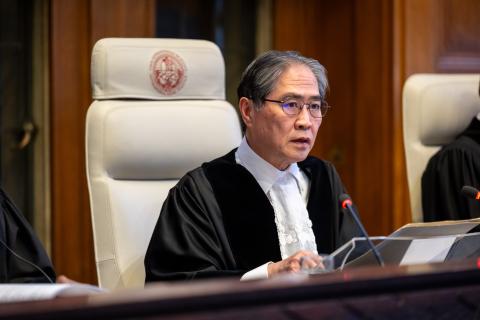
The announcement of the agreement prompted a response from Beijing. Speaking at a regular press conference today, Chinese Foreign Ministry spokesperson Guo Jiakun said China “firmly opposes the negotiating and signing of any agreement with sovereign connotations and an official nature between China’s Taiwan region and countries having diplomatic relations with China.” He added that the United States “needs to earnestly abide by the one-China principle and the three China–U.S. joint communiqués.”
The agreement comes amid heightened global competition over semiconductor supply chains and technology leadership, with governments increasingly using trade policy, investment incentives, and strategic partnerships to secure access to advanced manufacturing. U.S. officials said the deal with Taiwan forms part of a wider, government-wide strategy led by the Commerce Department to revitalise American semiconductor manufacturing and strengthen long-term economic resilience.
Implementation of the agreement will depend on regulatory approvals, investment decisions by companies, and evolving market conditions. U.S. authorities said additional details on project timelines and industrial park development will be released as the partnership progresses.
– global bihari bureau