
Book Review
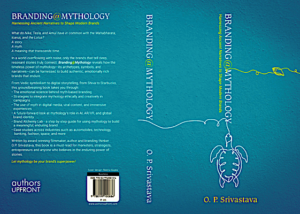
Book: Branding@Mythology
Author: O. P. Srivastava
Publisher: Le Press, Lucknow
When Myth Becomes Strategy in Modern Branding
In an age when brands often speak louder than nations and logos carry more emotional weight than institutions, the real struggle is no longer visibility but meaning. Products can be copied, campaigns forgotten, and technologies rapidly outpaced, yet some brands endure with an almost mythic permanence. They feel older than their balance sheets, familiar even at first encounter. Branding@Mythology, the new book by national award-winning filmmaker, former investment banker, and branding thinker O. P. Srivastava, enters this crowded marketplace with a proposition that feels at once radical and inevitable: the future of branding lies in the oldest stories humanity has ever told.
What gives this argument its authority is not abstraction but lived experience. For more than three decades, Srivastava worked in a world governed by numbers, risk, and consequence. As a senior investment banker, he advised on capital flows, valuations, and decisions where misreading a signal could cost millions. Markets rewarded clarity, punished illusion, and moved with ruthless efficiency. It is from this disciplined, unforgiving arena—not from an ivory tower of theory—that Branding@Mythology takes its first, surprising step.

That journey—from balance sheets to belief systems—is precisely what anchors the book. Srivastava did not arrive at mythology seeking romance or retreat. He arrived there because, after decades inside financial systems, he recognised something quietly unsettling: the strongest decisions, the most trusted institutions, and the most resilient brands were rarely built on logic alone. They endured because they understood the meaning.
“Finance taught me that numbers explain performance,” he says, “but they never explain loyalty. Loyalty belongs to another language altogether.”
That language, he argues, is myth—not as belief or poetry, but as structure. Mythology, for Srivastava, is not nostalgia. It is psychology, architecture, and continuity. “Mythology isn’t just about gods and ancient tales,” he explains. “It’s a set of stories, symbols, archetypes, rituals, folk memories, and cultural truths that shape how societies think.” In branding, mythology becomes “a shortcut to meaning—it connects instantly with human emotions and identity.” This, he suggests, is precisely what modern brands are struggling to achieve in a world saturated with content but starved of depth.
At the heart of Branding@Mythology lies a quiet but powerful reframing of branding itself. “Branding is the art of shaping perceptions,” Srivastava says. “It’s not just logos or taglines—it’s the story a brand tells, and the meaning people attach to it.” When branding meets mythology, that story acquires endurance. It stops chasing attention and begins earning belief.
The book opens with a metaphor drawn from the ancient story of the Samudra Manthan—the churning of the cosmic ocean by gods and demons in search of Amrit. Amid chaos, ambition, and conflict, Mount Mandara begins to sink, threatening collapse. It is then that Vishnu, in the form of Kurma the turtle, slips beneath the mountain and bears it on his back—silent, unseen, and indispensable—making transformation possible simply by staying still.
For Srivastava, this is not merely a mythological episode but a guiding principle. In markets churned by speed, trends, algorithms, and distraction, the brands that last are not the flashiest but the most grounded. “Like the turtle,” he notes, “they move with purpose, not haste. They bear the weight of meaning. They endure.”
That image—of calm endurance beneath chaos—forms the quiet centre of Branding@Mythology. It reflects what Srivastava had repeatedly observed in finance: moments when models functioned, yet confidence collapsed; when numbers aligned, yet institutions failed; when everything on paper suggested stability, but something essential was missing. What endured in those moments was never aggression or speed, but trust—quiet, load-bearing, and largely invisible.
It is precisely this invisible force that ancient mythology sought to describe.
From this foundation, the book expands outward across cultures and continents, revealing how mythology already structures some of the world’s most iconic brands. Nike draws directly from the Greek goddess of victory. Tesla echoes Prometheus, the bringer of fire—innovation paired with risk. Starbucks is anchored in the siren of maritime lore, a symbol of allure and journey. Ferrari channels the war-horse, a timeless emblem of power and speed. These are not coincidences. “Iconic brands—Nike, Tesla, Starbucks, Amul—are not just selling products,” Srivastava observes. “They’re selling myths, meanings, and archetypes.”
Drawing on Jungian psychology, civilisational symbols, and narrative patterns that recur from the Mahabharata to Homer, the book shows how archetypes such as the Hero, the Caregiver, the Explorer, and the Trickster continue to shape global brands—not as metaphors, but as psychological contracts. Symbols endure because they compress meaning. A swoosh, a cow, a thunderbolt, a turtle—each carries centuries of instinctive recognition.
Equally important is narrative structure. The ancient loop of departure, struggle, and return appears relentlessly in modern advertising because it mirrors how humans experience change. Brands that deny struggle promise perfection—and in doing so, lose credibility. “A brand that promises only success is lying,” Srivastava notes. “Struggle is not a flaw in the story. It is the story.”
The argument becomes especially compelling when the focus turns to India. Srivastava points out that Indian culture is among the richest mythological reservoirs in the world, yet its brands often hesitate to draw from this inheritance with intent. “Indian brands rarely tap into this depth consciously,” he says. Branding@Mythology is, in many ways, an attempt to bridge that gap—to restore confidence in indigenous stories as globally resonant tools of identity rather than local curiosities.
To translate philosophy into practice, Srivastava introduces the Brand Alchemy Lab, a structured framework that guides brands through decoding culture, identifying archetypes, selecting symbols, crafting narratives, and designing experiences that carry meaning. He likens the process to transformation itself—turning cultural insight into brand identity. The emphasis is not on appropriation, but alignment: brands discovering what story they are already part of, rather than inventing one artificially.
Yet the book is careful not to romanticise mythology uncritically. Srivastava repeatedly warns that myths are powerful precisely because they are sensitive. “Mythology is a double-edged sword,” he cautions. “A myth used without depth, sensitivity, or context can cause backlash.” He draws a sharp distinction between reverence and reduction, noting that “a cartoonish Krishna is not the same as Krishna from the Mahabharata.” The difference, he insists, determines whether mythology becomes a brand’s greatest asset or its most serious liability.
Branding@Mythology also situates itself firmly in the present moment—an era shaped by artificial intelligence, automation, and algorithmic efficiency. Srivastava does not see mythology as threatened by technology; instead, he sees it as essential to balancing it. “In a world where algorithms predict behaviour, myths explain behaviour,” he says. “AI can generate content, but only mythology can generate meaning.”
As younger audiences rediscover mythic symbols through gaming, animation, comics, and immersive digital worlds, the book argues that ancient narratives are not fading. They are returning—re-coded, re-imagined, but structurally intact.
Ultimately, Branding@Mythology is less a branding manual than a cultural argument. It suggests that brands which endure will do so not by shouting louder, but by standing for something deeper. They will not abandon structure in pursuit of relevance. They will not trade origin for novelty. Like the turtle beneath the churning ocean, they will stabilise rather than scramble. They will hold memory, not just market share.
“Myth doesn’t tell you what to sell,” Srivastava says. “It tells you what you must never betray.”
In that sense, the book proposes that the future of branding may look less like invention and more like remembrance. Not regression, but recognition. Like Kurma beneath Mount Mandara, myth does not seek applause. It seeks continuity—and in continuity, it enables transformation.
– global bihari bureau