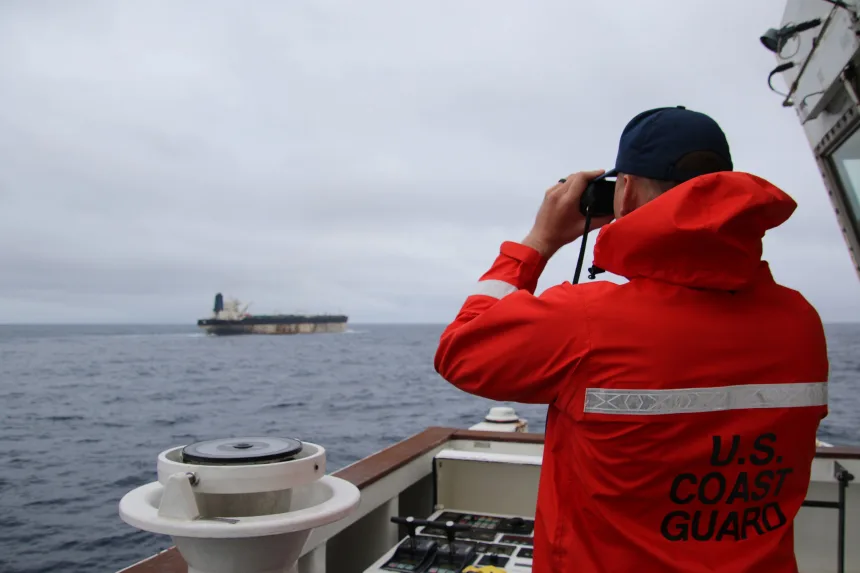
A photo of the oil tanker Bella 1, released by US European Command on Wednesday, January 7, 2026.
Atlantic Oil Tanker Dispute Heightens Russia-U.S. Tensions
Moscow: Russia today accused the United States of illegally seizing a Russian-flagged oil tanker in international waters, warning that the incident risked escalating already strained relations and undermining established norms of international maritime law. The protest followed a question raised at the United Nations in New York earlier in the day, where the UN Secretary-General’s spokesperson said neither Moscow nor Washington had formally approached the organisation on the matter.
At the UN’s daily press briefing on January 7, a journalist asked whether Russia or the United States had raised the issue of an oil tanker with the United Nations. Responding, Secretary-General António Guterres’ spokesperson Stéphane Dujarric said that, to his knowledge, no such communication had been made in the previous two hours. The exchange came amid growing diplomatic fallout from the reported boarding of the tanker Marinera by U.S. forces in the North Atlantic.
Hours later, the Russian Ministry of Foreign Affairs today issued a sharply worded statement expressing “grave concern” over what it described as the illegal use of force by the United States Armed Forces against the Marinera on January 7. According to Moscow, the vessel had been temporarily authorised to fly the Russian flag on December 24 in accordance with international and Russian law and was transiting peacefully through international waters en route to a Russian port.
Taken at face value, the Russian response frames the incident primarily as a legal and procedural dispute rather than a military confrontation. Moscow’s emphasis on flag-state jurisdiction, prior diplomatic protests, the civilian status of the vessel and crew, and the rejection of unilateral sanctions reflects an effort to contest the legitimacy of the U.S. action under international maritime law while keeping the issue within diplomatic and normative channels. While warning of escalation and broader risks to freedom of navigation, the statement stops short of announcing retaliatory measures, instead calling for adherence to established legal principles and the protection of civilians, signalling a calibrated response aimed at international audiences as much as bilateral interlocutors.
The ministry said U.S. authorities had been repeatedly provided, including through official communications with the Russian Foreign Ministry, with reliable information confirming the tanker’s Russian registration and its civilian, non-military status. It rejected any suggestion that the vessel was sailing without a flag or under false registration, arguing that there was no legal basis for stopping or inspecting the ship.
Russia maintained that international maritime law grants exclusive jurisdiction over vessels on the high seas to their flag state, with boarding or inspection permitted only under narrowly defined circumstances such as suspected piracy or slave trading. Neither condition applied to the Marinera, the statement said, adding that any other action would require the explicit consent of the flag state. Moscow said it had not only withheld such consent but had lodged formal diplomatic protests in recent weeks over what it described as the continued pursuit of the tanker by a U.S. Coast Guard vessel, demanding that the pursuit be halted and unlawful demands to the ship’s captain withdrawn.
Verified maritime tracking and reporting indicate that the Marinera, formerly known as Bella 1, was seized by U.S. authorities on January 7 after more than two weeks of pursuit linked to enforcement of sanctions on Venezuela’s oil exports. The vessel — once part of what U.S. officials describe as a “shadow fleet” involved in transporting Venezuelan and Iranian crude — had changed its name and adopted the Russian flag shortly before interception. Although historically tied to sanctioned cargoes, independent tracking data and maritime analysis show the tanker was empty at the time it was boarded in international waters between the United Kingdom and Iceland. A second vessel, the M Sophia, a Panama‑flagged oil tanker also under U.S. sanctions, was also seized by U.S. forces in the Caribbean Sea on the same day, with authorities describing it as engaged in illicit activities linked to Venezuelan oil shipments.
The shadow fleet referenced by U.S. officials is a network of commercial vessels that have historically been used to transport oil and related cargoes in ways designed to evade international sanctions, often by altering vessel names, ownership, or flags temporarily. Ships in this fleet are closely monitored by U.S. and allied authorities due to their links to sanctioned shipments, and enforcement actions may include tracking, interdiction, and seizure operations in international waters when vessels are found violating restrictions. The Marinera and M Sophia seizures are illustrative of this approach, highlighting both the challenges of enforcing sanctions across the global oil trade and the legal and diplomatic complexities that arise when actions occur on the high seas.
Describing the boarding and what it called the de facto seizure of the tanker by U.S. military personnel as a gross violation of international maritime law and freedom of navigation, the ministry said the action infringed upon the legitimate rights and interests of the shipowner. It also warned that the lives and health of the crew, which it said included citizens of several countries, were now at risk, and criticised what it described as threats of legal action by U.S. authorities on unacceptable grounds.
The Russian statement further raised environmental concerns, accusing U.S. forces of conducting an unsafe pursuit and armed seizure in severe weather conditions, thereby risking significant environmental damage to the North Atlantic. It dismissed references by Washington to domestic sanctions legislation as lacking legal foundation, arguing that unilateral restrictive measures imposed by the United States and other Western countries were illegitimate and could not justify asserting jurisdiction or seizing vessels on the high seas.
Moscow also rejected suggestions attributed to some U.S. officials that the seizure of the Marinera formed part of a broader strategy related to Venezuela’s natural resources, calling such claims cynical and accusing Washington of harbouring neo-colonial ambitions. The Foreign Ministry said the incident reflected a broader disregard for accepted norms of international maritime navigation and warned that it could further escalate military and political tensions in the Euro-Atlantic region, lowering the threshold for the use of force against civilian shipping.
In its statement, Russia criticised the United Kingdom, alleging that British authorities had acknowledged involvement in the U.S. military operation in North Atlantic waters. It warned that such actions could embolden other actors to take similar steps, further eroding maritime security and freedom of navigation.
Concluding its statement, the Russian Foreign Ministry called on the United States to return to established norms and principles of international maritime law and to immediately cease what it described as unlawful actions against the Marinera and other vessels engaged in lawful activity on the high seas. It demanded that Washington ensure appropriate and humane treatment of Russian citizens on board the tanker, fully respect their rights, and facilitate their swift return home.
As of the UN briefing in New York, the United Nations had not been formally seized of the issue by either party, leaving the dispute to play out through bilateral channels amid heightened scrutiny of maritime security and freedom of navigation in international waters.
– global bihari bureau