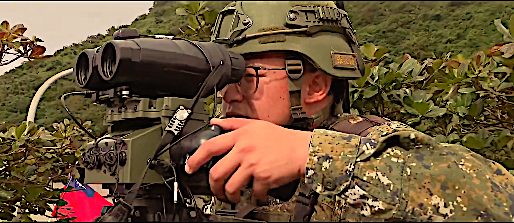
A Taiwani soldier keeps vigil
PLA Sorties, Warships Raise Tensions Across Taiwan Strait
US, Europe and Asia Respond
Taipei/Beijing/Washington: The new year of 2026 opened for Taiwan under the shadow of intensified Chinese military activity, as Taipei, Washington, and Beijing traded sharply contrasting assessments of a fresh round of People’s Liberation Army (PLA) air and naval operations around the island. Taiwan’s Ministry of National Defense (MND) reported continued PLA aircraft sorties, naval deployments, and auxiliary activities in waters and airspace surrounding Taiwan through December 31, extending into January 1, even as the United States and several allied governments issued public statements urging restraint and warning against unilateral changes to the status quo across the Taiwan Strait.
Washington reacted on January 1 by expressing concern that China’s military activities and rhetoric were unnecessarily raising tensions in the region. The U.S. State Department reiterated its opposition to the use of force or coercion and underscored American support for peace and stability across the Strait. These remarks came as Taiwan’s defence authorities released fresh operational data indicating that PLA pressure had not eased with the turn of the year, reinforcing perceptions that Beijing is sustaining a deliberate tempo of military signalling rather than conducting isolated drills.
The backdrop to this heightened activity includes the December 17, 2025, announcement by the U.S. government of an $11.1 billion arms sale to Taiwan, one of the largest in decades. The package integrates advanced surveillance systems, precision-strike capabilities, long-range artillery, anti-armour weapons, and naval support equipment, as well as battlefield communications tools like the Taiwan Tactical Network (TTN) and Team Awareness Kit (TAK), designed to enhance coordination and situational awareness across Taiwan’s military units. Taiwan’s government welcomed the package, linking it to a proposed supplementary eight-year defence budget of $40 billion, plans to raise defence spending to over 3% of GDP in 2026 (with a target of 5% by 2030), and ongoing investment in asymmetric capabilities and societal resilience. Officials framed these measures as essential to maintaining credible deterrence and regional stability, underscoring that the arms deal strengthens Taiwan’s defensive posture rather than signals offensive intent.
Taiwan’s asymmetric defence strategies, commonly referred to as the “porcupine strategy,” emphasise mobile, dispersed, and cost-effective systems—such as anti-ship missiles (e.g., Hsiung Feng and Harpoon), portable anti-air weapons (e.g., Stinger), loitering munitions and drones (including Altius and domestic Kuai Chi unmanned surface vessels), sea mines, and integrated air defense networks like the emerging “T-Dome”—to impose high attrition on any invading force while exploiting the island’s terrain and the challenges of cross-Strait amphibious operations. This approach, rooted in the Overall Defence Concept, prioritises deterrence by denial over symmetric competition, with recent procurements and budgets accelerating mass production of drones, missiles, and unmanned platforms to create layered, resilient denial zones.
Beijing responded with pronounced concern. Chinese Foreign Ministry spokesperson Guo Jiakun described the arms sale as a serious violation of Chinese sovereignty and a direct threat to peace in the Taiwan Strait. He emphasised that U.S. actions embolden Taiwan’s separatist authorities, accelerate risks of escalation, and could lead to serious consequences, framing the move as interference in China’s internal affairs and a challenge to the one-China principle and existing China-U.S. joint communiqués. Analysts note that Beijing perceives the sale not only as a military transaction but as a political signal, testing U.S. commitments and Taipei’s resolve while complicating regional strategic calculations.
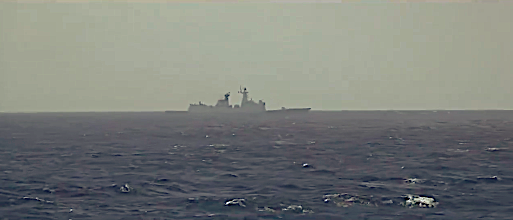
According to Taiwan’s MND, from late December through January 1, 2026, the PLA conducted repeated air and maritime operations around the island, involving combat aircraft, surveillance platforms, drones, and naval vessels operating in multiple sectors. On several days, dozens of aircraft crossed the median line of the Taiwan Strait or entered Taiwan’s northern, central, southwestern, and eastern air-defence identification zones. On December 29–30, 2025, MND claimed that 130 PLA aircraft sorties and 14 People’s Liberation Army Navy (PLAN) ships, along with 8 official vessels, were detected operating around Taiwan, with 90 of the 130 sorties crossing the Taiwan Strait median line and entering Taiwan’s northern, central, southwestern, and eastern air‑defense identification zones. On December 30–31, 77 sorties of PLA aircraft, 17 PLAN ships, and 8 official ships were detected, of which 35 sorties crossed the median line and entered Taiwan’s northern, central, and southwestern ADIZ. On January 1, 2026, more modest activity was observed, with 3 PLA sorties, 17 naval vessels, and 8 official ships operating in the vicinity, and 1 sortie crossing the median line into Taiwan’s southwestern airspace. Taiwanese forces responded each time with combat air patrol aircraft, naval vessels, and shore-based missile systems, while joint intelligence, surveillance, and reconnaissance assets tracked movements in real-time. Defence officials also confirmed the detection of Chinese balloons during this period, adding to what Taipei describes as multi‑domain pressure.
These daily operational disclosures form part of a broader pattern identified by Taiwan’s defence establishment over the course of 2025. Official figures show that from January through September last year, more than 3,000 PLA aircraft sorties crossed the Strait’s median line or entered Taiwan’s air-defence zones, alongside roughly 2,000 naval operations within Taiwan’s surrounding waters. Defence planners in Taipei have assessed that so-called “joint combat readiness patrols” now occur several times a month, increasingly compressing warning and response times and raising concerns about potential miscalculation.
The intensification of activity late in December followed earlier escalation milestones. In March 2025, Taiwan detected for the first time that the PLA conducted two joint combat readiness patrols within a single day. In early April, China’s Eastern Theatre Command carried out the “Strait Thunder‑2025A” exercise, including live-fire drills off the coast of Zhejiang. Taiwanese officials also point to a steady expansion of Chinese coast guard patrols near Kinmen and Matsu, with repeated crossings into restricted waters, as part of a broader effort to normalise a more assertive presence in areas long regarded by Taipei as sensitive.
Beyond the immediate military dimension, the pattern of drills carries wider strategic implications. Analysts note that the sustained tempo of PLA operations places emphasis not only on Taiwan’s own defensive readiness but also on the credibility and visibility of U.S. and allied deterrence in the Western Pacific. While Washington continues to signal political support for Taiwan and opposition to coercive changes to the status quo, Beijing’s incremental and repetitive operations effectively probe how those commitments are reflected in operational posture, alliance coordination, and crisis management short of direct confrontation. The integration of the arms sale into this context underscores a layered deterrence dynamic: while the PLA applies persistent operational pressure, Taipei’s strengthened capabilities provide credible denial, and Washington signals resolve through measured restraint rather than overt military escalation.
At the same time, the drills unfold in one of the world’s most heavily trafficked air and maritime corridors. Despite the scale of recent PLA activity, there were no confirmed reports of prolonged disruption to commercial aviation or shipping during the period, according to available civil aviation notices and maritime advisories. Analysts caution, however, that repeated military operations in congested airspace and sea lanes incrementally raise insurance, compliance, and rerouting risks, even in the absence of formal exclusion zones or declared blockades, thereby adding a less visible economic dimension to the pressure.
International reactions over the past week reflected these broader concerns. Australia and New Zealand publicly described China’s large-scale exercises as destabilising and warned of the risk of accident or miscalculation, while urging dialogue over coercion. European governments and the European External Action Service issued similar statements, stressing that cross-strait peace and stability are of direct relevance to global security and prosperity. Taiwan’s Ministry of Foreign Affairs welcomed these expressions of concern as evidence of a widening international consensus on maintaining the status quo.
Beijing, for its part, rejected the criticism. Chinese Foreign Ministry spokesperson Lin Jian said that dozens of countries had expressed support for China’s actions and reiterated Beijing’s view that Taiwan is an inalienable part of China’s territory and that the Taiwan question is an internal matter. Lin dismissed concerns raised by Japan, Australia, and European governments as hypocritical and warned that any moves perceived as supporting “Taiwan independence” would be met with firm countermeasures. In a separate exchange, he brushed aside remarks by a Japanese politician regarding a proposed visit to Taiwan, underscoring Beijing’s intolerance of what it sees as symbolic challenges to its sovereignty claims.
Within Taiwan, the sustained military pressure has reinforced an emphasis on preparedness beyond conventional forces. Vice Minister of National Defence Hsu Szu‑chien recently presided over an All‑Out Defence Education conference, highlighting civil resilience, continuity of governance, and societal readiness as complements to military capability. Defence officials say investments in long-endurance unmanned aerial vehicles, integrated intelligence imagery systems, and international intelligence cooperation are intended to secure earlier warning and improve decision-making under compressed timelines.
Taken together, the closing days of 2025 and the opening of 2026 illustrate how the Taiwan Strait has become a focal point of layered military signalling, diplomatic messaging, strategic calculation, and now, the dynamics introduced by a major U.S. arms sale. While none of the principal actors have signalled an intention to abandon the existing framework governing cross-strait relations, the persistence and scale of recent operations underscore the narrowing margin for error in one of the Indo-Pacific’s most sensitive theatres.
Beyond the immediate tactical picture, the latest sequence of PLA air and naval activities around Taiwan carries broader implications for U.S. deterrence posture and Indo-Pacific stability. While Washington has limited its public response to diplomatic statements urging restraint and opposing unilateral changes to the status quo, the absence of announced new U.S. military deployments or emergency force movements is itself a signal. U.S. officials appear to be relying on existing forward presence, alliance coordination, and declaratory policy rather than visible escalation, reinforcing a deterrence-by-denial approach intended to avoid validating Beijing’s narrative of crisis escalation while still maintaining operational readiness.
At the same time, the pattern of PLA operations—high sortie counts, repeated median-line crossings, and coordination between air, naval, coast guard, and auxiliary forces—continues to test the resilience of U.S. deterrence indirectly. By compressing Taiwan’s reaction timelines and normalising large-scale joint activity short of open hostilities, Beijing probes whether sustained pressure can gradually reshape operating norms without triggering a stronger U.S. military response. Analysts note that such activity functions not only as coercive signalling toward Taipei, but also as a stress test of U.S. alliance credibility and crisis-management thresholds across the first island chain. The integration of the December 17 arms notification strengthens Taipei’s asymmetric capabilities, providing real-time battlefield communication, anti-armour precision strikes, and rapid-response readiness, further shaping the calculus of deterrence and signalling to Beijing that aggressive escalation carries tangible costs.
Regionally, the implications extend beyond the Taiwan Strait. While Japan and Australia have issued statements expressing concern, several Southeast Asian states have remained publicly restrained, reflecting both economic interdependence with China and wariness of being drawn into great-power confrontation. This calibrated silence underscores the fragility of Indo-Pacific stability, where escalation dynamics are shaped as much by what regional actors choose not to say or do as by explicit alignment. The lack of reported disruptions to commercial shipping lanes or civilian aviation during this period—despite the scale of military activity—further illustrates Beijing’s effort to apply pressure without crossing thresholds that would galvanise a unified international response.
From a deterrence perspective, the continued absence of live-fire missile launches near Taiwan, formal blockade declarations, or direct interference with international trade delineates the boundaries within which the PLA is currently operating. These constraints suggest an intent to rehearse joint command-and-control and maritime–air integration under realistic conditions while stopping short of actions that would compel immediate U.S. or allied military countermeasures. For Washington, the challenge lies in signalling resolve and readiness without normalising coercive behaviour or allowing incremental shifts in the status quo to harden into precedent.
The evolving pattern of military activity around Taiwan illustrates how deterrence in the Indo-Pacific is no longer defined by discrete crises but by continuous pressure applied below the threshold of open conflict. For Beijing, the steady cadence of joint combat readiness patrols, median-line crossings, and multi-domain coordination serves to contest operational norms while reinforcing a political narrative that frames such actions as internal and legitimate. For Taipei, the response has been one of measured resilience: persistent monitoring, calibrated defensive deployments, and an emphasis on intelligence integration rather than dramatic counter-moves that could accelerate escalation.
For the United States, the implications are more complex. Deterrence is being tested not through direct confrontation but through endurance—whether Washington and its partners can sustain attention, credibility, and alliance cohesion in the face of incremental pressure that never quite triggers a crisis response. The absence of overt U.S. military escalation in the latest episode does not necessarily indicate disengagement; rather, it reflects a strategic judgment that stability is better preserved through existing force posture, alliance reassurance, and diplomatic signalling than through visible surges that might validate Beijing’s claims of encirclement.
Yet this approach carries risks. Over time, repeated PLA operations could normalise a higher level of military presence and activity around Taiwan, subtly shifting the baseline of what is considered routine. If left uncontested diplomatically and operationally, such normalisation may erode the practical meaning of the status quo even without a single dramatic rupture. This places a premium on sustained international scrutiny, clear articulation of red lines, and coordination among like-minded states—especially as some regional actors balance security concerns against economic ties with China.
Ultimately, the Taiwan Strait remains a barometer of Indo-Pacific order. The current phase underscores that the central challenge is not simply preventing war, but managing a prolonged contest in which coercion, deterrence, and restraint coexist uneasily. Whether this equilibrium can be maintained will depend on the capacity of all parties to avoid miscalculation, resist incremental destabilisation, and recognise that the costs of erosion may, over time, rival those of outright confrontation.
– global bihari bureau