DRDO Successfully Tests 120-Km Range Pinaka Guided Rocket
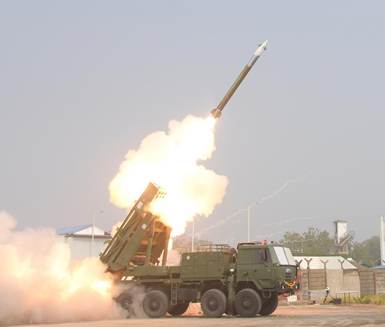
Chandipur: The Defence Research and Development Organisation (DRDO) today successfully conducted the maiden flight test of the Pinaka Long Range Guided Rocket, marking a key advancement in India’s indigenous rocket artillery capabilities. The test was carried out at the Integrated Test Range (ITR), Chandipur, with the rocket fired to its full designed range of 120 kilometres.
Official sources said the rocket, designated LRGR-120, demonstrated all planned in-flight manoeuvres during the trial and struck the designated target with a high degree of accuracy. Range instrumentation deployed along the flight path tracked the rocket throughout its trajectory, enabling validation of performance parameters across all phases of flight, including launch behaviour, mid-course guidance response, in-flight manoeuvring and terminal impact accuracy.
The LRGR-120 represents an extended-range, guided variant of the Pinaka rocket system and is the longest-range Pinaka rocket tested so far, with a verified strike reach of 120 kilometres. Unlike earlier unguided Pinaka rockets, the system incorporates a guidance mechanism that enables mid-course correction, allowing the rocket to execute controlled trajectory adjustments and improving accuracy over long distances. During the maiden test, the rocket’s guidance and control features were validated through controlled manoeuvring and precise target impact, as confirmed by DRDO.
The rocket was launched from an in-service Pinaka launcher, demonstrating the platform’s ability to fire multiple Pinaka variants of differing ranges from the same launcher system. Officials said this confirms launcher compatibility across the Pinaka family and allows operational units to deploy rockets of varying ranges without changes to the launch platform. Officials said this interoperability enhances operational flexibility and reduces logistical complexity for deployment.
The Pinaka Long Range Guided Rocket has been designed by the Armament Research and Development Establishment (ARDE) in association with the High Energy Materials Research Laboratory (HEMRL), with technical support from the Defence Research and Development Laboratory (DRDL) and the Research Centre Imarat (RCI). The flight trial was coordinated by the Integrated Test Range along with the Proof and Experimental Establishment.
Defence Minister Rajnath Singh congratulated DRDO and the teams involved in the project, stating that the successful design and development of long-range guided rockets would significantly strengthen the operational capabilities of the Indian Armed Forces. He described the achievement as an important step forward in enhancing indigenous defence systems.
Secretary, Department of Defence Research and Development and Chairman of DRDO, Dr Samir V Kamat, witnessed the flight test and commended the scientists and engineers for achieving all mission objectives.
Officials indicated that the successful maiden trial would pave the way for subsequent developmental and user-assisted evaluations before the system progresses further in the induction process. The organisation has not publicly disclosed additional technical parameters such as circular error probability figures, the exact nature of the guidance architecture or the type and weight of the warhead.
Officials also underlined that the entire flight was validated using a fully instrumented test range, with sensors and tracking systems monitoring the rocket from launch to impact to confirm stability, guidance performance and terminal accuracy. The system has been positioned as a long-range precision artillery asset intended to enhance the strike capability of the Indian Armed Forces, particularly by enabling accurate engagement of distant targets while retaining compatibility with existing Pinaka infrastructure.
– global bihari bureau