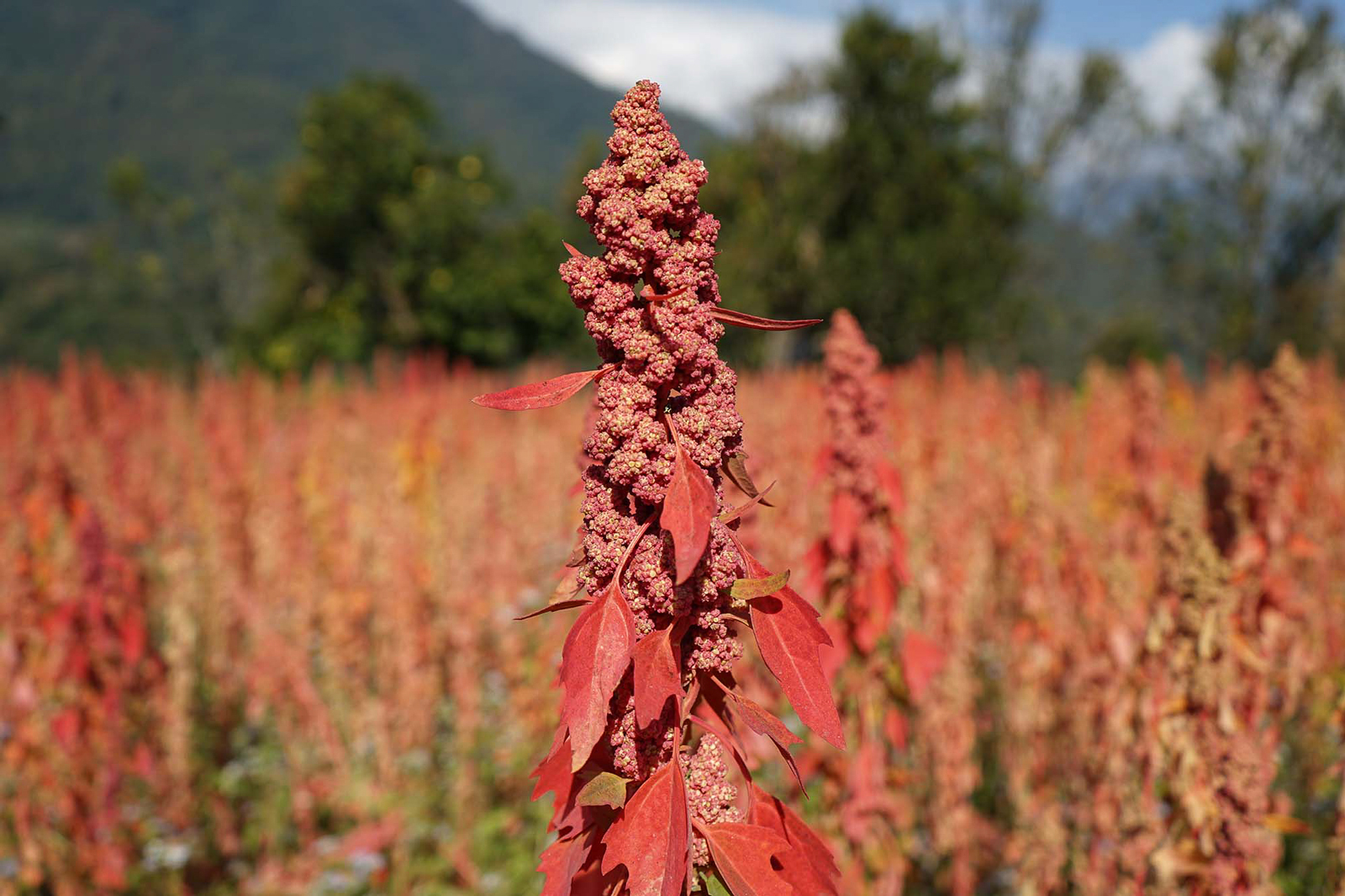
In the early 2010s, Bhutan faced erratic rainfall and declining productivity of traditional crops like red rice and buckwheat. FAO worked with the Bhutanese government to introduce quinoa as a climate-resilient and nutrient-rich crop suited to the country’s high-altitudes. ©FAO/Chimi Rinzin
Quinoa Blooms in Bhutan’s Highlands
Royal Push Transforms Bhutan with Quinoa
As dawn breaks over the terraced slopes of Bartsham in eastern Bhutan, soft light spills across Norbu Gyeltshen’s fields, illuminating the delicate seed heads of quinoa swaying gently beside rows of maize and chilli. Years ago, when Norbu and his wife Pema Sedon first sowed this unfamiliar crop, it occupied only a single tentative row in soil long devoted to rice and buckwheat. Today, it commands the heart of their livelihood. Last season brought them around 1,200 kilograms, a yield that has eased daily burdens and lifted household income. Norbu credits an improved variety and rich organic manure as he wipes red earth from his hands.
He speaks quietly of the change it has brought. Where once many local farmers scraped by on marginal returns, quinoa has kindled fresh optimism. It has drawn the community closer, proving that small-scale agriculture can still sustain families with dignity. Labour feels lighter now, the future steadier, the work itself more rewarding. Pests and unpredictable weather, once constant threats, trouble them far less.
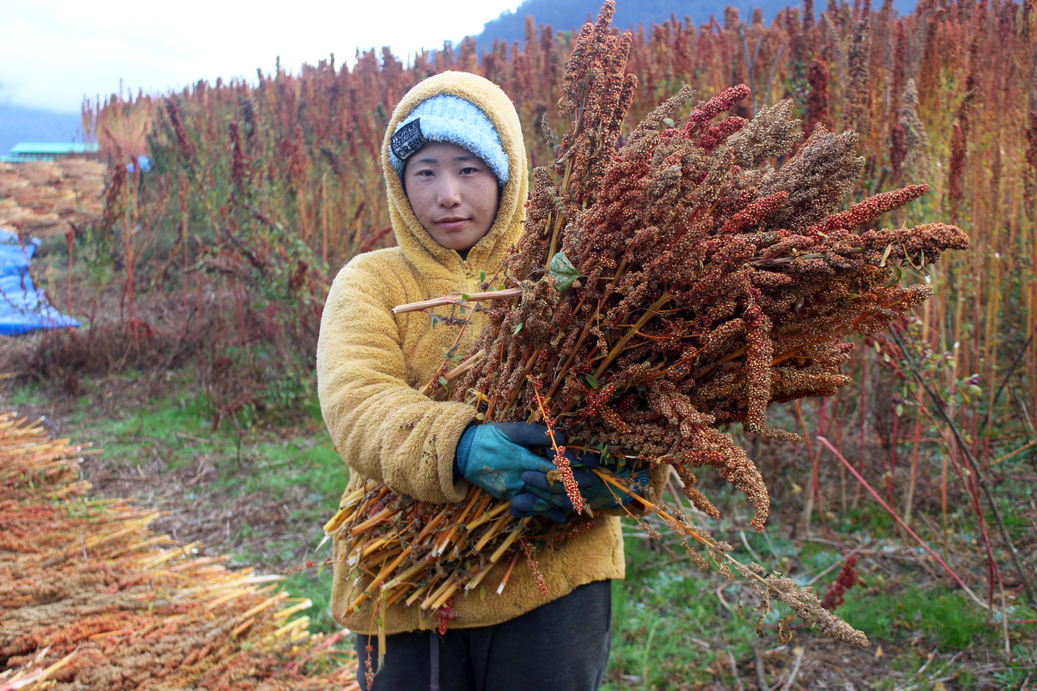
In barely a decade, this ancient Andean grain has travelled from distant obscurity to become a cornerstone of Bhutanese farming, propelled by royal vision and international partnership. Known affectionately as the Queen of Grains, it now grows in every one of the country’s twenty districts, though national production remains modest at around thirteen tonnes in 2023. In Bartsham alone, that year’s harvest reached seventeen tonnes.
The Food and Agriculture Organization of the United Nations (FAO)has recognised quinoa as Bhutan’s flagship product under its One Country One Priority Product initiative, channelling training, seed supply, and market support to farmers like Norbu. Community seed banks, nurtured jointly by FAO and the Ministry of Agriculture and Livestock, keep varieties circulating among neighbours and fuel quiet confidence that these high valleys can still feed those who tend them.
The story began in the early 2010s, when shifting rainfall patterns and falling yields of traditional staples pushed Bhutan toward greater reliance on imported cereals. In 2015, FAO collaborated with the government to trial climate-hardy, nutrient-dense crops suited to thin mountain soils. Quinoa quickly revealed its gifts: tolerance for erratic weather, modest demands on the land, and superior protein and fibre compared to familiar grains.
A pivotal moment arrived when King Jigme Khesar Namgyel Wangchuck visited a demonstration plot in Yusipang. Moved by its promise, he directed that cultivation be expanded nationwide. Between 2016 and 2019, seeds were multiplied, farmers trained, and awareness raised until what started as scattered trials matured into a unified national programme.
Bhutan’s alignment with the FAO initiative gave the effort clear direction, focusing the entire value chain—from seed selection to market access—on a single strategic crop whose resilience matched the kingdom’s aspirations for dietary diversity, higher rural incomes, and organic purity.
Bartsham, with its cool temperate climate, became the living proof. Seventy-two households now grow quinoa, and five leading farmers tend sixteen acres between them. For fifty-eight-year-old Jampel Gyeltshen, the crop’s gentle demands are a particular blessing. As strength wanes with age, he explains, quinoa asks for little weeding and suffers almost no damage from foraging wildlife.
Winning over palates proved the greater challenge. Bhutanese tables have long centred on red rice, buckwheat, and millet; quinoa arrived without tradition to anchor it. Yet cooks have gradually woven it into daily meals—blended with red rice, folded into buckwheat pancakes known as khule, stirred into warming porridge, or shaped into dumplings shared at village gatherings.
At Jigme Dorji Wangchuck National Referral Hospital, an FAO-backed pilot quietly replaced ten per cent of white rice with quinoa in patient diets. Over six months, rice use fell by two thousand kilograms while fibre and protein intake rose, offering a modest shield against rising non-communicable diseases. Remarkably, three-quarters of patients welcomed the substitution.
Encouraged, authorities have expanded the approach, introducing quinoa into meals at additional hospitals in Gelephu and Mongar, as well as selected schools, aiming to trim rice consumption further. Yet voices like that of Bartsham Central School principal Dawa Gyeltshen wonder aloud whether supply can keep pace with appetite.
The government has responded by declaring quinoa a priority commodity for food security and climate adaptation. Commercial scale-up is advancing through cooperatives, state enterprises, and private partners. Researchers continue refining high-yielding lines, including colourful tricolour varieties that command premium prices.
Recent efforts have brought fresh momentum: trials have extended to lower-altitude areas like Chukha district, where hundreds of farmers are cultivating quinoa on expanding acreage. In Phuentsholing, a new processing facility, inaugurated just weeks ago, now cleans and packages the grain—turning raw harvests into vacuum-sealed products ready for domestic shelves and potential export.
In Bartsham, a new FAO-installed weather station now delivers precise local data on rain, frost, and temperature swings. Those readings will underpin applications for Geographical Indication and environmental sustainability certification—credentials that could unlock export markets and honour the kingdom’s commitment to organic methods.
As evening shadows lengthen across the terraces, the last rays glance off ripening quinoa tassels, turning bronze in the fading light. For Norbu, Jampel, and their neighbours, these fields carry more than a harvest; they hold a quiet renewal of mountain farming and the promise of enduring prosperity for those who work the land.
Source: The FAO News And Media Office, Rome
– global bihari bureau