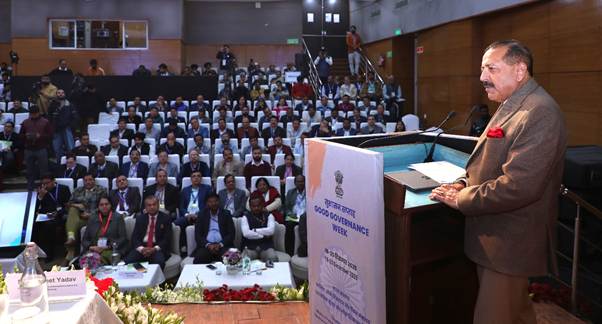
Union Minister Dr. Jitendra Singh at the Good Governance Workshop
Five Governance Reforms Target Transparency and Efficiency
Digital Tools Launched to Modernise Core Governance Processes
New Delhi: On the occasion of Good Governance Day, the Union government today unveiled five digital governance reforms aimed at improving transparency, efficiency and citizen-centric delivery across the administrative system. The initiatives were launched by Union Minister Jitendra Singh at the National Workshop on Good Governance Practices 2025 in New Delhi, with senior officials, policymakers and stakeholders in attendance.
Addressing the gathering, the Minister said that good governance must be understood not as a theoretical concept but as a continuous administrative responsibility grounded in accountability, clarity of rules and responsiveness to citizens. He noted that Good Governance Day, observed annually on December 25, also marks the birth anniversary of former Prime Minister Atal Bihari Vajpayee, under whose tenure probity in public life and people-first administration were institutionalised. According to the Minister, the emphasis on governance reforms has gathered momentum since 2014, guided by the principle of “Minimum Government, Maximum Governance”.
The five initiatives launched by the Department of Personnel and Training are designed to address structural gaps in recruitment, personnel management, capacity building and service delivery. Together, they seek to reduce ambiguity in rules, accelerate administrative processes, and equip civil servants with tools and skills suited to a rapidly evolving governance environment.
Officials said the reforms are designed for system-wide adoption across central ministries, with several of the digital platforms already being used by large numbers of government employees and trainees as part of ongoing administrative processes. They added that key platforms, particularly iGOT Karmayogi and digital capacity-planning tools, are structured for use by States and Union Territories as well, enabling alignment of training and governance practices across different levels of government.
The first reform is a consolidated Compendium of Guidelines on Reservation for Ex-Servicemen in Central Government. By bringing together all existing instructions into a single, updated reference, the initiative aims to eliminate inconsistencies and interpretation gaps across Ministries and Departments. Officials said the compendium is intended to ensure uniform implementation of reservation provisions, reduce procedural errors and improve the timely delivery of benefits to ex-servicemen.
The second reform focuses on recruitment processes through an AI-powered Recruitment Rules Generator Tool, integrated with the Recruitment Rules Formulation, Amendment and Monitoring System. Recruitment Rules are central to ensuring fairness, transparency and predictability in government appointments and promotions. The new tool guides users through structured inputs, suggests appropriate recruitment methods and automatically generates draft rules aligned with existing guidelines. The objective is to reduce delays in framing or amending rules, minimise drafting inconsistencies and standardise recruitment practices across the government.
The third initiative is the launch of the e-HRMS 2.0 mobile application for Android and iOS platforms. As part of Mission Karmayogi, the application integrates key human resource services, including service records, promotions, transfers, deputations, training and superannuation. It also connects with platforms such as SPARROW, PFMS and Bhavishya. Officials said the aim is to reduce paperwork, speed up approvals and enhance transparency in personnel management by giving employees direct digital access to HR-related services.
The fourth set of reforms relates to the expansion of artificial intelligence-based features on the iGOT Karmayogi platform, which underpins the government’s civil services capacity-building programme. These include AI Sarthi for identifying relevant learning resources, AI Tutor for personalised in-course assistance, structured Specialisation Programmes in priority domains, and an AI-based Capacity Building Plan Tool to help Ministries and States map roles, competencies and training needs. The objective is to move from generic training to role-based, need-driven capacity building across services.
The fifth initiative is the Karmayogi Digital Learning Lab 2.0, an upgraded facility designed to create high-quality digital learning content using technologies such as augmented and virtual reality, gamification and interactive simulations. The lab is intended to accelerate the creation and dissemination of training material, reforms documentation and best practices, thereby strengthening implementation capacity at all levels of government.
Secretary, Department of Personnel and Training, Rachna Shah, said that Good Governance Day serves as a reminder that governance must remain efficient, transparent and humane. Referring to the Prashasan Gaon Ki Ore campaign conducted during Good Governance Week, she said the initiative had reached more than 700 districts through thousands of camps focused on grievance redressal, service delivery and documentation of grassroots-level best practices. She added that special administrative campaigns launched since 2021 have helped shift governance processes from pendency-driven systems to outcome-oriented functioning.
Concluding the event, the Minister said the five reforms reflect a coordinated and future-oriented approach to governance, combining technology adoption with institutional strengthening. He expressed confidence that the initiatives would contribute to a more responsive, accountable and citizen-focused administrative framework, in line with the legacy of Atal Bihari Vajpayee and the government’s broader governance reform agenda.
– global bihari bureau