India–NZ FTA opens zero-duty access for all Indian exports, set to double trade in five years
New Delhi: The Union government today announced the conclusion of the India–New Zealand Free Trade Agreement (FTA), outlining a wide-ranging framework that eliminates duties on all Indian exports to New Zealand, commits USD 20 billion in investment over 15 years, creates new mobility pathways for students and skilled professionals, and establishes binding rules governing services, agriculture, investment, intellectual property, and trade facilitation. The agreement, concluded in December 2025 after negotiations that began in March this year, is among India’s fastest-concluded free trade agreements, according to the government.
The announcement followed a telephone conversation between Prime Minister Narendra Modi and New Zealand Prime Minister Christopher Luxon, during which the two leaders jointly confirmed the successful conclusion of the agreement. The government stated that negotiations were initiated during Prime Minister Luxon’s visit to India in March 2025 and were completed within nine months, reflecting what it described as sustained political engagement between the two sides. Officials said the agreement is expected to deepen bilateral economic engagement, expand market access, promote investment flows, and open opportunities for innovators, entrepreneurs, farmers, micro, small and medium enterprises, students, and youth in both countries.
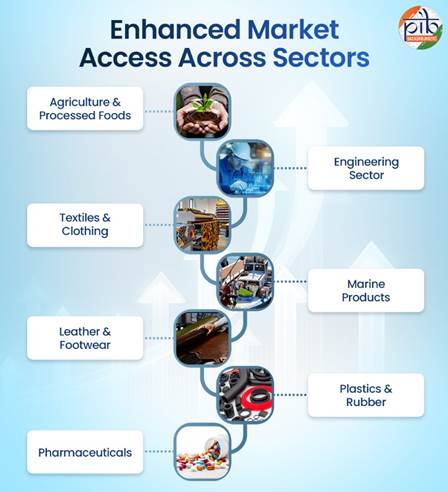
According to the Ministry of Commerce and Industry, the agreement provides immediate zero-duty access for 100 per cent of Indian exports to New Zealand across 8,284 tariff lines from the date of entry into force. New Zealand’s applied tariffs, which averaged 2.2 per cent in 2025 and were as high as 10 per cent on about 450 Indian export lines, including textiles, apparel, leather, headgear, ceramics, carpets, automobiles and auto components, will be eliminated. The government stated that this market access extends across labour-intensive sectors such as textiles, clothing, leather and footwear; engineering sectors including transport equipment, pharmaceuticals, plastics, rubber, chemicals and machinery; and agricultural and processed food products including fruits, vegetables, cereals, coffee and spices. The agreement also facilitates imports of inputs such as wooden logs, coking coal, and ferrous and non-ferrous metal scrap to support domestic industries.
On India’s tariff commitments, the government stated that market access has been offered on 70.03 per cent of tariff lines, while 29.97 per cent have been kept in the exclusion list to protect sensitive domestic sectors. Thirty per cent of tariff lines will see immediate elimination of duties, including products such as wood, wool, sheep meat and raw hides. A further 35.60 per cent of tariff lines will be subject to phased elimination over three, five, seven and ten years, covering products such as petroleum oils, malt extract, vegetable oils and selected electrical and mechanical machinery. About 4.37 per cent of products will see tariff reductions, including wine, pharmaceutical products, polymers, aluminium, and iron and steel articles. A small share, 0.06 per cent of tariff lines, will be governed by tariff rate quotas, including honey, apples, kiwifruit and albumins such as milk albumin.
The government emphasised that India has protected its key interests in dairy and agriculture. Products such as milk, cream, whey, yoghurt and cheese, most animal products other than sheep meat, selected vegetables and pulses including onions, chana, peas and corn, sugar, artificial honey, animal and vegetable fats and oils, arms and ammunition, certain metals including copper and aluminium products, and gems and jewellery remain excluded. For selected agricultural imports from New Zealand, including apples, kiwifruit and manuka honey, market access will be provided through tariff rate quotas combined with minimum import prices and seasonal restrictions to safeguard domestic producers.
In agriculture, the agreement establishes an Agricultural Productivity Partnership under which the two sides will cooperate on focused action plans for kiwifruit, apples and honey. The government stated that this cooperation will include the establishment of centres of excellence, improved planting material, capacity building for growers, technical support for orchard management, post-harvest practices, supply chains and food safety. Projects targeting premium apple cultivation and sustainable beekeeping are expected to improve productivity and quality standards. All tariff rate quotas in agriculture will be linked to agri-technology action plans and monitored through a Joint Agriculture Productivity Council to balance market access with protection of sensitive domestic sectors.
Beyond goods trade, the agreement contains New Zealand’s most extensive services offer to India, with commitments across 118 services sectors and most-favoured-nation treatment in 139 sectors. For the first time, New Zealand has signed an annex on health and traditional medicine services with India. According to the government, this annex facilitates trade in Ayurveda, yoga and other traditional medicine services, supports medical value travel, and promotes collaboration in wellness services. The annex provides recognition to India’s AYUSH systems—Ayurveda, Yoga and Naturopathy, Unani, Sowa-Rigpa, Siddha and Homoeopathy—alongside Maori health practices.
The agreement also contains a dedicated annex on student mobility and post-study work visas, marking the first such arrangement New Zealand has entered into with any country. Indian students will be permitted to work up to 20 hours per week during study, with these rights protected even if New Zealand’s domestic policies change in future. Post-study work visas have been extended, with up to three years for science, technology, engineering and mathematics bachelor’s and master’s graduates, and up to four years for doctoral graduates. In addition, a quota of 5,000 visas has been created for skilled Indian professionals for stays of up to three years in sectors of interest, including AYUSH practitioners, yoga instructors, Indian chefs and music teachers, as well as information technology, engineering, healthcare, education and construction. A working holiday visa arrangement will allow 1,000 young Indians each year to undertake multiple-entry stays of up to 12 months.
On investment, the government stated that New Zealand has committed to invest USD 20 billion in India over the next 15 years. The agreement also provides for cooperation on organic primary products, with mutual recognition of organic certification to be agreed between the two sides. Institutional linkages for micro, small and medium enterprises are included to facilitate access to trade-related information and global markets. Technical assistance provisions cover areas such as AYUSH, audiovisual industries, tourism, sports and traditional knowledge systems.
The agreement includes detailed regulatory and institutional provisions. Annexes on pharmaceuticals and medical devices provide for expedited regulatory pathways and recognition of inspections from trusted regulators in jurisdictions such as the United States, European Union, United Kingdom and Canada. On intellectual property rights, New Zealand has made a binding commitment to amend its domestic laws within 18 months to provide European Union-level protection for India’s geographical indications. Customs and trade facilitation provisions include advance rulings, electronic documentation and faster clearance timelines of 48 hours and 24 hours for perishable goods. Robust rules of origin have been incorporated to prevent circumvention and ensure the integrity of preferential market access.
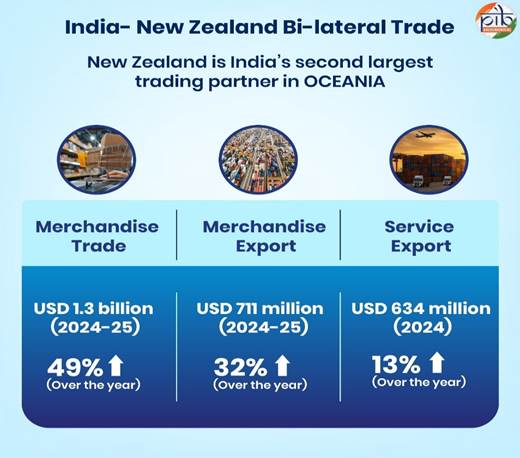
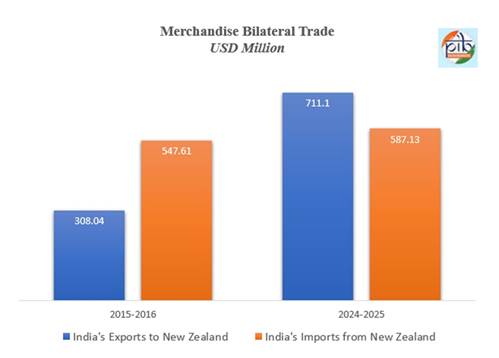
In explaining the broader context, the government noted that New Zealand is India’s second-largest trading partner in Oceania. Merchandise trade between the two countries grew from USD 873 million in 2023–24 to USD 1.3 billion in 2024–25, representing a growth of 49 per cent. India’s merchandise exports to New Zealand rose to USD 711 million during the same period, while services exports grew by 13 per cent in 2024 to USD 634 million, led by travel, information technology and business services. Over the past decade, India’s exports to New Zealand increased by 130 per cent, while imports grew by 7.21 per cent, resulting in a positive trade balance for India in 2024–25.
The government also highlighted the role of the Indian diaspora, noting that around 300,000 persons of Indian origin and non-resident Indians live in New Zealand, accounting for nearly five per cent of its population. Officials described the diaspora as a cultural and economic bridge supporting bilateral trade and services demand.
Union Home Minister and Minister of Cooperation Amit Shah welcomed the conclusion of the agreement, stating in a post on social media that the India–New Zealand Free Trade Agreement reflects the government’s trade diplomacy and would bring investment and opportunities for Indian innovators, entrepreneurs, farmers, micro, small and medium enterprises, students and youth.
According to the government, the negotiated legal texts may be published on a mutually agreed date following the formal announcement. The agreement will be signed after completion of domestic procedures in both countries and is expected to enter into force following ratification, with implementation envisaged next year.
Officials said the agreement fits within India’s broader trade strategy, which has seen the conclusion of multiple free trade and comprehensive economic partnership agreements in recent years, including with Oman and the United Kingdom in 2025, the European Free Trade Association in 2024, and earlier agreements with the United Arab Emirates, Australia and Mauritius. The government stated that the India–New Zealand Free Trade Agreement is intended to provide a predictable and transparent framework for trade and investment while aligning with domestic priorities of economic growth, employment generation and integration into global value chains.
– global bihari bureau