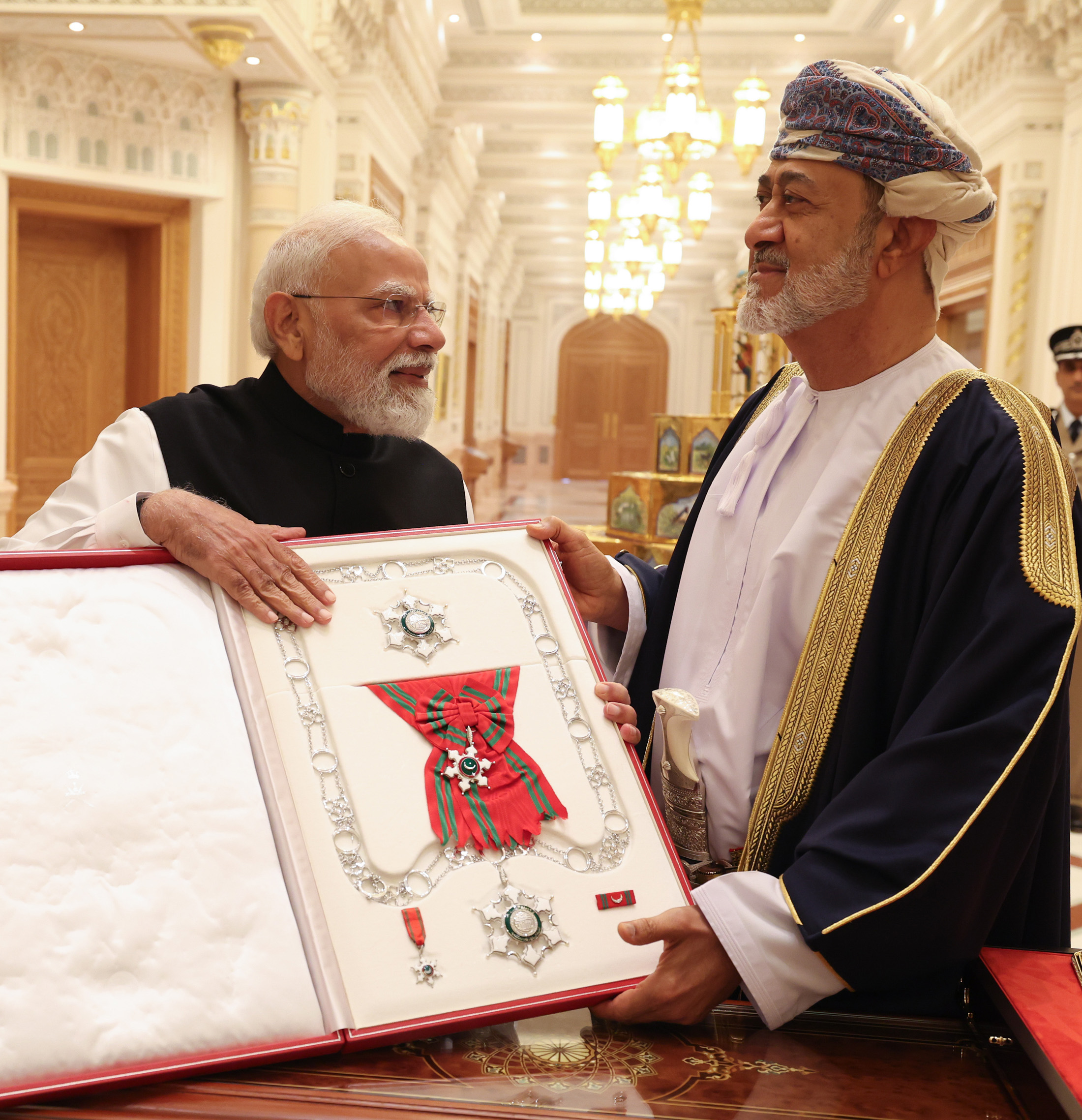
Prime Minister Narendra Modi being conferred with Oman's Highest Honour at Muscat, in Oman on December 18, 2025.
Institutionalising India–Oman Ties Amid Gulf Geopolitics
Muscat: In a Gulf region undergoing steady but consequential transformation—marked by economic diversification, energy transition, and cautious geopolitical balancing—India’s engagement with Oman has entered a phase that is more structured, institutionalised, and strategically layered than before. Long defined by maritime exchange, hydrocarbons, and labour mobility, the bilateral relationship is now being recalibrated to reflect shifting regional political economies and India’s own evolving external economic strategy. This recalibration aligns with India’s broader West Asia–Africa policy, where strategic partnerships are increasingly anchored in institutional depth, trade integration, and long-term political trust.
This recalibration was underscored during Prime Minister Narendra Modi’s visit to Muscat, which coincided with the signing of the India–Oman Comprehensive Economic Partnership Agreement (CEPA), the celebration of 70 years of diplomatic relations, and the conferment of the ‘Order of Oman’, the Sultanate’s highest civilian honour, on the Indian leader. While the symbolism of the award was unmistakable, its significance lay less in ceremony than in the broader strategic context within which it was bestowed—one marked by deepening economic integration and long-term policy alignment.
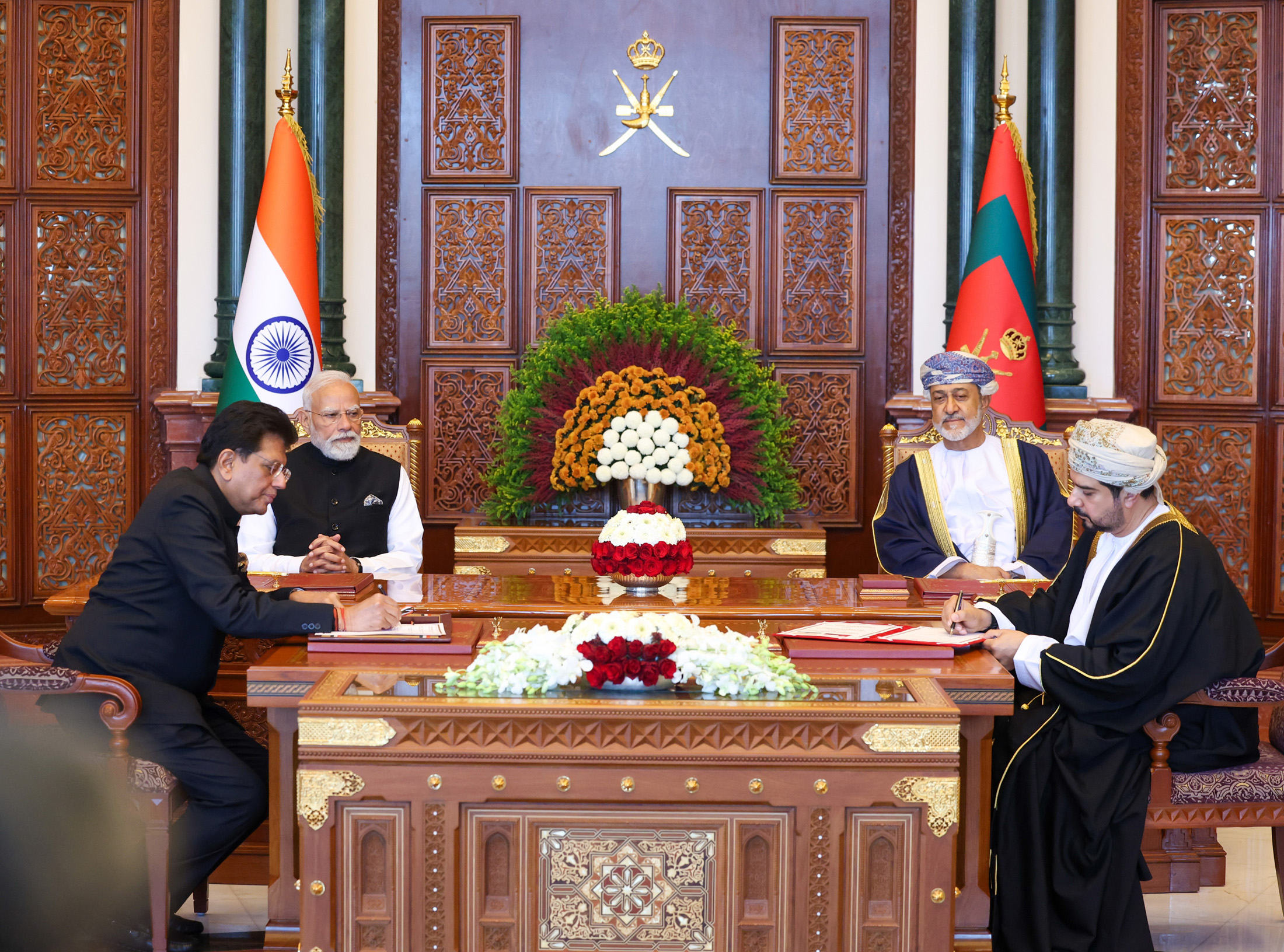
The CEPA, signed by Commerce and Industry Minister Piyush Goyal on behalf of India and Qais bin Mohammed Al Yousef, Oman’s Minister of Commerce, Industry and Investment Promotion, is the first bilateral agreement Oman has signed with any country since its 2006 treaty with the United States. It eliminates or reduces tariffs on 98.08% of Oman’s tariff lines, covering 99.38% of India’s exports by value, including textiles, leather, gems and jewellery, engineering goods, pharmaceuticals, automobiles, and furniture. Beyond goods, it opens 127 services sub-sectors, enables enhanced mobility for Indian professionals, permits 100% FDI in key service sectors, and introduces structural commitments in standards, certification, health product approvals, and Traditional Medicine. These provisions signal a shift from transactional trade to institutionalised, long-term economic interdependence, reflecting strategic alignment beyond mere commerce. Additionally, the CEPA is designed to provide enhanced facilitation for start-ups, MSMEs, and technology-driven enterprises, further supporting bilateral innovation and industrial collaboration.
Historically, India–Oman ties have rested on durable foundations: centuries-old maritime links across the Arabian Sea, energy trade, and a substantial Indian expatriate workforce that has contributed to Oman’s economic development. What distinguishes the present moment is the attempt to systematise this relationship through institutional frameworks capable of absorbing global economic uncertainty, supply-chain fragmentation, and the pressures of energy transition.
The CEPA represents the most concrete expression of this shift. Rather than functioning merely as a tariff liberalisation instrument, it integrates goods, services, investment facilitation, and regulatory cooperation, signalling a move towards managed economic interdependence. Its sectoral coverage—spanning manufacturing, logistics, textiles, agro-processing, automobiles, renewable energy, metals, and advanced services—reflects a shared preference for production-linked integration over transactional trade expansion.
This alignment mirrors structural transformations underway in both economies. Oman’s Vision 2040 seeks to reposition the Sultanate as a logistics, manufacturing, and clean-energy hub connecting the Gulf, Africa, and South Asia. India’s trade policy, meanwhile, has increasingly emphasised diversification, resilience, and outward investment, particularly in strategically located and politically stable markets. Oman’s geography—overlooking key sea lanes of the Indian Ocean and functioning as a gateway to the Gulf Cooperation Council, Eastern Africa, and parts of Eurasia—enhances its appeal within this strategy.
Investment flows provide a clearer measure of this evolving relationship. Indian investments in Oman have crossed USD 5 billion, rising sharply in recent years and increasingly concentrated in capital-intensive sectors such as green steel, aluminium, green ammonia, and port-linked infrastructure. This marks a departure from earlier phases dominated by services and smaller enterprises. For Oman, Indian capital is framed as long-term, technology-enabled, and aligned with diversification goals; for India, Oman increasingly serves as a stable operating base within a region characterised by regulatory and political heterogeneity.
Energy cooperation remains foundational, but its character is changing. While hydrocarbons continue to anchor bilateral trade, recent engagements have foregrounded renewable energy, green hydrogen, and clean industrial technologies. This reflects broader transitions within Gulf political economies, where climate commitments coexist with the imperative to retain relevance in global energy markets. For India, such cooperation supports domestic transition objectives while embedding Indian firms within emerging clean-energy value chains.
The strategic subtext of the relationship, though articulated cautiously, is difficult to miss. Oman’s location at the mouth of the Strait of Hormuz and along the Indian Ocean littoral confers enduring maritime significance. References to ports, multimodal logistics, and connectivity, even when framed economically, situate the partnership within India’s wider westward maritime engagement. Oman’s long-standing reputation for diplomatic autonomy and regional balance further enhances its value as a stable interlocutor in an increasingly polarised Gulf environment.
Institutionally, the visit emphasised consolidation rather than expansion. Cooperation across defence, security, space, agriculture, education, and technology was reiterated, but the emphasis lay on embedding these domains within predictable frameworks rather than announcing new initiatives. This reflects a broader Indian foreign-policy trend that privileges regulatory alignment and institutional depth over episodic political signalling. People-to-people ties continue to provide social ballast to this evolving partnership. The Indian diaspora remains integral to Oman’s economy, while educational and cultural linkages—symbolised by the long presence of Indian schools and community institutions—reinforce societal connectivity. These elements, often treated as peripheral, assume greater importance as the relationship becomes more strategically layered and economically complex.
From Ethiopia to Oman: India’s West Asia–Africa Strategy
It is precisely this combination of institutional depth and societal connectivity that framed the broader context of Prime Minister Modi’s three-nation tour to Ethiopia, Jordan, and Oman. Beyond economic and institutional consolidation, the visit carried deliberate geopolitical and symbolic weight. In Ethiopia, the Prime Minister was conferred the Great Honour Nishan of Ethiopia, that country’s highest civilian award, recognising his role in deepening India–Ethiopia cooperation and elevating the relationship to a strategic partnership. In Jordan, engagements across political dialogue and security cooperation reinforced years of steady bilateral cooperation. In Oman, the conferment of the Order of Oman and the CEPA anchored the visit in concrete deliverables on trade, investment, and long-term engagement. Together, these honours and agreements underscored India’s calibrated effort to strengthen diplomatic trust, expand economic integration, and embed partnerships within durable institutional frameworks across Africa and West Asia, while linking these engagements to India’s wider West Asia–Africa strategic outlook.
Viewed within India’s wider Gulf engagement, the Oman partnership reveals a differentiated strategic logic rather than a uniform regional template. India’s relations with the United Arab Emirates have been characterised by rapid institutional expansion and scale, particularly since the India–UAE CEPA came into force in 2022, catalysing cooperation across finance, digital trade, infrastructure, food security, and emerging technologies. India’s engagement with Saudi Arabia has increasingly centred on strategic political economy, with the Strategic Partnership Council providing a structured mechanism for cooperation on energy, infrastructure, and technology. Oman’s role in this spectrum is distinct: while trade volumes and investment flows may be more modest relative to the UAE and Saudi Arabia, its strategic steadiness, institutional predictability, and geographic position make it a complementary pillar in India’s Gulf strategy—a partnership designed to endure across economic cycles and geopolitical flux.
Taken together, the conferment of the Order of Oman and the conclusion of the CEPA signal a transition from historically embedded cooperation to strategically managed engagement. In an international environment shaped by trade fragmentation, energy transition, and contested maritime spaces, India and Oman appear to be anchoring their partnership in economic institutionalisation reinforced by political trust. The durability of this recalibration will depend less on symbolism than on the capacity of these frameworks to deliver sustained economic value and strategic stability over time.
– global bihari bureau