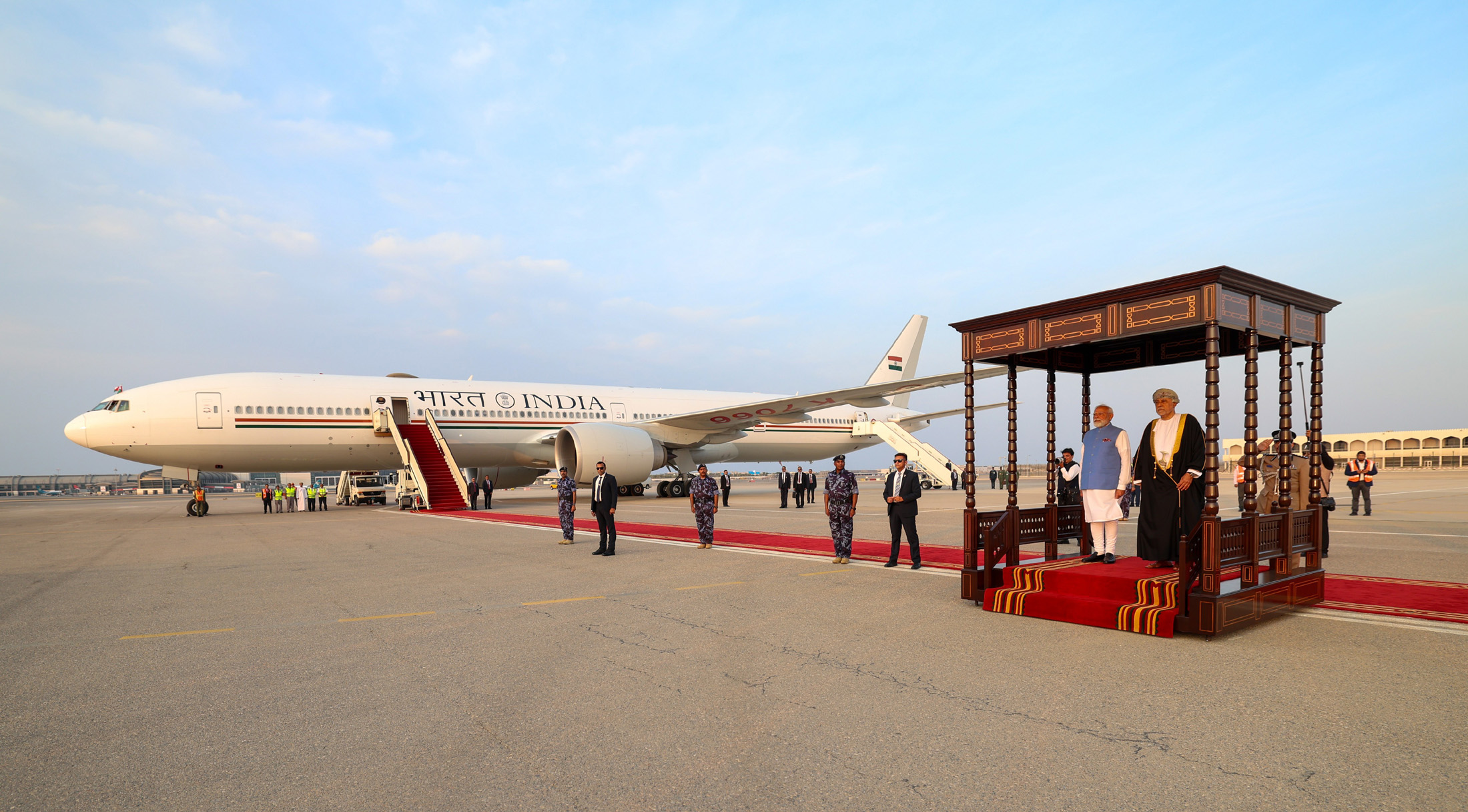
Prime Minister Narendra Modi was accorded a ceremonial welcome upon his arrival in Muscat, Oman on December 17, 2025.
Modi in Muscat as India–Oman FTA Ushers Gulf Growth Phase
Muscat: Prime Minister Narendra Modi arrived in Muscat today for a two‑day visit to Oman, marking the 70th anniversary of diplomatic relations between the two countries. His arrival, welcomed by senior Omani officials and members of the Indian diaspora, underscores deep historical, cultural and economic ties as the two nations formalise a landmark India–Oman Free Trade Agreement (FTA), structured as a Comprehensive Economic Partnership Agreement (CEPA). The treaty, expected to be signed on Thursday in Muscat, is Oman’s first free trade pact in nearly twenty years and a significant step forward in bilateral engagement.
The agreement comes against a backdrop of expanding trade and investment between the two countries. Bilateral trade between India and Oman reached about USD 10.5–10.61 billion in 2024–25, growing by nearly 19 per cent year‑on‑year. India’s exports to Oman stood at around USD 4.07–4.10 billion in the same period, while imports from Oman were approximately USD 6.55–6.54 billion, resulting in a trade deficit driven largely by energy imports. Petroleum products and urea together account for over 70 per cent of India’s imports from Oman.
Indian investments in Oman have more than tripled since 2020, crossing USD 5 billion and spanning sectors that include green steel, green ammonia, aluminium manufacturing and logistics. Oman’s Minister of Commerce, Industry and Investment Promotion described India as the country’s third‑largest trading partner, reflecting mutual confidence and a steadily deepening economic relationship.
At the India–Oman Business Forum in Muscat, India’s Commerce and Industry Minister outlined the breadth of opportunities the FTA will unlock across key sectors, including textiles, food processing, automobiles and auto components, gems and jewellery, agrochemicals, and renewable energy. The pact is also designed to facilitate cooperation in professional services, accounting, business process re‑engineering, research and development, tourism, healthcare and education, which are seen as growth engines for future bilateral commercial engagement.
Officials identified four broad pillars for enhanced cooperation under the agreement: energy transition, with a focus on green hydrogen and renewable energy; infrastructure development, including modernisation of ports and multimodal logistics corridors; food security, through establishment of cold chains and food parks; and technology and startup ecosystem collaboration, especially in deep technology, artificial intelligence and logistics. These sectors align with India’s long‑term economic vision of Viksit Bharat 2047 and Oman’s Vision 2040, which both emphasise innovation, industrial diversification and youth‑driven economic growth.
Oman’s strategic location as a gateway to the Gulf Cooperation Council region, Eastern Europe, Central Asia and Africa provides expanded market access for Indian businesses and positions the pact as a catalyst for regional integration. By reducing or eliminating tariffs on a wide range of goods and promoting regulatory alignment, the FTA aims to strengthen bilateral trade flows, enhance competitiveness and attract greater investment in both directions, while facilitating smoother trade in services and technology.
Historical maritime links, including centuries‑old trade exchanges through ports such as Lothal, were highlighted during discussions as evidence of the enduring nature of India–Oman commercial relations. The FTA’s signing during Prime Minister Modi’s visit, coinciding with seven decades of diplomatic engagement, reflects both nations’ shared commitment to deepening economic and strategic cooperation. Past high‑level interactions, including inviting Oman as a special guest during India’s G20 Presidency in 2023, underscore continuity in political trust and mutual respect.
While phased implementation of tariff reductions and regulatory harmonisation lies ahead, the FTA framework includes mechanisms for monitoring commitments and addressing disputes. Its design is intended not merely to liberalise trade but also to anchor India’s expanding economic and strategic presence in the Gulf region, diversify trade beyond hydrocarbons, and support joint pursuits in emerging sectors such as renewable energy and advanced services.
The India–Oman Free Trade Agreement, set against a backdrop of robust bilateral trade, expanding investment flows and deepening strategic engagement, signifies a transformative chapter in the relationship. It strengthens regional connectivity, supports energy transition goals, and creates durable pathways for growth across industries — laying the groundwork for sustained economic cooperation in the years ahead.
– global bihari bureau