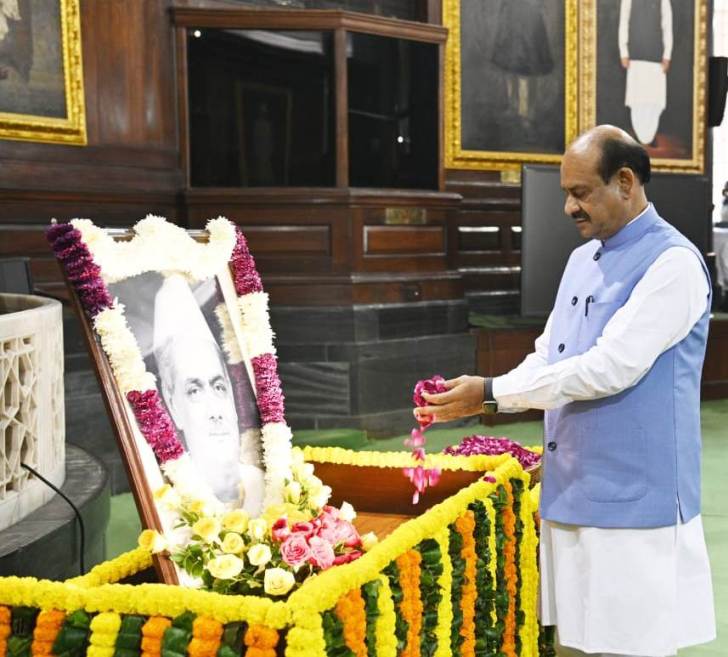
Prime Minister Narendra Modi receives warm welcome by King of Jordan Abdullah II bin Al Hussein at the Husseiniya Palace in Amman, Jordan on December 15, 2025.
India, Jordan Set $5 Billion Trade Goal as Ties Mark 75 Years
Push Digital, Trade and Security Cooperation
New Delhi/Amman: India’s three-nation diplomatic outreach to West Asia and Africa gathered momentum on December 15 with the Prime Minister’s arrival in Amman, marking the first leg of visits to Jordan, Ethiopia and Oman and setting out an agenda that blends political dialogue, economic ambition, security cooperation and engagement with the Global South.
The tour began with a full bilateral visit to Jordan after a gap of 37 years, coinciding with the 75th anniversary of the establishment of diplomatic relations between the two countries. On arrival in the Jordanian capital, the Prime Minister was received by Prime Minister Jafar Hassan and accorded a ceremonial welcome, a gesture reflecting the importance attached by both sides to the visit. The Prime Minister also engaged with members of the Indian community in Amman, whose contributions to India–Jordan relations were highlighted in the lead-up to the visit.

Later in the day, the Prime Minister met King Abdullah II at the Al Husseiniya Palace, where talks were held in restricted and delegation-level formats. The two leaders recalled their previous meetings and underscored the depth of the historic ties between India and Jordan, describing the timing of the visit, during the 75th anniversary year of diplomatic relations, as particularly significant. King Abdullah II conveyed strong support for India’s fight against terrorism and condemned terrorism in all its forms and manifestations. The Prime Minister, in turn, acknowledged Jordan’s leadership in addressing terrorism, extremism and radicalisation and its contribution to broader global efforts in this domain.

The discussions covered a wide spectrum of bilateral cooperation. Trade and investment, defence and security, renewable energy, fertilisers and agriculture, innovation, information technology and digital technologies, critical minerals, infrastructure, health and pharmaceuticals, education and capacity building, tourism, heritage, culture and people-to-people exchanges all featured prominently. Noting that India is Jordan’s third-largest trading partner, the Prime Minister proposed that both sides work towards expanding bilateral trade to 5 billion US dollars over the next five years. He also called for collaboration between Jordan’s digital payment systems and India’s Unified Payments Interface, reflecting India’s push to extend its digital public infrastructure partnerships overseas.
Fertiliser security emerged as a key area of convergence, with Jordan identified as an important supplier to India. Companies from both countries are in discussions on further substantive investments in Jordan to help meet India’s growing demand for phosphatic fertilisers. The two leaders also exchanged views on regional developments and other global issues, reiterating the importance of restoring peace and stability in the region. India reaffirmed its support for ongoing efforts aimed at achieving a durable peace.
The visit produced tangible outcomes, with the finalisation of memoranda of understanding in the fields of culture, renewable energy, water management and digital public infrastructure, along with a twinning arrangement between Petra and Ellora aimed at strengthening cooperation in heritage conservation. The talks were followed by a banquet hosted by King Abdullah II, after which the Prime Minister invited the King to visit India, an invitation that was accepted.
Ahead of the tour, the Prime Minister described the three-nation visit as an opportunity to deepen ties with partners that share age-old civilisational links with India as well as strong contemporary relations. From Amman, the visit proceeds to Ethiopia, marking the Prime Minister’s first visit to the country. In Addis Ababa, the headquarters of the African Union, he is scheduled to hold talks with Prime Minister Abiy Ahmed Ali and interact with the Indian diaspora. The programme also includes an address to a joint session of the Ethiopian Parliament, where the Prime Minister is expected to speak on India’s democratic journey as the “Mother of Democracy” and the value of the India–Ethiopia partnership for the Global South. The visit comes against the backdrop of the African Union’s admission as a permanent member of the G20 during India’s 2023 G20 Presidency, a development repeatedly cited by India as a milestone in strengthening Africa’s global voice.
The final leg of the tour will take the Prime Minister to Oman, where the visit will mark 70 years of diplomatic relations between the two countries. In Muscat, discussions are expected to focus on strengthening the strategic partnership and expanding commercial and economic cooperation. The programme also includes an address to the Indian diaspora in Oman, which has played a significant role in the country’s development and in deepening bilateral ties.
Taken together, the three-nation tour signals a calibrated diplomatic push by India across West Asia and Africa, combining political engagement with economic objectives and a renewed emphasis on digital cooperation, development partnerships and people-to-people connections.
– global bihari bureau