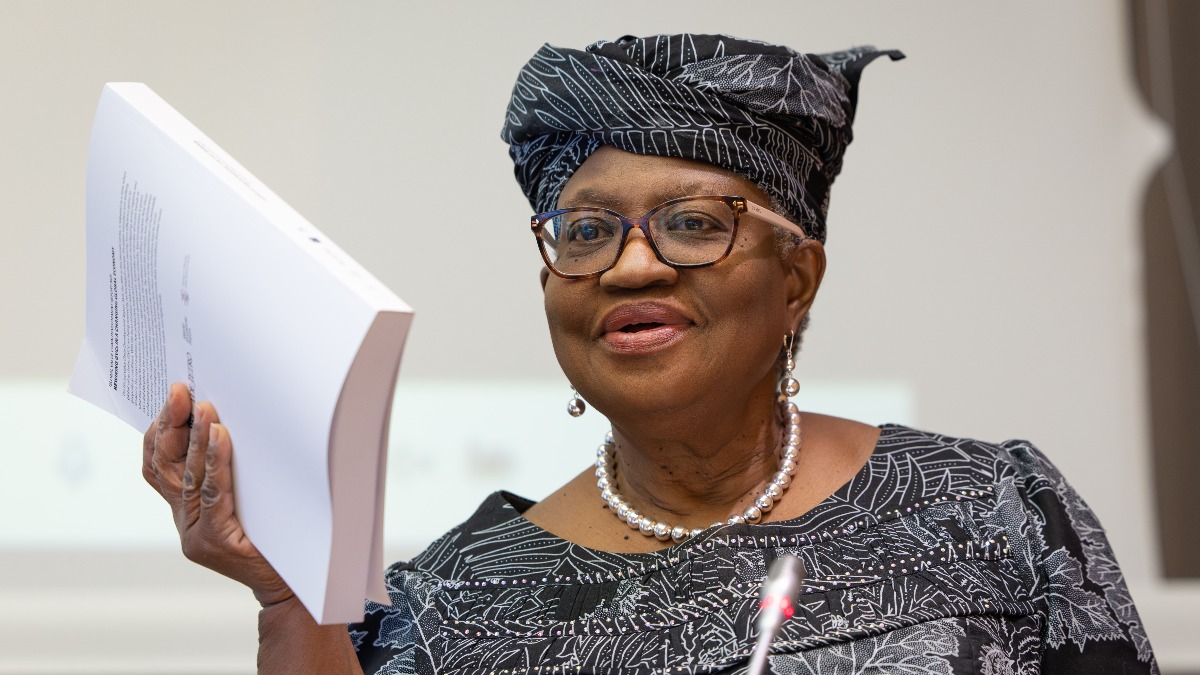
WTO Director-General Ngozi Okonjo-Iweala with a new report which finds global value chains resilient, reconfiguring amid latest challenges.
WTO Study Flags Resilience, Inequality and Policy Risks in GVCs
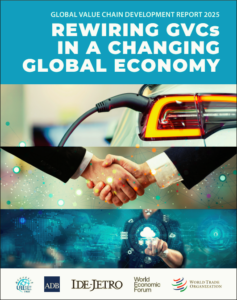 Geneva: Global value chains are showing a capacity to absorb shocks and adapt rather than fracture, even as geopolitical tensions, climate pressures, financial uncertainty and policy fragmentation continue to reshape the global economy, according to the Global Value Chain Development Report 2025 released at the World Trade Organization (WTO), here today.
The report finds that despite repeated predictions of deglobalization, international production networks remain a central feature of world trade. Global value chain–related trade accounted for 46.3 per cent of global trade in 2024, only a modest decline from a peak of 48 per cent in 2022, indicating adjustment rather than retreat. Trade growth, the report notes, remained resilient through the end of 2024, and available data up to December 2025 suggest momentum has continued despite fresh tariff hikes and heightened uncertainty this year.
Speaking at the launch, WTO Director-General Ngozi Okonjo-Iweala said the findings reinforced the argument that globalisation is being reshaped rather than dismantled. Firms and governments, she said, are reconfiguring how they participate in global value chains to respond to new economic, political and social priorities, a shift the WTO has described as “re-globalisation”. This reimagined phase, she argued, seeks to diversify supply chains and bring economies that have remained on the margins more firmly into global production networks.
The report, titled GVC Development Report 2025: Rewiring GVCs in a Changing Global Economy, is the fifth in a biennial series and is jointly produced by the Asian Development Bank, the Research Institute for Global Value Chains at the University of International Business and Economics, the Institute of Developing Economies of the Japan External Trade Organization, the World Economic Forum and the WTO Secretariat. Drawing largely on data through the end of 2024, it examines how global value chains are being reorganised across regions and sectors as resilience increasingly rivals efficiency as a guiding objective.
According to the analysis, this “rewiring” is occurring along several interconnected dimensions. Production networks are being geographically reconfigured through nearshoring, regionalisation and diversification away from single-country dependencies. Technological change, driven by digitalisation, automation and the growing role of services, is altering how value is created and captured along supply chains. Governance structures are evolving as governments rely more heavily on industrial policies and targeted, issue-specific trade arrangements rather than broad-based liberalisation alone. Environmental considerations, including green investment strategies, carbon pricing mechanisms and climate-related trade measures, are also reshaping supply chains, particularly in energy-intensive and resource-dependent sectors.
At the same time, the report cautions against overstating the extent of de-concentration. Empirical measures of supplier concentration show that while some diversification has taken place, especially at the regional level, global value chains in several strategic sectors remain highly concentrated. In some cases, concentration has increased within regions even as inter-regional exposure has declined, suggesting that resilience gains have often come through clustering rather than a broad dispersion of production across new economies.
While these adjustments have enhanced stability in many established production hubs, the benefits of reconfiguration have been uneven. Policy-driven increases in trade costs, rising regulatory fragmentation and elevated uncertainty have disproportionately affected regions that lack a long-standing presence in multinational production networks. Persistent shortages of trade finance, estimated at more than one trillion US dollars annually, are identified as a continuing barrier for firms in developing and least-developed economies seeking deeper integration into global value chains.
As a result, the report finds that much of the recent restructuring has favoured countries that were already embedded in global supply chains, rather than significantly expanding participation by new entrants. Okonjo-Iweala noted that without deliberate efforts to reduce entry barriers, address financing gaps and improve infrastructure and institutional capacity, the promise of more diversified and inclusive value chains may remain constrained.
The analysis also highlights distributional effects within economies. While participation in global value chains is associated with productivity gains and technology diffusion, these benefits have often accrued unevenly across firms and workers. Leading firms tend to capture a disproportionate share of gains, while smaller or less connected enterprises lag behind, and labor shares in some sectors have come under pressure. The report frames these dynamics as an important policy challenge, particularly as governments seek to balance competitiveness with inclusive growth.
Regional assessments focus in particular on Latin America, the Caribbean and Africa, identifying both structural constraints and emerging opportunities. Weaknesses in digital infrastructure, logistics performance, regulatory capacity and institutional stability continue to weigh on competitiveness. At the same time, nearshoring trends, green investment and supply chain diversification are opening new avenues for integration, with some economies pursuing sector-specific cooperation and regulatory alignment rather than comprehensive trade agreements.
Sectoral case studies illustrate how policy choices are reshaping value chains. In the electric vehicle industry, the report documents a restructuring of production networks as governments intervene to secure access to critical minerals, promote domestic manufacturing and manage carbon footprints. China has consolidated a leading role across multiple stages of the electric vehicle supply chain, while resource-rich developing economies, particularly in Africa, are exploring strategies to retain more value through local processing and downstream activities.
Environmental policy emerges as a defining force in the current phase of global value chain evolution. By tracing carbon emissions embodied in trade, the report assesses the implications of emissions trading systems, carbon border adjustment mechanisms and other climate-related measures for competitiveness and development. It concludes that poorly coordinated or rigid policies risk shifting emissions rather than reducing them, potentially deepening inequalities between countries with differing regulatory and technological capacities.
Governance arrangements are also evolving as traditional multilateral and regional trade negotiations struggle to keep pace with rapidly changing production realities. The report identifies more than 180 targeted trade deals signed by 2024, many of them informal, non-binding and focused on specific issues such as digital trade rules and access to critical raw materials. These arrangements reflect a turn toward flexible, issue-specific cooperation, but the report also warns that greater transparency and interoperability will be essential to avoid further fragmentation.
Industrial policy receives particular scrutiny. The report finds that subsidies, localisation requirements and strategic trade interventions have expanded rapidly across jurisdictions, often with limited coordination. While such measures can enhance resilience or accelerate green transitions, the analysis cautions that unaligned industrial policies generate cross-border spillovers, distort investment decisions and carry risks of retaliation that could undermine the stability of global value chains.
Former WTO chief economist Robert Koopman, the report’s editor-in-chief, presented the main findings alongside Asian Development Bank chief economist Albert Park. Their presentation was followed by discussions involving contributing authors, government representatives and business leaders, highlighting how firms are adjusting sourcing strategies, investment decisions and risk management practices in response to shifting policy and market signals. Closing remarks were delivered by UIBE President Zhao Zhongxiu and IDE-JETRO President Fukunari Kimura.
Although the report’s core data predate the most recent escalation in tariff measures and policy uncertainty in 2025, its authors note that early indicators point to continued robustness in trade flows. This resilience, they argue, reflects both firm-level agility and the adaptive capacity of global value chains that have been repeatedly stress-tested over the past decade.
The report concludes that global value chains remain deeply embedded in the world economy, even as their structure, governance and geographic footprint continue to evolve. The central policy challenge ahead, it suggests, lies in managing this transition in a way that strengthens resilience without sacrificing openness, inclusiveness or long-term sustainability.
– global bihari bureau