

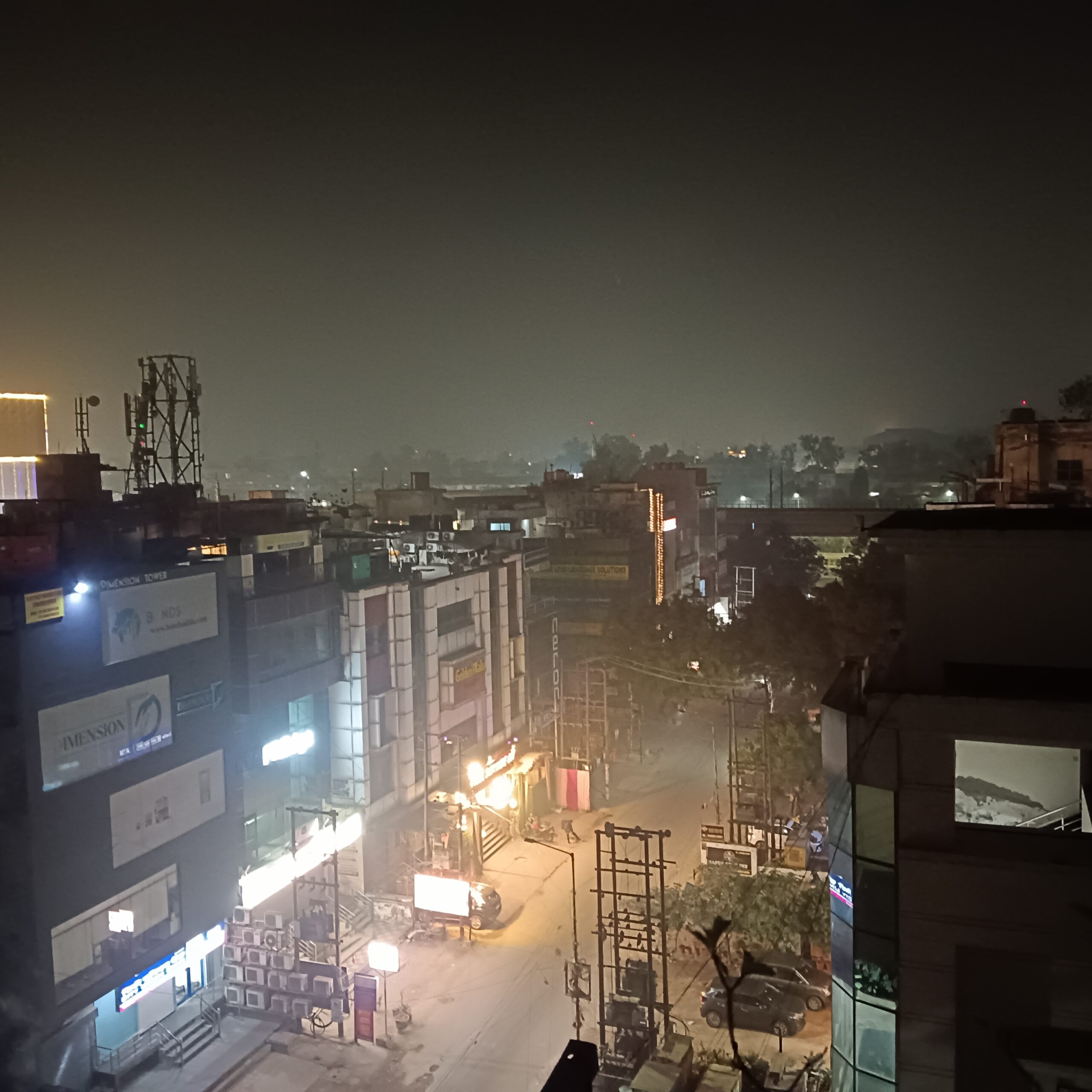
Photo by Deepak Parvatiyar
Smog Siege: Delhi’s Deadly Dust Trap
AQI Hell: Polluters Win, Citizens Gasp
New Delhi: Delhi is once again locked in its familiar winter chokehold, with air quality sliding deep into the “hazardous” zone as particulate-laden smog erases skylines and turns breathing into a health gamble. Air Quality Index readings across the capital have swung between the high 300s and extreme levels at several monitoring stations, driven overwhelmingly by PM2.5 and PM10 concentrations. In this seasonal siege, the capital’s air is no longer merely polluted; it has become an openly hostile environment, one in which daily life continues less because conditions are safe than because residents have few practical alternatives.
The anatomy of the crisis is by now well documented, even if it remains politically inconvenient. The dominant local contributor is not a distant thermal power plant but road dust—resuspended endlessly by traffic, construction activity, and poorly maintained streets. Multiple official and academic assessments have consistently attributed a substantial share of PM10 to road dust, often accounting for a third or more of the load, with the proportion rising sharply when enforcement of construction norms, debris management, and mechanical cleaning slackens. This dust burden is compounded by a dense and ageing vehicular fleet—diesel trucks, two-wheelers, private cars—whose exhaust emissions are reinforced by non-exhaust sources such as tyre and brake wear. Add household biomass and waste burning in peripheral and informal settlements, and winter meteorology does the rest: cold, still air settles over the city like a lid, trapping pollutants at breathing height.
Agricultural stubble burning in Punjab and Haryana continues to feed into this mix, but more as a variable amplifier than the primary driver it is often portrayed to be. Scientific analyses show its contribution to Delhi’s PM2.5 fluctuating widely—spiking on peak fire days, receding to background levels when winds shift or fire counts fall. This season, average contributions have been lower than in some earlier years, though episodic surges have still occurred during October and November. Once winter deepens and winds weaken, however, Delhi’s own emissions reassert dominance. Even in a hypothetical scenario where farm fires were eliminated overnight, the capital would remain mired in toxic air generated by its dust, traffic, peripheral industries, and unregulated combustion.

It is against this backdrop that the Union government has stepped up a new round of official reviews, seeking to project urgency and administrative grip. On Monday, Union Minister for Environment, Forest and Climate Change Bhupender Yadav chaired a high-level meeting to review the air pollution action plans of Ghaziabad and Noida, the first in a series of city-specific reviews across the National Capital Region that will culminate in a state-level assessment in the coming days. The exercise, conducted in a prescribed format refined earlier this month, focused on progress and gaps in on-ground implementation rather than paper compliance.
Senior officials from the two cities presented updates covering a wide sweep of interventions: smart traffic management to curb vehicular emissions; industrial compliance with pollution norms; the status of commercial electric vehicle fleets and charging infrastructure; strengthening of public transport and parking systems; management of construction and demolition waste and municipal solid waste, including legacy dumps; end-to-end paving of roads to suppress dust; deployment of mechanical road sweeping machines, anti-smog guns and water sprinklers; greening of open spaces; and public participation initiatives, including information campaigns and app-based grievance redressal.
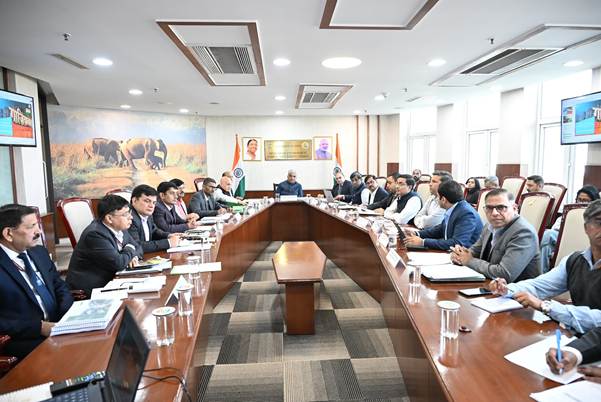
During the review, the Minister took stock of progress on installing Online Continuous Emission Monitoring Systems in industrial units, based on inputs from the Central Pollution Control Board, and reiterated a hard deadline of December 31, 2025, for completion. He directed zero tolerance for non-compliance, calling for stringent action against defaulting units, and asked both central and state pollution control boards to intensify inspections of polluting industries, particularly in peri-urban belts that often escape sustained scrutiny. The Commission for Air Quality Management in Delhi-NCR was tasked with fine-tuning the parameters used to evaluate city action plans and collating them for a region-wide assessment, while also examining upgrades to National Clean Air Programme benchmarks to enable more rational allocation of funds.
The official emphasis on “Jan Bhagidari” — public participation — ran through the meeting, with the Minister urging deeper involvement of citizens and public representatives in greening drives and local enforcement. Municipal authorities were advised to partner with forest departments to plant indigenous, heat-resistant, low-water species, and to move towards integrated waste management plans that cut across departmental silos. Suggestions also included developing standard operating procedures for the use of urban open spaces, mapping major traffic corridors for end-to-end public transport provisioning, and future-proofing municipal plans for rising volumes of waste.
Yet on the ground, the familiar pattern persists. The Graded Response Action Plan, Delhi-NCR’s emergency framework, has again been escalated to its harshest stages as AQI thresholds were breached, triggering bans on construction, restrictions on trucks, and a flurry of enforcement drives. Schools have shifted to hybrid modes, flights have been delayed or diverted as visibility drops, and inspection teams have fanned out across construction sites and industrial clusters. As in previous years, the measures have the feel of crisis management rather than prevention—activated after damage is done, applied unevenly, and eased as soon as weather conditions offer temporary relief.
Techno-fixes have offered little respite. Cloud-seeding proposals, repeatedly showcased as bold interventions to induce artificial rain, remain hostage to meteorological constraints and have yet to demonstrate reliable pollution reduction at scale. Diwali firecracker bans have followed their annual arc: prohibitions announced, enforcement patchy, “green crackers” marketed with limited emission benefits, and predictable post-festival spikes in particulate matter recorded and debated for a few days before attention drifts.
Globally, Delhi’s air emergency continues to occupy an odd blind spot. Foreign travel advisories meticulously flag crime, terrorism, and political risks, while treating extreme air pollution as a marginal inconvenience rather than a serious public health hazard. Airlines issue operational advisories when smog disrupts schedules, but health warnings for passengers remain muted. For visitors, the implicit message is to stay alert to conventional threats, even as prolonged exposure to toxic air goes largely unacknowledged.
For residents, especially those without air purifiers, sealed homes, or the option to work remotely, the crisis is neither abstract nor seasonal theatre. Construction labourers, street vendors, delivery workers, sanitation staff, traffic police—those who spend long hours outdoors—absorb the heaviest exposure, with little insulation from policy lapses they did not create. Meanwhile, fine-grained, publicly accessible source attribution for pollution spikes remains elusive, allowing responsibility to dissolve into broad regional explanations.
Delhi’s smog is often framed as a quirk of weather or an unavoidable winter ritual. The reality is less forgiving. It is the cumulative outcome of policy choices, uneven enforcement, and a preference for short-term optics over sustained, unglamorous governance. Until those choices change, the city’s most predictable winter phenomenon will not be fog or cold, but the slow, abrasive burn in the lungs of those who live and work within it.
– global bihari bureau


😷🌫️ Delhi’s air is in crisis again! Hazardous AQI, smog-covered skylines, and pollution spikes making breathing tough. Urgent action needed from authorities and public participation! 🌿🚦 #DelhiAirCrisis #SmogAlert #CleanAirNow