Photo credit: UNEP
UNEA-7 Delivers Boldest Environmental Push in Years
11 Resolutions and Major Declaration
Global Delegates Seal Ambitious Eco-Outcomes
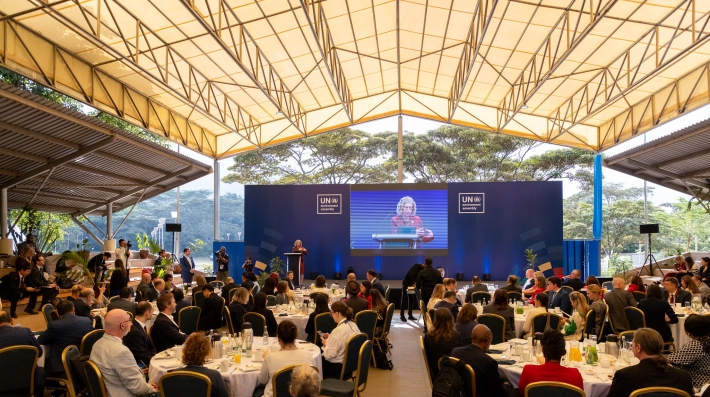
Nairobi: The seventh session of the United Nations Environment Assembly (UNEA) concluded today with an unusually wide set of global commitments, as Member States adopted 11 resolutions, three decisions and a Ministerial Declaration that amounted to one of the most expansive environmental negotiation outcomes in recent years. More than 6,000 participants representing 186 countries attended the week-long gathering at the UN Environment Programme (UNEP) headquarters in Nairobi, pressing for credible action across the triple planetary crisis of climate change, biodiversity loss, and pollution. As the session closed, negotiators described the outcomes not as final answers but as a collective attempt to push back against accelerating degradation that is now straining governments, economies and societies worldwide.
The Ministerial Declaration, the centrepiece of the session, opened with a reaffirmation of the Rio Declaration and the 2030 Agenda for Sustainable Development, while acknowledging the growing complexity of the environmental landscape. Ministers recognised the interconnected nature of global challenges: climate change, biodiversity collapse, pollution, desertification, soil and land degradation, drought, wildfires, deforestation, and the increasingly frequent sand and dust storms that destabilise entire regions. The text called for bold actions, stronger international cooperation and an evidence-based response that aligns the work of governments, civil society, scientific communities and the private sector. Delegates emphasised that the environmental crisis no longer fits neatly within national borders or sectoral mandates, and that solutions must match the scale and speed of the pressures now reshaping the planet.
In concrete terms, ministers pledged to strengthen international cooperation to prevent and reduce all forms of pollution, invest in national monitoring and response systems, and advance sustainable consumption and production through circular-economy approaches, resource efficiency and waste minimisation. They committed to reducing exposure to hazardous chemicals, promoting sustainable lifestyles, and supporting a sustainable and inclusive bioeconomy that reinforces climate resilience and biodiversity conservation. The declaration called for systemic shifts in high-impact sectors, accelerated transition to sustainable food systems, and policy responses aimed at eradicating hunger and all forms of malnutrition. Member States promised to support just transitions through education, skills development and public awareness, ensuring that workers and vulnerable communities are not left behind.
Water governance featured prominently, with ministers committing to stronger cooperation under UNEA resolution 6/13 and to actively engage in preparations for the 2026 UN Water Conference. The One Health approach was elevated as an essential framework linking human, animal, plant and ecosystem health, while delegates urged ambitious nationally determined contributions consistent with limiting global temperature rise to 1.5°C above pre-industrial levels. Climate finance remained a critical issue, and governments reaffirmed the new collective quantified goal agreed in Baku, emphasising the need to mobilise at least $1.3 trillion annually by 2035 for climate action in developing countries, alongside a commitment to remain on a pathway toward $300 billion a year exclusively for adaptation and resilience.
Recognising the escalating impacts of climate-related disasters, states stressed the need to strengthen coordination between early warning systems and disaster-risk reduction frameworks and emphasised nature-based and ecosystem-based approaches as core tools for building long-term resilience. Digital technologies — especially artificial intelligence — were acknowledged for their potential to accelerate progress toward the Sustainable Development Goals, but the declaration urged responsible, ethical and environmentally sound deployment, alongside deeper scientific assessment of their impacts.
Member States recommitted themselves to implementing multilateral environmental agreements and internationally agreed environmental frameworks with renewed resolve. They supported the Global Framework on Chemicals and welcomed the establishment of the Intergovernmental Science-Policy Panel on Chemicals, Waste and Pollution. Negotiators reaffirmed their intent to continue work on a legally binding instrument on plastic pollution, acknowledging the need for a comprehensive, fair and effective treaty. Marine biodiversity also came into focus, with encouragement for countries to join the new agreement on the conservation and sustainable use of marine biological diversity of areas beyond national jurisdiction. Delegates reinforced the priorities articulated at the 2025 UN Ocean Conference in Nice, pledging action to restore and protect ocean ecosystems.
The declaration committed governments to fully implementing the Kunming-Montreal Global Biodiversity Framework, halting and reversing biodiversity loss through national strategies and action plans, and closing the biodiversity funding gap by mobilising at least $200 billion per year by 2030. Ministers agreed to eliminate or reform incentives harmful to biodiversity, aiming for reductions of at least $500 billion annually by the end of the decade. The text underscored the importance of the UN Convention to Combat Desertification and outlined commitments to address land degradation and drought through restoration, sustainable land management and strengthened support for developing countries.
The commitments extended to broader governance and equity issues. Delegates called for scaling up finance, capacity-building and technology transfer for developing countries; reforming the international financial architecture; and making global financial flows consistent with sustainable, climate-resilient development. The declaration emphasised gender equality, meaningful participation of women, girls, youth, persons with disabilities, Indigenous Peoples, local communities and people of African descent, and recognised the human right to a clean, healthy and sustainable environment. Ministers pledged to deepen cooperation with Indigenous Peoples and local communities to integrate traditional and local knowledge into environmental decision-making. They also reaffirmed the need to strengthen international environmental governance, improve synergies between multilateral agreements, protect the environment in areas affected by armed conflict, and enhance responses to environmental crimes through stronger legislation, data collection and enforcement capacity.
This policy-rich ministerial declaration framed the broader outcomes of UNEA-7, where Member States advanced resolutions on safeguarding coral reefs, managing minerals and metals crucial to the energy transition, addressing chemicals and waste, ensuring the sustainable use of artificial intelligence, and promoting environmental solutions through sport. Other resolutions addressed international cooperation to combat wildfires, strengthened the environmental dimension of antimicrobial resistance, focused on the protection of glaciers, and targeted sargassum seaweed blooms affecting coastal ecosystems. The Assembly also approved UNEP’s Medium-Term Strategy for the next four years and its Programme of Work for the next two.
UNEP Executive Director Inger Andersen urged governments to follow through. She reminded delegates that the optimism inside the halls contrasted sharply with the suffering outside them, where homes and livelihoods are being destroyed and inequity deepens because environmental action remains insufficient. She urged Member States to “hurry down this path” and deliver real solutions for people and the planet.
UNEA-7 also showcased the broader ecosystem surrounding environmental diplomacy. It hosted the second Multilateral Environmental Agreements Day and launched the seventh Global Environment Outlook, which projected that investments in climate stability, healthy ecosystems and a pollution-free planet could generate trillions of dollars in global GDP, prevent millions of premature deaths and lift hundreds of millions out of poverty and hunger. It was preceded by a Youth Environment Assembly of over 1,000 young delegates, a Cities and Regions Summit focused on local leadership in environmental action and the 21st Global Major Groups and Stakeholders Forum, which brought civil society into direct dialogue with governments and UNEP.
The session also hosted the Gala of Hope, celebrating the 2025 Champions of the Earth and the latest UN World Restoration Flagships. UNEP’s Goodwill Ambassadors contributed high-profile visibility, with Patron of the Oceans Lewis Pugh climbing Mount Kenya — one of Africa’s last remaining glacier sites, expected to lose its ice within five years — and Frida Amani performing her new song “Resilience” alongside the Kenya Boys Choir at the high-level segment.
As UNEA-7 closed, Member States elected Jamaica’s Minister of Water, Environment and Climate Change, Matthew Samuda, to preside over UNEA-8. He emphasised that communities on the frontlines of climate impacts “cannot afford delay and do not have the luxury of indifference,” pledging to lead an Assembly grounded in inclusivity, transparency and practical action. The next UN Environment Assembly will reconvene in Nairobi from 6 to 10 December 2027.
– global bihari bureau