Taragiri
Project 17A Milestone: Indigenous Warship Taragiri Joins Fleet
Delivery of Taragiri Frigate Marks an Incremental Step in Naval Self-Reliance Drive
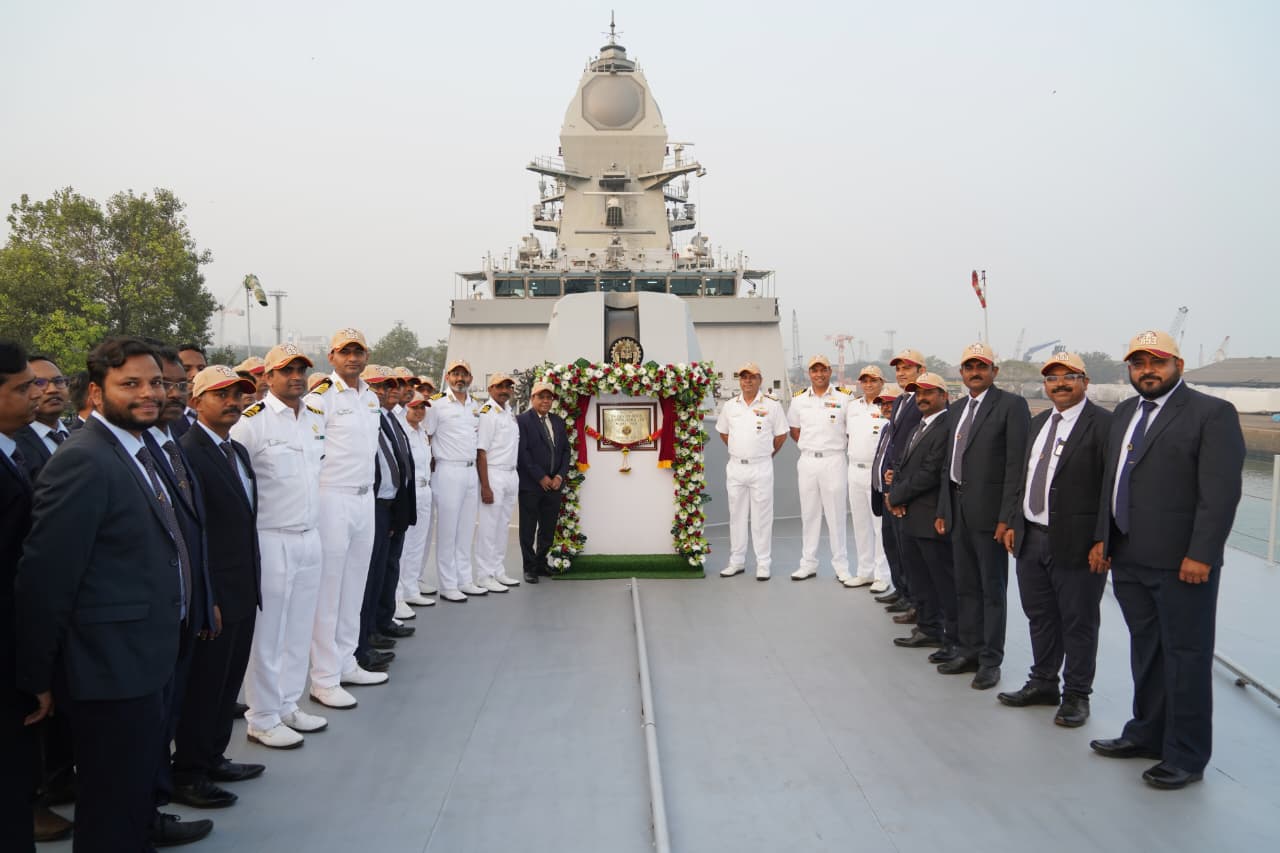
Mumbai: The Indian Navy took delivery of Taragiri, the fourth vessel in the Nilgiri Class under Project 17A, at an event described as a “major milestone” in indigenous warship construction, at the Mazagon Dock Shipbuilders Limited yard, on November 28.
Taragiri, yard number 12653, represents the third such frigate constructed by Mazagon Dock Shipbuilders Limited, a public sector undertaking under the Ministry of Defence. The Nilgiri Class, formally designated Project 17A, comprises advanced stealth frigates intended as multi-mission platforms capable of addressing maritime security challenges. These vessels incorporate enhanced stealth features, firepower, automation, and survivability measures compared to the preceding Project 17 Shivalik Class.
The stealth package includes angular hull facets and sloped superstructures to deflect radar waves, radar-absorbent materials and coatings on metallic and composite surfaces, cooled exhaust mixing for infrared suppression, vibration-dampened propulsion components for acoustic quieting, and de-gaussing systems to counter magnetic detection. Deck fittings are integrated or angled to minimise right-angle returns, while recessed vertical launch modules and low-probability-of-intercept radar modes further reduce electromagnetic emissions. Official claims suggest a substantial reduction in radar cross-section, though exact figures remain undisclosed.
The ship’s name revives that of a previous Indian Naval Ship, Taragiri (F41), a Leander-class frigate built at Mazagon Dock and decommissioned on May 9, 2013, after 33 years of service. That vessel belonged to the six-ship Indian “Nilgiri-class” (distinct from the present Project 17A series), which were licence-built British Leander designs commissioned between 1972 and 1981, primarily for anti-submarine escort duties.
Official statements today highlight this as a “quantum leap” in design capabilities, aligning with the government’s Aatmanirbhar Bharat initiative for self-reliance in defence manufacturing.
Design responsibility for Project 17A frigates rests with the Warship Design Bureau, with oversight provided by the Warship Overseeing Team in Mumbai. Construction followed an integrated approach, adhering to the planned schedule. The vessels employ a Combined Diesel or Gas propulsion system, integrating diesel engines and gas turbines to power controllable pitch propellers on each shaft. An Integrated Platform Management System manages onboard operations.
Primary strike armament is the BrahMos supersonic cruise missile, capable of speeds of Mach 2.8–3.0 (approximately 3,400–3,700 km/h), with operational ranges of 290–600 km depending on variant, and a 200–300 kg high-explosive warhead. The missile follows a sea-skimming or high-altitude trajectory with terminal-phase manoeuvres and sub-metre accuracy, launched from vertical or inclined modules on the frigate. Additional sensors include the MF-STAR multi-function surveillance and threat alert radar and the Medium Range Surface-to-Air Missile complex. Close-in weaponry comprises a 76-millimetre Super Rapid Gun Mount, 30-millimetre and 12.7-millimetre guns, anti-submarine rockets, and torpedoes.
This delivery constitutes the fourth Project 17A frigate handed over to the Indian Navy within the past 11 months, following the lead ship Nilgiri and two others. Construction timelines have reportedly shortened, with Taragiri completed in 81 months against 93 months for Nilgiri, attributed to lessons from prior builds. The remaining three ships—one at Mazagon Dock Shipbuilders Limited and two at Garden Reach Shipbuilders and Engineers Limited—are slated for delivery by August 2026.
Project 17A incorporates 75 per cent indigenous content, engaging over 200 micro, small, and medium enterprises. It has generated direct employment for approximately 4,000 personnel and indirect jobs for more than 10,000. The Press Information Bureau release, issued by the Ministry of Defence, underscores these figures as evidence of national engineering prowess, though independent verification of employment impacts remains pending.
The handover proceeds amid ongoing scrutiny of defence procurement delays and indigenisation targets across public sector shipyards.
– global bihari bureau