South Africa's President Cyril Ramaphosa Hails G20 Declaration as Victory for Multilateralism
Empty Chair Marks U.S. Takeover as G20 Adopts Declaration
Summit Forges Path Without U.S.
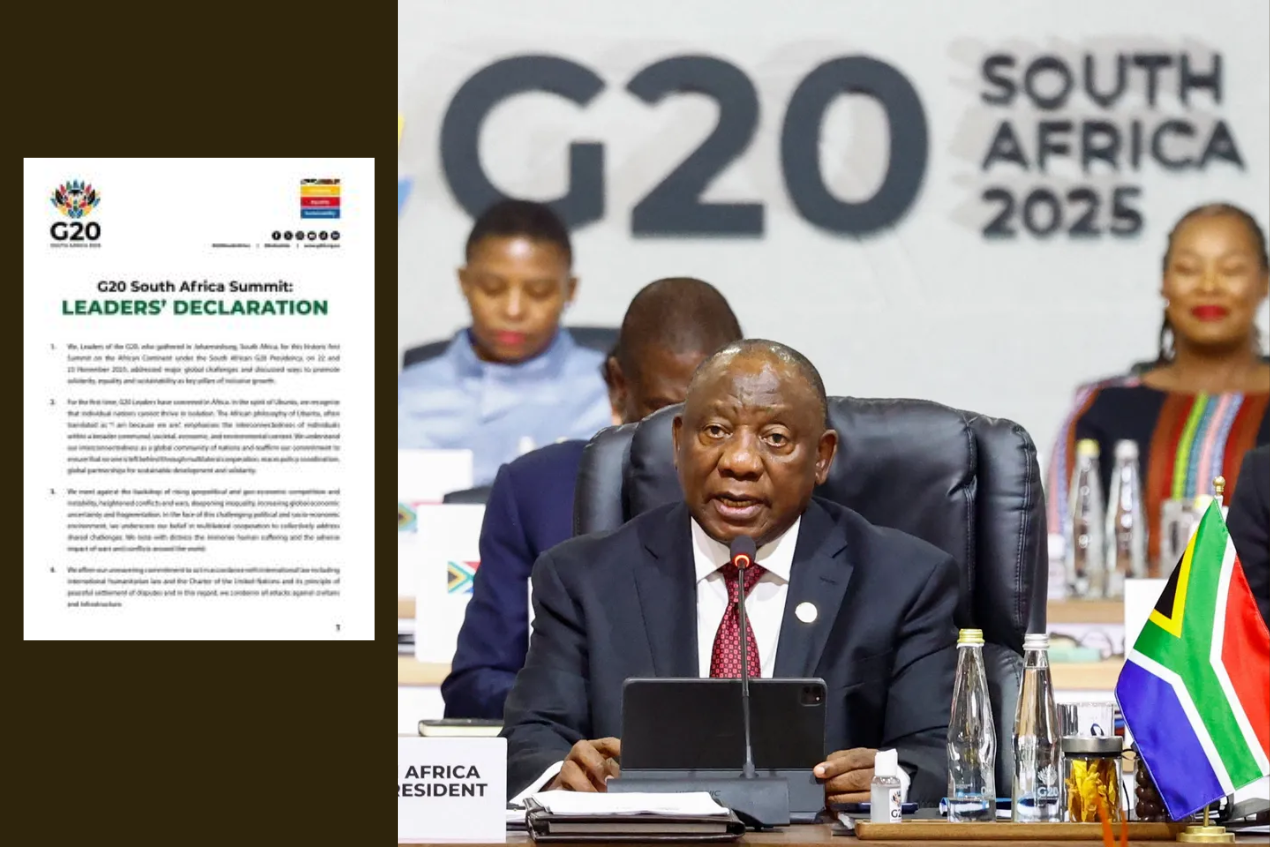
Johannesburg: The Group of Twenty (G20) leaders’ meeting in Johannesburg on November 22–23, 2025, closed with a formal leaders’ declaration that runs to 122 numbered paragraphs and places Africa and the needs of low-income countries at the centre of its ambitions for the next multi-year cycle. The declaration, tabled by the South African Presidency, frames the summit around the Presidency’s theme of “Solidarity, Equality, Sustainability” and contains commitments across disaster resilience, debt treatment, energy transitions, critical minerals, inclusive industrialisation, food security, artificial intelligence and data governance, finance architecture, pandemic prevention and universal health coverage, and support for African industrialisation and trade. The document also records the Group’s pledge to work “together under the United States’ Presidency in 2026,” formalising the scheduled rotation of the chair to the United States.
The implications of the United States’ absence from the Johannesburg summit were visible throughout the process. President Donald Trump’s instruction not to send a head-of-state or senior-level delegation left the incoming Presidency without representation at the level usually associated with the ceremonial transfer of the chair. South Africa declined to conduct the handover with a junior U.S. official, maintaining that protocol required a head-of-state presence for the symbolic act. The result was a procedural transfer recorded in the declaration but no formal ceremony, creating an unusual transition at a moment when continuity is central to advancing an agenda that spans financial reform, climate action and Africa-focused development. International coverage noted that this marked the first time an incoming Presidency assumed the role without participating in the preceding summit at the leadership level.
The absence also shaped the negotiations that produced the Johannesburg Declaration. Delegates from other member states completed sections of the draft without active U.S. participation after Washington indicated its opposition to elements concerning global governance reform, debt treatment and climate finance. The declaration was adopted despite these objections, allowing the South African Presidency and a broad coalition of developing countries to advance priority areas that had previously encountered resistance. While this ensured the summit produced a comprehensive outcome, it also means that several workstreams will now move into 2026 without the benefit of consensus-building normally facilitated by incoming hosts.
The declaration’s most extensive provisions concern global financial architecture reform. It welcomes ongoing work by the International Monetary Fund and the World Bank to update quota shares, strengthen governance and expand lending capacity. It calls for further efforts by multilateral development banks to refine capital adequacy frameworks, deepen the use of hybrid capital and guarantees, and mobilise greater volumes of affordable long-term financing for low- and middle-income countries. The document highlights the need for predictable financing to support energy transitions, climate adaptation and resilient infrastructure, while encouraging multilateral development banks to collaborate more closely to reduce fragmentation in global financing channels.
Africa’s development appears throughout the declaration as a cross-cutting theme. The summit endorsed the next phase of cooperation under the Compact with Africa, supported the World Bank–African Development Bank partnership to expand investment channels, and emphasised industrialisation pathways consistent with Africa’s economic strategies. References to the Mission 300 platform and multi-donor mechanisms signal an intention to scale private-sector mobilisation and capacity-building programmes. Energy access, regional power systems, sustainable infrastructure and technology partnerships are presented as essential components of Africa’s growth trajectory, reflecting the strong focus the South African Presidency placed on aligning global governance with African developmental priorities.
Disaster risk financing is another major component. The declaration endorses a strengthened framework for pre-arranged finance linked to hazard forecasting, calls for integrating disaster risk into macroeconomic planning, and encourages the development of layered financial instruments tailored to different shocks. This framework seeks to improve countries’ abilities to respond to climate-related and other emergencies while reducing fiscal vulnerability.
Food systems commitments include improving storage and cold-chain infrastructure, supporting fertiliser access, strengthening land-use practices and promoting climate-resilient crop systems. The declaration acknowledges the disruptions in global agricultural markets and emphasises coordinated responses to protect vulnerable populations affected by rising food insecurity.
Trade-related commitments reaffirm support for a rules-based, non-discriminatory multilateral trading system. The document reiterates the centrality of the World Trade Organization and calls for restoring a fully functioning dispute settlement system. It supports ongoing negotiations in plurilateral areas under the Joint Statement Initiatives and emphasises the need for modernised trade rules that reflect digital transformation and evolving supply chains.
Health commitments range from pandemic preparedness to universal health coverage and antimicrobial resistance. Leaders agreed to strengthen surveillance, expand access to medical countermeasures and support sustainable financing for global health security. The declaration reaffirms the leadership role of the World Health Organization and links health resilience with broader development objectives.
The section on artificial intelligence and digital public infrastructure outlines voluntary principles for safe, secure and trustworthy systems. It emphasises inclusive digital growth, equitable access to technology and the importance of data governance frameworks that safeguard privacy while enabling innovation. These discussions intersected with India’s proposals on healthcare response mechanisms, traditional knowledge repositories, open satellite data and circularity for critical minerals, each of which aligns with the broader themes of sustainable development and technological cooperation.
The declaration also makes clear that many of its frameworks remain voluntary and rely on member-driven implementation. The commitments on critical minerals, energy security, food systems, artificial intelligence and disaster risk financing operate as cooperative platforms rather than binding arrangements. Their effectiveness will therefore depend on coordinated follow-through among members and sustained engagement in international institutions.
The wider significance of the United States’ absence lies in the gap between adopting these commitments and implementing them. Many of the reforms identified in the Johannesburg programme require leadership and financial contributions from major shareholders in multilateral institutions, including the United States. Debt restructuring processes, multilateral development bank reforms, capital increases, trade negotiations and global health financing each rely on consensus among countries with substantial voting power. As the incoming chair, the United States inherits an agenda it did not shape at the leader level but will now be responsible for steering through complex technical and political processes.
Despite the diplomatic tensions created by the U.S. boycott, the Johannesburg summit delivered a wide-ranging declaration that reflects the priorities of the South African Presidency and developing countries across regions. It sets out a multi-year roadmap anchored in inclusive growth, multilateral reform and resilience-building. Whether this programme progresses as intended will depend on how the incoming Presidency engages with the responsibilities it has formally inherited and how effectively it navigates the political consequences of its absence from Africa’s first G20 leaders’ summit.
– global bihari bureau