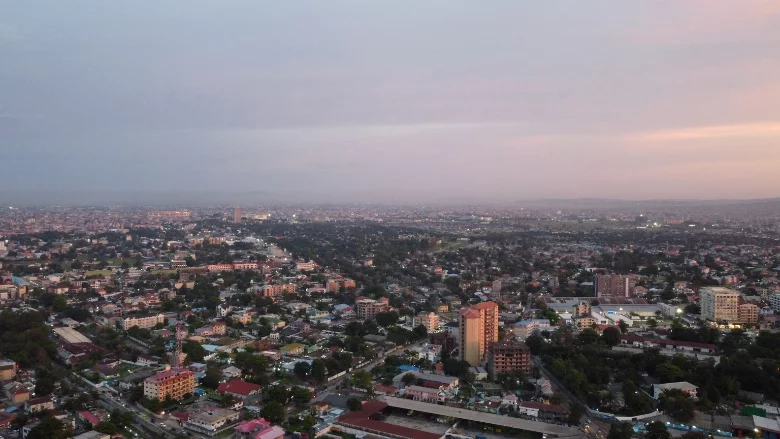
DRC Capital Kinshasa. Photo source: The World Bank
DRC Famine: 3 Million Desperate, Aid at Breaking Point
Kigali/Kinshasa/Geneva: As clashes echoed through the mist-shrouded hills of North Kivu, the United Nations World Food Programme (WFP) today issued a stark alert from Geneva: the crisis in eastern Democratic Republic of the Congo (DRC) continues to worsen amid ongoing fighting that has driven tens of thousands of people from their homes and created acute hunger.
United Nations aid agencies are struggling in particular in provinces overrun by Rwanda-backed March 23 (M23) Movement rebel fighters at the start of the year, although dramatic funding shortfalls for humanitarian work have also contributed to the dire situation.
Kigali has consistently denied providing military backing to the group. Nearly 25 million people across the Democratic Republic of Congo are now mired in high levels of food insecurity, rated as phase three on the Integrated Food Security Phase Classification scale that runs from one—minimal concerns—to five, the threshold for famine.
Within this grim tally, three million have plunged into phase four, emergency conditions that demand immediate intervention, a surge of almost double from the previous year and encompassing 75 per cent of all such cases nationwide. Cynthia Jones, the WFP’s Country Director for the DRC, conveyed the human toll via video link from Kinshasa, painting a tableau of families rationing meagre portions, bartering away livestock and heirlooms, and, in isolated enclaves, succumbing to starvation—a reality the agency has documented amid the fray.
“This means what for families? It means that they’re skipping their meals, depleting all of their household assets. They’re selling off their animals,” she said, speaking to journalists in Geneva. According to the United Nations agency, people are already dying of hunger in parts of the eastern Democratic Republic of the Congo.
This escalation traces a direct line to the resurgence of the M23 Movement rebels, whom the United Nations reports and Kinshasa accuse of receiving logistical and military support from neighbouring Rwanda, a charge Kigali has steadfastly refuted across diplomatic channels and public statements. Born from the March 23, 2009, peace accord that integrated the Tutsi-led National Congress for the Defence of the People into the DRC Armed Forces, the M23 Movement emerged in April 2012 when around 300 soldiers, led by Bosco Ntaganda—an International Criminal Court-indicted commander convicted in 2021 for war crimes—and Sultani Makenga, mutinied over alleged breaches of the pact, including salary shortfalls, ethnic discrimination, and failure to neutralise Hutu militias like the Democratic Forces for the Liberation of Rwanda. That first rebellion (2012–2013) saw the M 23 Movement seize Goma in November 2012 after a 12-day siege, briefly controlling mineral-rich territories while committing atrocities—140 civilian killings in Goma alone, rapes including a 10-year-old girl who died from injuries, and child recruitment of over 146 boys as young as 12—before a United Nations Force Intervention Brigade routed them by October 2013, prompting Ntaganda’s surrender in Kigali and over 500 fighters demobilising in Uganda.
Dormancy ended in November 2021, when the M23 Movement relaunched attacks in North Kivu’s Ndiza and Runyoni areas, exploiting the DRC Armed Forces’ withdrawals and framing demands around Tutsi protection, refugee returns, and national governance critiques under President Félix Tshisekedi. By mid-2022, the group—now 8,000–11,000 strong per United Nations estimates—had tripled its territory, capturing Bunagana on the Ugandan border and, in early 2025, encircling and then seizing Goma in January and Bukavu in South Kivu by February, displacing over 660,000 from Goma in the year’s first months alone. United Nations Group of Experts reports again documented 3,000–4,000 Rwandan Defence Forces personnel embedded by 2023, alongside arms and recruitment, fueling coltan and gold smuggling routes that generate millions, while locals face starvation.
Since reactivating, the M23 Movement has contributed to a regional total of 5.2 million internally displaced persons, including 1.6 million uprooted since January. Jones noted that fighting between M23 Movement members and DRC government forces is continuing, sparking new displacement and forcing people from their homes over and over again. In eastern Democratic Republic of the Congo, this has left about 5.2 million displaced people, including 1.6 million that have been displaced this year alone, making the Democratic Republic of the Congo one of the world’s largest displaced person crises. The fighting, intertwined with skirmishes involving dozens of other armed groups spawned from the 1994 Rwandan genocide’s aftermath, has shuttered two critical airports in M23 Movement-held territories basically since the end of January, severing supply chains and prompting the United Nations World Food Programme’s urgent plea for a humanitarian air corridor—potentially routed through Rwanda for efficiency, though such proposals carry their own geopolitical frictions. Help could be provided more easily if air access were re-established, the United Nations World Food Programme insisted. “We’re urgently calling for a humanitarian air corridor to be established,” Jones said.
Beyond the front lines, the crisis ripples into everyday existence in provinces like North Kivu, South Kivu, Ituri, and Tanganyika, where insecurity has felled banks and markets, eroding livelihoods built on subsistence farming. “The banks are closed, there’s no money available, and this has just had a major impact on the population and on the humanitarian response,” Jones explained. “It has devastated livelihoods and really put the food security of affected people in dire, dire circumstances.” Millions of cultivators—predominantly women tending plots of cassava and maize—have forfeited the 2025 planting season, either fleeing violence or cowering too afraid to till their fields, a lapse that forecasts barren yields and compounded scarcity come harvest. Equally worrying is the fact that millions of subsistence farmers forced from their homes or too fearful to access their land have missed the planting season this year. Displaced throngs, numbering in the hundreds of thousands weekly at peaks, converge on overburdened urban outposts like Ituri, where host communities are already struggling to cope as families seek shelter in urban centres. Over 140,000 have spilt across borders since January, with Burundi and Uganda absorbing 70,000 and 60,000 respectively, straining regional capacities and inflating food prices amid a depreciating Congolese franc and disrupted trade.
The United Nations World Food Programme’s operational ledger underscores the bind: despite deepening hunger, funding is running out for lifesaving humanitarian work, and the agency has been forced to reduce the number of people it assists, from around one million at the start of the year, to 600,000 now. “We will only be able to support a fraction of those in need moving forward,” Jones said, in an appeal for $350 million to support emergency food and nutrition assistance over the next six months. “Without it, we will have to make further cuts, reduce [assistance] even further, down to 300,000, which is only 10 per cent of the three million in need.”
This shortfall, part of a broader $433 million gap for Democratic Republic of the Congo operations through October, has compelled office closures in urban hubs, staff trims, and logistical improvisations in a terrain riddled with ambushes and roadblocks.
Without a significant funding boost, the United Nations World Food Programme warned of a total pipeline break in assistance by March 2026. “That means a complete halt of all emergency food assistance in the eastern provinces.” The dire funding shortfall has also impacted the agency internally, too. “We’re starting to close downtown offices, we’re reducing our footprint, the number of staff and juggling how to maintain the operational capacity to deliver in a very complex environment,” Jones explained. The agency’s United Nations Humanitarian Air Service, ferrying 2,464 aid workers and 23 metric tons of cargo thus far, teeters on suspension by March 2026 without $33.1 million more, risking a total pipeline break that would eclipse all emergency feeds in the east. Yet amid the strain, the United Nations World Food Programme has treated over one million children and nursing mothers for acute malnutrition since January, a flicker of reach in a nation where 26.6 million confront crisis-level want by early 2026.
Interpreting this tableau demands confronting entrenched fissures. The M23 Movement offensive, layered atop three decades of militia entanglements rooted in the First and Second Congo Wars (1996–2003) and the 1994 genocide’s spillover, not only fragments territory but exploits mineral-rich veins—coltan, gold—that fuel global electronics supply chains, even as locals barter heirlooms for survival.
Since the 2025 offensive, the group’s documented war crimes have escalated: in January, shelling near Goma killed and injured civilians in displacement sites; by February, mass burials followed the Bukavu takeover, with over 7,000 deaths nationwide since January, including 406 bodies collected in South Kivu alone (110 civilians); March-May saw gang rapes of dozens in Goma and Bukavu, plus abductions and torture in hospitals; July’s Virunga massacres claimed over 140 lives (potentially 300) in 14 Hutu-majority villages, with summary executions and arson; August added 140 killings amid ceasefire violations.
Peace efforts falter: the 2013 Addis Ababa Framework, July 2025 Doha Declaration, and Qatar-mediated ceasefires collapse amid Kinshasa’s military pushback and Rwanda’s denials, despite United Nations evidence of de facto control. Regional mediators, including the European Union with its March air bridge to Goma, have nudged ceasefires, but Doha talks stall, with Kinshasa eyeing military reclamation of lost ground—a gambit that analysts warn could ignite broader conflagration, imperilling President Félix Tshisekedi’s tenure.
Jones’s voice from Kinshasa cuts through: the afflicted—women shielding children from marauders, men bartering tools for tubers—are “tired, exhausted,” yearning not just for rations but respite from the ceaseless churn of flight and fortitude. “The women, children, men, they’ve just been suffering devastating sequences of violence, perpetrated by the non-state armed groups and fleeing from conflict. They’re tired, exhausted and need peace,” she insisted. With 3.9 million projected for phase four in the east alone and Integrated Food Security Phase Classification analyses charting a path to unprecedented peaks, the Democratic Republic of the Congo’s plight interrogates the global compact: can fractured diplomacy and donor fatigue yield to sustained access and equity before phase five engulfs the vulnerable? The metrics suggest a narrowing window, where inaction risks not merely hunger’s blade but the unravelling of a nation’s mosaic.
– global bihari bureau