India Expands Social Security to 940 Million
e-Shram Registers 310 Million Workers
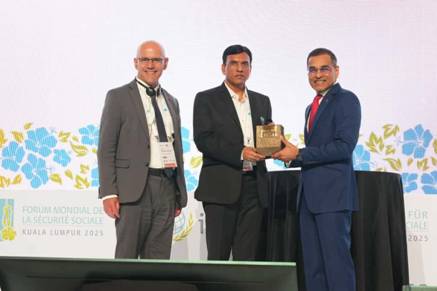
Kuala Lumpur: India was awarded the International Social Security Association (ISSA) Award 2025 for ‘Outstanding Achievement in Social Security’ at the World Social Security Forum (WSSF), here today.
Union Minister for Labour & Employment and Youth Affairs & Sports, Dr Mansukh Mandaviya, accepted the award, noting that India’s social security coverage increased from 19% in 2015 to 64.3% in 2025, covering over 940 million citizens, according to data recognised by the International Labour Organisation (ILO).
The ISSA Award was presented during the WSSF, attended by over 1,200 social security policymakers and professionals from 163 countries. India is the fifth recipient of this triennial award. Dr Mandaviya stated that the achievement aligns with Prime Minister Narendra Modi’s principle of Antyodaya, focusing on supporting the most marginalised. India secured 30 seats in the ISSA General Assembly, the highest vote share among member countries.
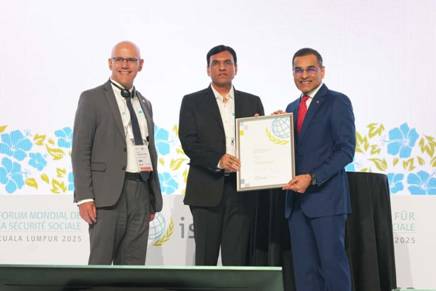
The award recognises the e-Shram portal, a national digital database that has registered over 310 million unorganised sector workers since its launch four years ago. Dr Mandaviya described the portal as a “one-stop solution” for connecting workers to social welfare schemes through a multilingual interface. The National Career Service (NCS) portal, integrated with e-Shram, connects job seekers and employers with a database of skilled workers accessible globally. Dr Mandaviya stated that this integration allows workers to pursue global opportunities while retaining social security benefits.
The e-Shram portal’s role extends beyond registration, enabling direct access to government welfare programs for unorganised workers, including those in agriculture, construction, and street vending. Its multilingual interface supports India’s diverse workforce, ensuring accessibility across regions and languages. The NCS portal complements this by providing a platform for skill certification and job matching, with data indicating its use by employers in both domestic and international markets. Dr Mandaviya emphasised during the WSSF that these digital tools are designed to address gaps in social protection for informal workers while fostering economic mobility.
India’s social security system includes the Employees’ Provident Fund Organisation (EPFO) and Employees’ State Insurance Corporation (ESIC), which offer healthcare, insurance, and pension schemes. During the WSSF plenary session, Dr Mandaviya discussed India’s use of digital tools and policy reforms to address changes in labour markets, stating, “India is leveraging technology to create new income opportunities and social security net through a holistic approach that combines financial access, skilling, self-employment, and digital innovation.”
On the same day, Dr Mandaviya met with members of Malaysia’s Indian diaspora, which numbers over 2.9 million, the third-largest globally. He noted their contributions to Malaysia and the presence of over 150 Indian companies, including three public sector undertakings, operating in Malaysia, alongside nearly 70 Malaysian firms in India in sectors such as infrastructure, healthcare, and tourism. He highlighted a Memorandum of Understanding (MoU) signed with Malaysia in August 2024 to address recruitment, employment, and repatriation of workers. Dr Mandaviya also promoted the Pravasi Bharatiya Bima Yojana, an insurance scheme for Indian workers abroad covering accidental death, disability, medical emergencies, and repatriation, stating, “We are committed to ensuring that your rights are protected, your voices are heard, and your families back home remain secure.”
The economic partnership between India and Malaysia supports the welfare of Indian workers abroad, with the August 2024 MoU formalising cooperation on labour mobility. The agreement outlines protocols for fair recruitment and repatriation, aiming to protect workers’ rights in both countries. Dr Mandaviya noted that the presence of Indian companies in Malaysia and Malaysian firms in India strengthens bilateral ties, with sectors like telecommunications, oil and gas, and power also seeing mutual investment, according to data shared at the WSSF.
– global bihari bureau