 By Vidyadhar Date*
Ambanis Steal Ganesha’s Sacred Spotlight
Mumbai: This is one of the most obscene, revolting scenes I have witnessed, and it tells a lot about what Indian society has become, been reduced to. At Chowpatty beach, where waves once carried the Lalbaugcha Ganapati’s farewell with reverent grace, a grotesque parade unfolded: Mr Anant Ambani, a titan of corporate India, strode from the immersion ceremony, enveloped by a battalion of armed security men. Their guns gleamed under the light as they carved a path through the exclusive Mafatlal Bath, a fortress of privilege where no ordinary devotee could follow. It was like a security for a VVIP. Those not holding guns held hands together, forming a chain around him, a living wall that shielded wealth from worship. The crass rich have destroyed all the wisdom that the deity stands for, transforming a sacred rite into a brazen display of power and excess.
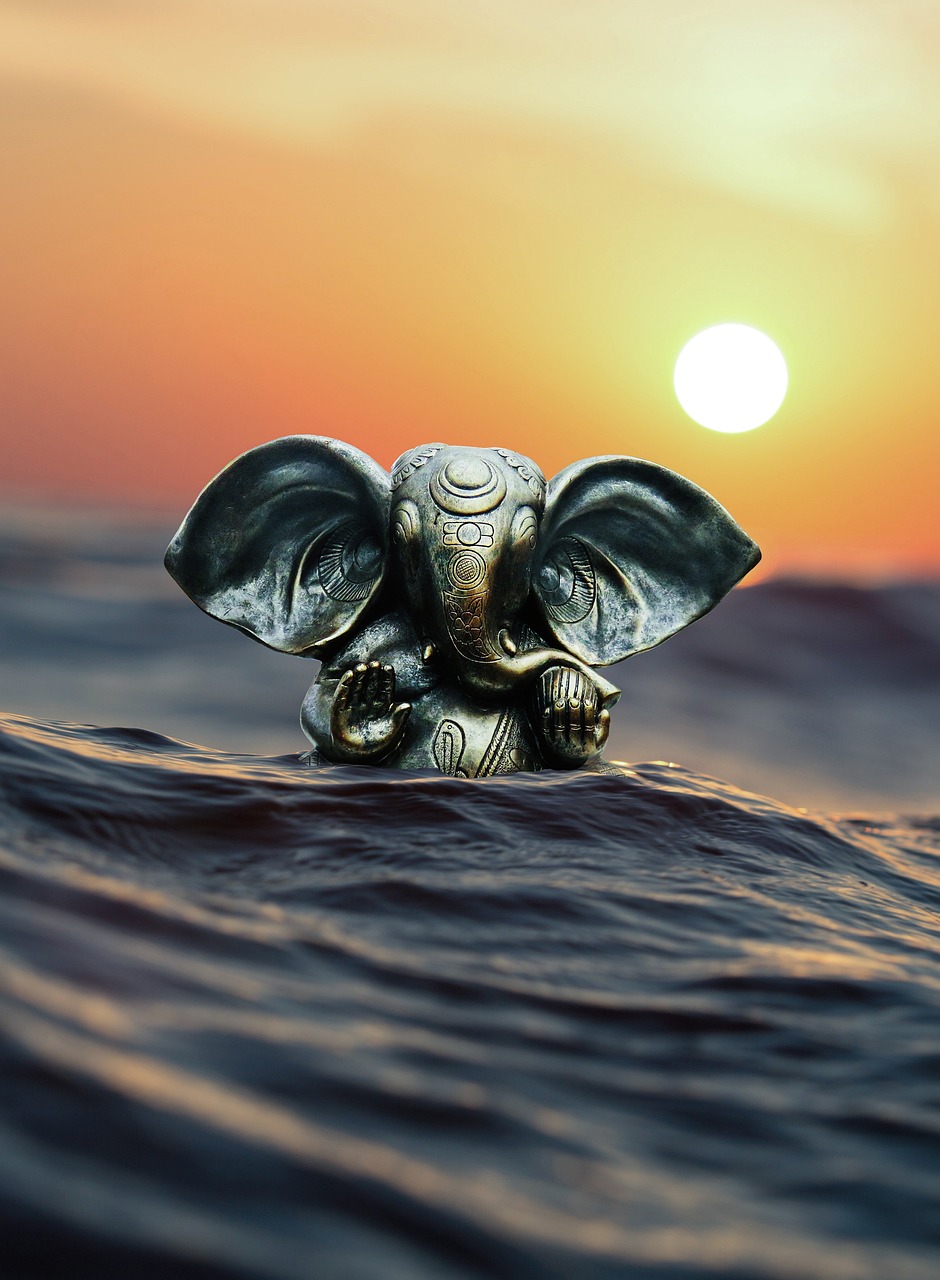
The Lalbaugcha Ganapati, systematically promoted over the years by corporates as in the case of the Siddhi Vinayak temple, was this year taken over by the Ambanis, causing widespread anger among people. Ganapati, the deity of intellect and remover of obstacles, embodies the ancient Gana republics—non-monarchical assemblies where collective voices shaped governance through elections. It has now been privatised.
There could not be a worse mockery of Lokmanya Tilak’s idea of organising the festival as a form of resistance against authority. Tilak, a visionary patriot, wove the Ganapati festival into a tapestry of defiance against colonial rule, a celebration where artists, musicians, and dancers once thrived, their creativity a living pulse of democracy. It was also a festival of democracy in a way, as far as the arts were concerned, we have now forgotten for decades hundreds of artists in every field, music, theatre, dance, who flourished here. Yet, everywhere, politicians, dubious elements have taken over the festival, creating a din that leaves many, many devout Hindus sick; you cannot run for cover anywhere; you have to bear this torture for days.
The clamour of loudspeakers and frenzied crowds now suffocates the festival’s soul, leaving devotees to mourn its lost sanctity. So nothing can now happen without the overbearing presence of the rich and the powerful. The rich are now the real rulers. This was long overdue.
In The Times of India (TOI), people like me could sense this many years ago. Its owner declared in no uncertain terms that people like him are the new State, the new authority, not the government. The editor echoed that. Those were the days when journalism had begun to collapse. Sankarshan Thakur, former editor of The Telegraph of Kolkata, was widely mourned recently. Never seen so many obits, but TOI did not carry a word on his passing away, as senior journalist Anil Singh pointed out, a deafening silence that betrays the media’s surrender to corporate influence.
“Gana republics” refer to non-monarchical, oligarchic states in ancient India, often contrasted with the monarchical kingdoms, where power was held by a community of individuals or ruling families, with a title like “Ganapati” for a chief among these rulers, a term also associated with D.D. Kosambi, a prominent 20th-century historian who studied these ancient forms of government. Damodar Dharmanand Kosambi, a polymath whose Marxist lens illuminated India’s past, traced the social and economic currents that shaped these tribal assemblies. Gana Republics (Gana-Sanghas) were non-monarchical states where a group of people, or a clan, held collective power. Their oligarchic nature meant power was not concentrated in one ruler but was shared by a council of leaders or a community. The chief of a gana was often called a Ganapati, and the title was not hereditary, unlike in kingdoms. Many of these republics were found in or near the Himalayan foothills in eastern India. Examples include the Vajji confederacy, which included the Licchavis, a well-known example of a gana republic. Kosambi’s scholarship, rigorous and iconoclastic, revealed the democratic roots of these systems, now a distant echo in a festival hijacked by modern oligarchs.
Ganapati has a special place in the cultural life of Maharashtra, apart from the festival celebration. Traditionally, all theatre performances began with an invocation to the Lord, and this was more so in the folk theatre in the Konkan coastal belt, where songs wove tales of divine wisdom under starlit skies. Ganapati was also the main deity of the Brahmin Peshwa rulers. The memorable production by Theatre Academy of Ghashiram Kotwal, Vijay Tendulkar’s, begins with a very well-choreographed dancing Ganapati with a chorus of Brahmins, Sri Gana Raya Brahman Hari, Amhi Punyache Brahman Hari is the famous line from that performance that still haunts fifty years later, its cadence a haunting reminder of a culture now commodified. In the Konkan coastal belt Ganapati festival is more important than Diwali, train reservations are booked well in advance, as communities unite in devotion to honour their beloved deity. Tilak drew inspiration from the Greek and ancient Roman festivals, which drew together artists and athletes in the public arena, envisioning a similar unity for India’s masses. Maratha princely states had been observing the Ganapati festival earlier. Tilak, a Chitpavan Brahmin, also started the Shivaji festival, which is very interesting because, till then, the Marathas, who now claim him as their property for political ends, had little place for him in their lives, a reinvention that foreshadows the festival’s current distortion.
Over the years, the Ganapati images have become bigger and bigger because of the grandiose project of some people. It is becoming difficult to immerse these images; their towering forms are a monument to hubris rather than faith. This year, it was particularly difficult to immerse the image of Lalbaugcha Raja; it was hard to lift the image onto a raft and then immerse it, its unwieldy bulk defying the ritual’s solemn grace. The traditional Koli community’s control over this image was taken over by the Ambanis this and this created many problems because they brought some rafts from Gujarat, which did not work; their failure was a stark metaphor for corporate hubris clashing with tradition. Lack of respect for nature has also had serious consequences. High and low tides are very important; these aspects were ignored, disrupting the sacred rhythm of the sea. The image has to be immersed at the end of the tenth day, but because of commercialisation and political exploitation, the processions continue up to the next evening. This is a travesty because Muhurta, the auspicious time, is considered very important, its violation a wound to the festival’s spiritual core.
The rot started with the commercialisation of the Siddhi Vinayak temple in Prabhadevi. This very simple temple was converted into a high-rise with a golden dome. The authorities are grabbing more and more space around it, causing serious traffic problems. Now they have acquired an entire housing society complex in the vicinity. They have so much money and power. Their greed is choking the temple’s humble roots.
Film stars, many of whom can be considered vulgar in their popularity, are exploiting it to boost their image, their presence a mockery of the festival’s artistic heritage. The renovation began with the initiative taken by former Shiv Sena minister Pramod Nawalkar, who had some good qualities; no one knew Mumbai’s lanes and bylanes, the nightlife, the crime scene like him, yet his efforts unwittingly paved the way for this corporate takeover.
Traditionally, people pray to Ganapati, saying in Marathi Changli Buddhi d Dey (buddhi here means wisdom, give us good sense). One can only pray that in the future Ganesha will bring some wisdom, Buddhi will dawn on politicians and corporates, restoring the festival to its sacred, democratic essence, and freeing it from the gilded chains of wealth and power.
*Senior journalist