

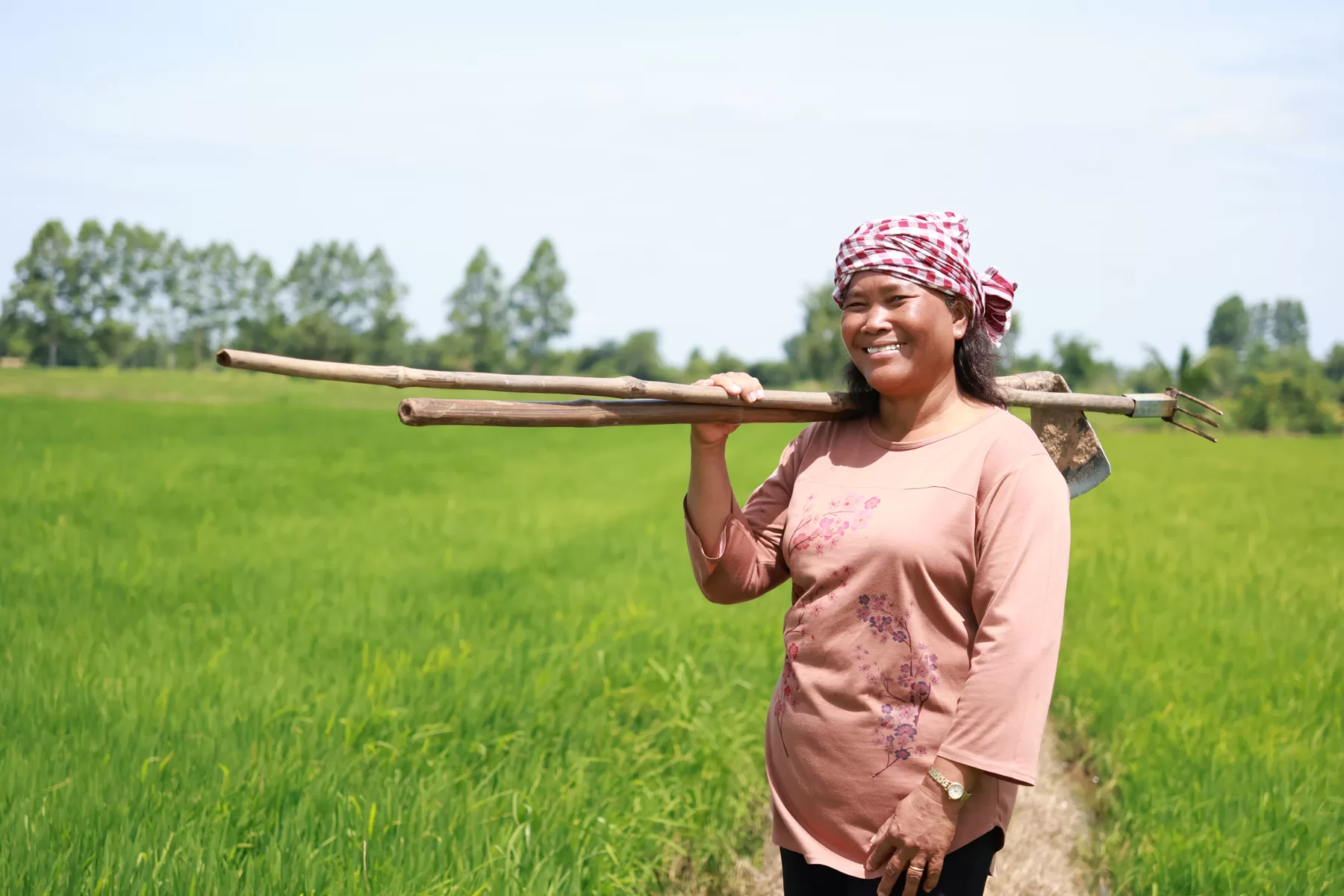
Applying new techniques that she learned in trainings, Champey Ream has reduced her use of seeds, fertilisers and pesticides, but still doubled her yield. She hopes to help other women farmers do the same. ©FAO/Bormey Chy
Widow’s Rice Defies Cambodia Floods
In the lush rice paddies of northwestern Cambodia’s Tean Kam commune, Seuy Phok carries the weight of her family’s legacy on her shoulders—literally and figuratively. After losing her mother, the 50-something widow has tended her ancestral fields single-handedly for over four decades, raising her young child alone while honouring the traditional methods passed down from her grandmother and late father. “Mixing the fertiliser, ploughing, and sowing—I do it all by myself,” she says with quiet determination, her voice echoing the solitude of a life shaped by loss and unyielding labour. These fields, once a reliable source of sustenance, now face an uncertain future amid Cambodia’s changing climate.

Every June, the wet season arrives like a double-edged sword, sweeping rains across the Tonle Sap region’s vast landscape and soaking the paddies that generations of farmers like Seuy have tilled for their daily roti and family income. But over the years, these monsoons have turned erratic—sometimes arriving too late to plant, other times unleashing floods too fierce to harvest. Four years ago, a torrential downpour submerged Seuy’s crops, flattening her hard-earned yield and leaving the remnants too sodden for manual reaping. She had to resort to machines, a stark departure from the hand-to-heart farming she knew, amplifying her isolation and financial strain.

It was in this moment of despair that hope sprouted through the “Promoting Climate-Resilient Livelihoods in Rice-based Communities in the Tonle Sap Region” (PCRL) project, led by the Food and Agriculture Organization of the United Nations (FAO) and backed by the Global Environment Facility. The initiative didn’t just offer tools; it reignited Seuy’s spirit by providing certified, high-quality rice seeds tailored to the harsh new realities of climate variability, along with practical training in sustainable practices. “After receiving the seeds and learning about production techniques, my yields started doubling,” Seuy recalls, her eyes lighting up. She could now sell not only rice but also the resilient seeds themselves. “I sold one barrel and ten bags of rice the first year. The second harvest was much better: two barrels and five bags.” These seeds yield fragrant jasmine rice, celebrated for its purity and aroma, fetching premium prices in export markets without the discolouration that plagued her earlier crops.
Seuy isn’t alone in this turnaround. In the nearby Ang Trapeang Thmor Protected Landscape, fellow farmer Champey Ream, a tireless champion of women’s empowerment, has woven her own tapestry of resilience. Embracing PCRL’s guidance, Champey slashed her reliance on seeds, fertilisers, and pesticides through efficient techniques. “We use fewer seeds and apply fertilisers according to what we learned,” she explains. “Our rice used to battle diseases, but now it’s thriving—healthy, robust, and pure.” Starting with just 40 kilograms of seeds, she reaped two tons of rice, pocketing nearly 1.5 million Riels (about USD 375). “We’ve doubled our yield, cut costs on inputs, and boosted our health and income,” she says proudly. For Champey, who has spent her life advocating for education and equality, the gains ripple beyond the fields: her daughter secured a scholarship for a doctorate in environmental research, and the extra earnings now fund her grandchildren’s schooling. “Knowledge is extremely important to help them and to help us,” Champey affirms, her words a beacon for village women she trains in sustainable farming.
The windfall has been life-changing for Seuy, too. The additional income built fences around her fields, raised walls for a sturdy new home, and created savings to reinvest in her land—while crucially covering her child’s school fees. “The money I earn goes to education,” she shares softly. “It helps children learn without the burden of debt, just as my family taught me the value of perseverance.” Champey’s dreams extend further: organising sessions for women in her village, she envisions ecotourism in the protected areas and marketing local products to foster community pride. “I want other women to be strong, to understand the value of knowledge,” she says. “Not to think that wealth is everything—without knowledge, it’s not enough.”
At the heart of PCRL’s success are its farmer field schools, spreading wisdom across 17 community-protected areas and 45 communes in the Tonle Sap basin. Here, growers master climate-resilient rice varieties that defy droughts and floods, learn soil-specific fertiliser use, adopt water-efficient preparation methods, and diversify crops for stability. Demonstration plots bring theory to life, with farmers tracking seasonal progress to refine their practices. When climate finance bridges the gap to these resources and expertise, it empowers ordinary people to navigate the storms of a warming world.
For Seuy and Champey, farming transcends mere survival—it’s a profound path to dignity, independence, and legacy-building. In the shadow of personal loss and environmental peril, they’ve turned vulnerability into victory, ensuring a brighter tomorrow for their families. “I want peace for families, peace for society,” Champey reflects. “As a woman, I want to understand the world—and help others do the same.” Across Cambodia’s emerald rice fields, this vision is taking root, one resilient stalk at a time, promising a harvest not just of grain, but of hope and empowerment.
Source: The FAO News And Media Office, Rome
global bihari bureau


It’s inspiring to see how Champey Ream has managed to double her yield while reducing the use of seeds, fertilizers, and pesticides. The techniques she learned in her trainings seem to be highly effective. It’s great that she wants to share her knowledge with other women farmers—this could lead to significant improvements in agricultural practices. I wonder if these techniques are widely applicable across different regions or if they are specific to certain conditions. Do you think similar results can be achieved on a larger scale? Also, how accessible are these trainings for other farmers? I’d love to learn more about the specific methods she used.
By the way, we have integrated libersave into our regional voucher system. It’s amazing how easy it is to bring together different providers on one platform. Whith regards,EURSP