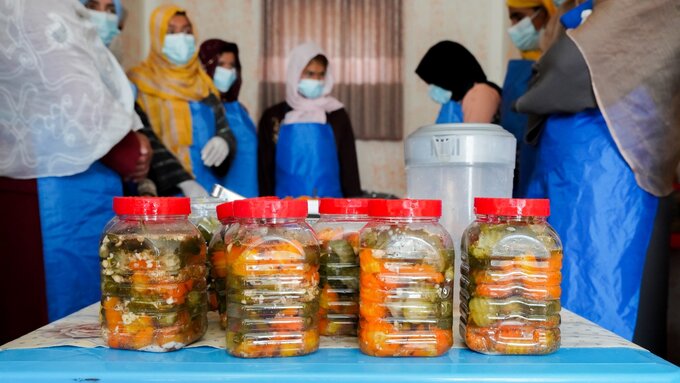
In Afghanistan, where women's livelihood options are limited, the women of Jabal Saraj have turned producing pickles and jams into a source of income. ©FAO/Hashim Azizi
In the heart of Jabal Saraj, a district nestled in Afghanistan’s northeastern Parwan province, tables gleam with jars of vibrant pickles, sweet jams, and rich tomato paste, each a testament to resilience and ingenuity. Here, a group of women skillfully dice bright orange carrots, grinds aromatic garlic, and peels crisp apples, transforming fresh produce into products that promise both flavour and opportunity. Their work is more than culinary—it’s a bold step toward economic independence.
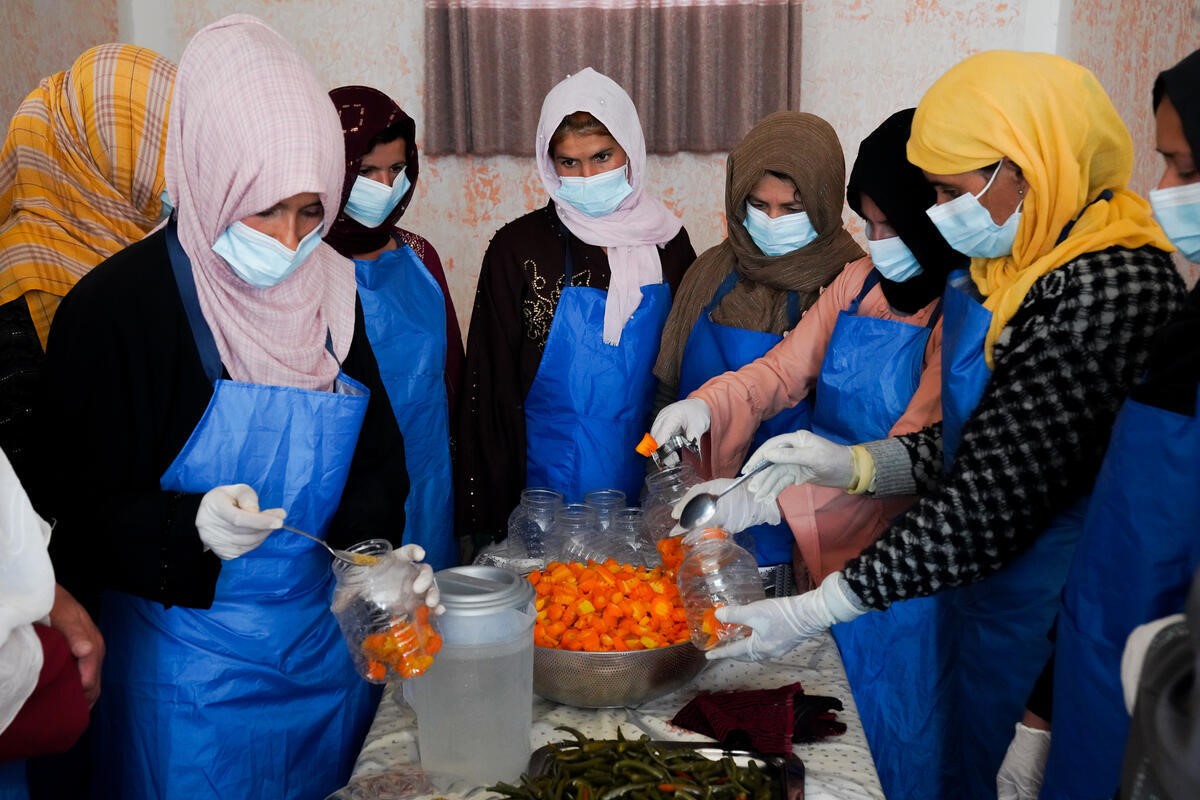
In a country where women’s economic prospects are often constrained, these women have transformed food processing into a lifeline. Hasina, alongside 19 others, gathers regularly at a food processing centre to peel, chop, and package goods for sale, stepping into roles as breadwinners for their families. Agriculture, a cornerstone of Afghanistan’s economy, offers a vital pathway for women’s empowerment, and the Food and Agriculture Organization of the United Nations (FAO) harnesses its expertise to unlock these opportunities.
“Before this, we were housewives, grappling with financial strain and emotional burdens,” Hasina shares. “This project has shown us that women can stand tall and provide for ourselves.” Through the Household Food and Livelihood Security (HFLS) project, funded by the Government of Luxembourg, FAO established this centre, equipping it with tools and training to help women like Hasina process and market an array of produce with skill and confidence.
The impact is tangible. By selling their products in local markets, the women have begun earning steady incomes, enabling them to afford essentials like food, clothing, and school fees. For Hasina, the earnings cover her five children’s education, baby supplies, and transportation costs, weaving financial stability into her family’s life.
The women’s success is bolstered by social mobilizers like Fazila Sadat, a young agriculture graduate who guides the group. Early on, Fazila led hands-on training sessions one to two times a week, teaching safe food preparation, packaging techniques, and hygiene standards. As the women honed their skills, these sessions evolved into weekly check-ins to strategise on production, market trends, and progress, ensuring their learning translates into action.
To broaden their reach, the HFLS project opened doors to agricultural fairs and exhibitions, including a notable event in Kabul where the women networked with buyers and gained insights into market demands. They also enhanced their products’ appeal by designing and printing eye-catching labels, elevating their brand in competitive markets.
Beyond economic gains, the centre fosters a sense of community. It’s a space where women not only tackle financial challenges but also share emotional support, forging bonds that strengthen their resolve. From January to June 2025, women across four target districts produced over 154,000 kilograms of goods—jams, chutneys, sauces, and pickles—generating approximately AFN 6,930,000 (USD 99,000). This income, previously out of reach, has reduced reliance on imported goods and bolstered local economies.
FAO’s broader Food, Nutrition, and Livelihood Security Programme targets the poorest 20 per cent of households in each district, tailoring support to local conditions and market potential. Participants receive farming inputs, food processing kits, and business training to enhance productivity. Since April 2010, the programme has touched over 385,000 lives across 16 districts in eight provinces, supporting 55,000 families, roughly one in six led by women. Through these efforts, women and men alike are turning small-scale endeavours into lasting progress, sealing jars and opening doors to brighter futures.
Source: The FAO News And Media Office, Rome
– global bihari bureau