Photo source: X
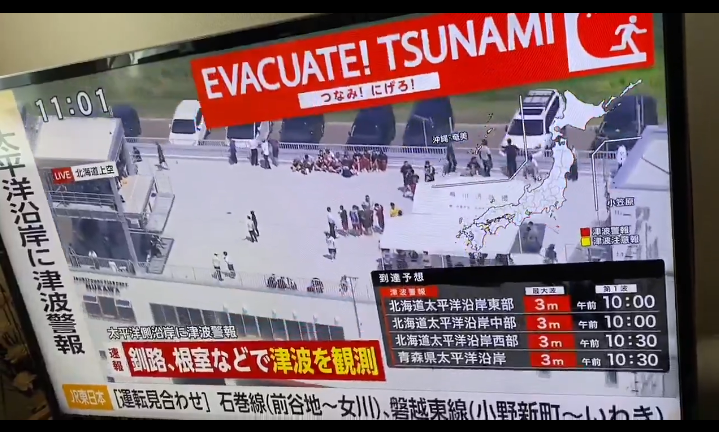
Washington/Tokyo/Manila: A magnitude 8.8 earthquake struck off Russia’s Kamchatka Peninsula today, triggering tsunami warnings across the Pacific, including Japan and Hawaii.
The megathrust quake on the Kuril–Kamchatka subduction zone, located in far eastern Russia, between the Sea of Okhotsk on the west and the Pacific Ocean and the Bering Sea on the east, struck at 11:24:50 PETT (23:24:50 UTC, July 29, 2025/4:54 am IST, July 30, 2025 ), centred 119 kilometres east-southeast of Petropavlovsk-Kamchatsky at a 19.3-kilometre depth.
Initially reported as 8.7, the U.S. Geological Survey revised the magnitude, ranking it among the strongest quakes since the 2011 Tōhoku event (magnitude 9.0). The Klyuchevskoy volcano erupted after the quake, with lava flowing and ash spreading. Over 50 aftershocks, including a magnitude 6.9 event, occurred, with more up to 7.5 possible for a month based on Russian Geophysical Service estimates.
Tsunami waves reached 1.8 metres in Kahului, Maui, 1.2 metres in Oahu, and 3–4 metres in Russia’s Kuril Islands, flooding Severo-Kurilsk’s port and damaging a fish processing plant. Japan recorded 1.3-metre waves in Kuji, Iwate, and 30–40 cm in Hokkaido, with nearly 2 million evacuated. Hawaii’s warning was downgraded to an advisory by Wednesday evening, with no major damage but concerns for strong currents. Crescent City, California, recorded 1.1-metre waves, with advisories for Alaska, Chile, and Ecuador.
The Kamchatka quake damaged buildings, including a kindergarten, and caused minor injuries, with some hurt during evacuation. One death was reported in Japan when a 58-year-old woman’s car veered off a cliff during evacuation.
Japan’s Fukushima nuclear plant halted water discharge as a precaution, with no irregularities. Tsunami advisories may persist for weeks.
President Donald Trump of the United States posted on X, stating, “Due to a massive earthquake that occurred in the Pacific Ocean, a Tsunami Warning is in effect for those living in Hawaii. A Tsunami Watch is in effect for Alaska and the Pacific Coast of the United States. Japan is also in the way. Please visit https://tsunami.gov for the latest information. STAY STRONG AND STAY SAFE!”
The United States is intensifying support for the Philippines following devastating storms in November 2024, notably Super Typhoon Man-yi, which struck on November 16 and 17, 2024, and Typhoon Usagi, which hit on November 14, 2024. In a July 29, 2025, U.S. State Department briefing, spokesperson Tammy Bruce stated, “In the aftermath of the recent typhoon and tropical storm that have devastated the Philippines, the United States remains committed to supporting the Philippine Government in assessing the needs and providing critical assistance. The State Department is deploying a U.S.-based team to strengthen the local relief efforts, including supporting food distribution efforts for displaced families and coordinating logistics for relief efforts led by the Government of the Philippines. To date, we have helped transport tens of thousands of food packs to the hardest hit communities, ensuring vital resources reach those in need. This collaboration underscores the enduring partnership and strong ties between the United States and the Philippines.”
Super Typhoon Man-yi, locally named Pepito, made landfall in Panganiban, Catanduanes, on November 16, 2024, and in Dipaculao, Aurora, on November 17, 2024, marking the sixth consecutive cyclone in a month. The storm affected over 1.1 million people, with 719,000 evacuated. It caused seven deaths in a Nueva Vizcaya landslide and damaged homes in Catanduanes. Typhoon Usagi, striking Cagayan on November 14, 2024, displaced over 82,500 people. The U.S. Agency for International Development provided $1 million on November 19, 2024, for shelter, water, and sanitation, with C-130 aircraft and MV-22 Ospreys delivering aid by July 29, 2025.
Since 2010, the U.S. has contributed $390 million for Philippine disaster relief, including $7 million in 2024. The Philippine Department of Social Welfare and Development, with U.S.-funded UN World Food Programme support, delivered 150,000 food packs to Bicol and Batangas. The 2024 season’s six cyclones affected 10 million, displaced 617,000, and caused 160 deaths before Man-yi, driven by climate-amplified warmer seas. The Philippines, on the Pacific Ring of Fire, draws on Typhoon Haiyan lessons from 2013, which killed over 7,000.
U.S. aid and regional preparedness will likely shape recovery in the Philippines and tsunami response across the Pacific as per a projection based on USAID commitments.
– global bihari bureau