Photo source: IOM
Sudan Returnees Face Mines, Hunger, Hope
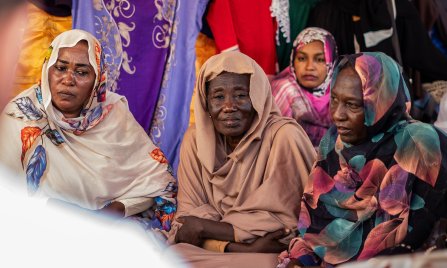
Geneva: As conflict rages on across parts of Sudan, pockets of relative safety have emerged in the past four months, spurring more than one million internally displaced Sudanese to make their way home, according to the International Organization for Migration (IOM). A further 320,000 cross-border refugees have come back to Sudan since last year, mainly from Egypt and South Sudan, to assess the current situation before deciding to return to their country for good. The returnees face a daunting landscape shaped by over two years of brutal warfare, with destroyed homes and shattered communities awaiting their arrival, yet hope persists amid the ruins.
“The majority of returns have been to Al-Jazirah, almost 71 per cent; and then 13 per cent to Sennar and, so far, 8 per cent to Khartoum,” said Othman Belbeisi, IOM Regional Director, speaking from Port Sudan, his voice carrying the weight of the crisis. Most of the Internally Displaced People, or IDPs, are from Sudan’s capital, Khartoum. “We expect about 2.1 million to return to Khartoum by the end of this year, but this will depend on many factors, especially the security situation and the ability to restore services in a timely manner,” Mr. Belbeisi explained, underscoring the fragile balance between hope and uncertainty. Since the current conflict began in April 2023, more than 12 million people – the equivalent of the entire population of Chile, or of Russia’s capital Moscow – have been forcibly displaced, making it the largest displacement crisis in the world. Almost five million people have sought refuge in neighbouring countries, fleeing the relentless violence that has torn the nation apart.
Sudan’s military took control of the Greater Khartoum region, including the capital, in May of this year, after a long-running battle against the Rapid Support Forces in the western and southern areas. The brutal conflict has pushed parts of the country into famine, leaving fields fallow and markets empty as hunger stalks the land. Sudanese are now returning to areas that are accessible, but the impact of more than two years of violent conflict is immense, with every step home revealing the scars of war etched into the earth and the people.
During a recent visit by UN representatives to Khartoum, an old man approached them to stress that their needs are simple. “Food, water, healthcare– and education, since this is the future of our children and we really need to invest in this future,” the old man insisted, according to the IOM Regional Director, his plea echoing the desperation of a community clinging to survival. Efforts are underway to support returnees in their choice to go back. It is a race against time to clear the rubble, provide essential services like clean water, power, and boost the capacities of health facilities to prevent the spread of deadly diseases such as cholera, which has already claimed lives in overcrowded camps.
“There are about 1’700 wells that need to be rehabilitated, and they need power and solarisation here is a great solution,” explained Luca Renda, Sudan Resident Representative for the United Nations Development Programme (UNDP), offering a glimmer of hope amid the devastation. The United Nations Development Programme aims at developing long-term solutions for war-displaced people to secure livelihoods and basic services, a mission that feels both urgent and monumental. “There are at least six hospitals that require urgent rehabilitation and repair and a number of primary health centers,” he continued, painting a picture of a healthcare system on the brink. Transport and cash for food, hygiene kits, medicines and clothes are also distributed to vulnerable people arriving in border areas, providing a lifeline to those most in need.
Mine clearance is another urgent challenge facing the capital, Khartoum if rehabilitation and reconstruction are to begin. “There are hundreds of thousands, if not more, of unexploded ordnance in the city”, said Mr. Renda. “The local Mine Action Authority, with the support of the UN Mine Action Service (UNMAS), started the decontamination. Even in our own office, we found literally hundreds of unexploded ordnances (UXO),” he stressed, revealing the hidden dangers lurking beneath the city’s surface. It will take years to fully decontaminate the city from this deadly debris of war. UNDP estimates that the United Nations Mine Action Service (UNMAS) will need at least USD 10 million to be able to deploy the required number of demining teams to work in partnership with the national authorities and inform the population about the risks of unexploded ordnance, a daunting financial hurdle in a country already stretched thin.
As of 21 July 2025, aid agencies, including the UN, have only received 23 per cent of the USD 4.2 billion required to deliver life-saving aid to the nearly 21 million vulnerable people inside Sudan, leaving a gaping hole in the humanitarian response. Despite the recent returns, hundreds of people daily continue to flee — both within Sudan and across its borders — due to the ongoing conflict. This is especially true in the Darfur and Kordofan regions, according to the UN refugee agency (UNHCR), where violence shows no sign of abating. “In the Darfurs, they keep producing refugees, over 800,000” since the beginning of the conflict, said Mamadou Dian Balde, UNHCR Regional Refugee Coordinator for the Sudan Crisis, his words a stark reminder of the unending exodus. According to the UN refugee agency, USD 1.8 billion is needed to support 4.8 million people who have fled Sudan to neighbouring countries, but only 17 per cent of that money has been made available. “People who are refugees still need greater support from our side,” Mr. Balde said. “And overall, we need peace, we need peace, we need peace, so that this brutal conflict ends,” he concluded, his repeated plea a desperate cry for an end to the suffering that has gripped Sudan for far too long.
It may be noted that Sudan remains home to 10 million internally displaced people, including 7.7 million forced from their homes by the current conflict. It also still hosts around 882,000 refugees and asylum seekers, primarily from South Sudan, Ethiopia, and Eritrea.
– global bihari bureau