Bengaluru: Scientists in Bengaluru have developed a groundbreaking material that can detect harmful chemicals, including explosives like TNT and RDX, even at trace levels as low as a billionth of a mole (nanomolar concentrations). This innovation, created by researchers at the city-based Centre for Nano and Soft Matter Sciences (CeNS), an autonomous institute under the Department of Science and Technology, could transform safety protocols at airports and enhance environmental pollution monitoring with exceptional precision.
The material is a sophisticated composite of reduced graphene oxide (rGO) (a carbon-based material), silver nanoparticles (Ag) (tiny silver particles), and cerium oxide (CeO₂) (a protective metal oxide), all layered on a glass substrate (base) using physical vapour deposition (a coating technique). This method ensures a uniform and scalable sensing platform (a consistent and expandable detection system).
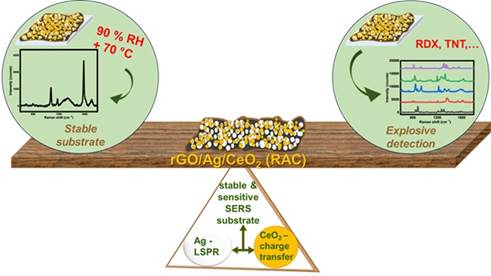
Each component serves a critical function. Silver nanoparticles excel at amplifying Raman signals (chemical fingerprints) through surface-enhanced Raman spectroscopy (SERS) (a technique that boosts molecular identification), enabling precise detection at extremely low concentrations. However, silver is prone to oxidation (degradation) in humid or warm conditions, reducing its effectiveness over time. The cerium oxide layer provides two key benefits: it enhances charge transfer (electron movement) between the material and the analyte (substance being tested), amplifying the Raman signal (chemical fingerprint), and acts as a protective barrier, shielding silver from humidity and temperature-induced degradation (breakdown), ensuring long-term stability. The reduced graphene oxide layer quenches (suppresses) the overwhelming fluorescence (unwanted light emission) from silver nanoparticles, which could otherwise obscure the distinct Raman fingerprints (chemical signatures), ensuring clear and accurate detection.
Environmental chamber tests (controlled condition experiments) demonstrated the material’s stability under extreme conditions—90% humidity and 70°C—proving its reliability. The material achieved a detection limit of 10 nanomolar (a billionth of a mole) for 4-mercaptobenzoic acid (MBA) (a test chemical) and successfully identified explosives like TNT and RDX at similar trace levels, showcasing its versatility for trace-level contaminant detection (spotting tiny amounts of harmful substances).
Unlike traditional materials relying on costly gold or less stable silver, this composite overcomes commercial barriers with its cost-effectiveness and durability. Its simple fabrication process (manufacturing method), exceptional sensitivity, and robust performance make it ideal for real-world applications, such as screening luggage for explosives at airports or monitoring water and air for pollutants. By leveraging the synergistic interplay (combined effect) of silver-based plasmonic enhancement (signal amplification) and cerium oxide-mediated charge transfer (electron movement), this advanced SERS substrate (detection platform) offers a reliable and sensitive solution, potentially saving lives and protecting the environment from hazardous substances.
– global bihari bureau