 By Vivekanand Jha*
Has Sindoor’s fallout dimmed India’s strategic vision?
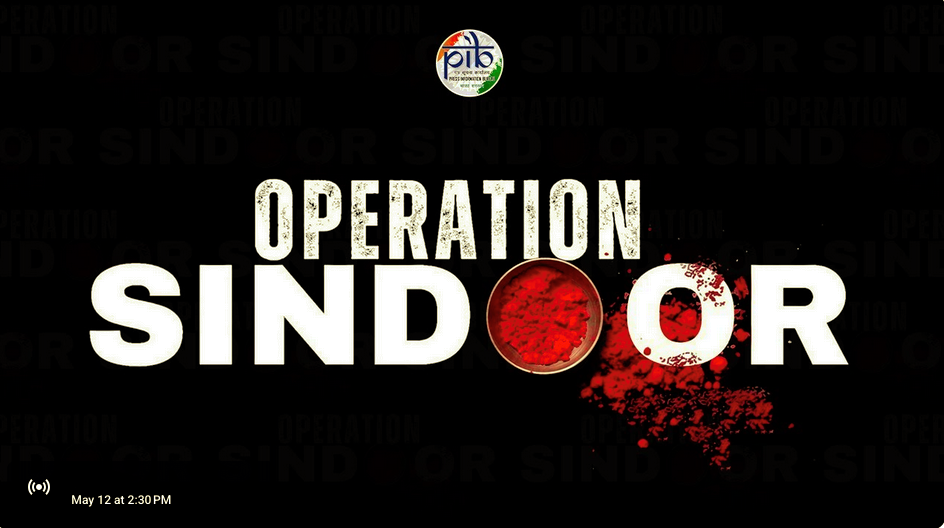
Operation Sindoor, India’s military strikes into Pakistan targeting terrorist strongholds, has rekindled the India-Pakistan rivalry, undoing former Prime Minister Atal Behari Vajpayee’s vision of aligning India with China as a strategic priority, leaving the nation isolated, its long-term interests sacrificed for short-term political gains, and Pakistan emboldened with stronger alliances and arsenals.
Vajpayee, a Bharatiya Janata Party (BJP) stalwart and Prime Minister from 1998 to 2004 (with a brief term in 1996), was known for his diplomatic finesse, seeking to de-hyphenate India’s fixation with Pakistan through initiatives like his 1998 letter to U.S. President Bill Clinton post-Pokhran nuclear tests.
Narendra Modi, also a BJP leader and Prime Minister since 2014, has pursued a muscular security policy, with Operation Sindoor exemplifying this shift through precision strikes on terrorist hideouts and Pakistani airfields, including Noor Khan Airbase, to counter cross-border terrorism, a scourge highlighted by the 2008 Mumbai attacks, where India’s response was limited to diplomatic protests and candlelight marches.
Vajpayee’s approach during the 2001 Parliament attack by Jaish-e-Mohammad contrasted sharply with Modi’s. The attack prompted a massive military mobilisation along the Pakistan border, costing an estimated five hundred crores daily, yet Vajpayee refrained from crossing into Pakistan, wary of escalation and historical judgment. In a press interaction, he stated, “I am not only concerned about the present but also about how history would dub my action,” reflecting his focus on India’s long-term global image. This restraint, though criticised for indecision and financial strain, aimed to elevate India beyond its regional rivalry, prioritising strategic alignment with China as a counterweight. His 1998 letter to Clinton, written after nuclear tests triggered U.S. sanctions, subtly positioned China as India’s primary threat without naming it, unsettling Beijing, which saw India as inferior and preferred hyphenation with the U.S. Vajpayee’s advisor, Sudheendra Kulkarni, noted that the Prime Minister formed a committee to address the India-China boundary dispute, involving key stakeholders to explore resolutions, a move that underscored his commitment to long-term strategic clarity.
Operation Sindoor, launched under Modi, marked a departure, embracing confrontation. The strikes targeted terrorist dens and Pakistani military infrastructure, signalling a new policy of pursuing adversaries into their strongholds. The operation’s slogan, “Ghar mein ghus ke mara” (entering the enemy’s home to strike), became a domestic rallying cry, projecting strength and decisiveness. However, its strategic impact is questionable. While it neutralised several terrorists, it has not demonstrably deterred Pakistan’s state-sponsored terrorism, which remains integral to Islamabad’s policy.
The operation’s politicisation by the opposition, amplified by Modi’s rhetoric—often invoking his “56-inch chest”—has reduced a military action to a tool for electoral gain, contrasting with Vajpayee’s restraint in avoiding military posturing for political mileage. This public amplification, coupled with media-driven comparisons to historical figures like Chandragupta Maurya, has fueled a war-mongering narrative, sidelining India’s civilizational ethos of “Buddh, Not Yuddh” (peace, not war), which Vajpayee championed.
Today, Operation Sindoor, India’s resolute resolve to chase its enemy to the den of his hiding, into their own bastions, is the new normal that the Narendra Modi government has daringly been showcasing as its instrument of state policy. Indeed, this is a new sign and symbol of male machismo, which was conspicuous by its absence, unless the Modi Government took over in the year 2014. Insuperably, Modi’s invention, or rather, innovation, of the doctrine of ‘ghar mein ghus ke mara‘, appears to romanticise India’s valour, especially when India, since ages – Mumbai terrorists attack in 2008 was the blatant instance of the typical India’s timorous response of taking the candle light march when terrorists had unleashed genocide – the chasing of terrorists back to their dens in their own country, Pakistan, provided a new relief to the nation of 1.40 billion people.
Thus, Operation Sindoor appears to be a new dawn in the history of the nation, which has been the target of cross-border terrorism for decades. But then, the moot question which arises is whether India, by its actions in Operation Sindoor, achieved its objective of injecting dread in the hearts and minds of terrorists whose very raison d’être and summum bonum are to attack and bleed India perpetually? India might have killed several terrorists in the process. But the question that begs an answer is whether New Delhi succeeded in institutionalising the deterrent or an antidote to terrorists unleashing tandav on us, especially when India has been losing its diplomatic heft in its immediate neighbourhood.
The Prime Minister’s visits to foreign countries to bolster ties with them, even as the media sing panegyrics on the PM factor, contributing to India’s diplomatic triumphs, the ground reality seems to be different. The diplomatic fallout of Operation Sindoor reveals its steep costs. India’s neighbourhood policy, a priority under Modi, has faltered. Even Nepal, the only Hindu majority nation besides India, is today aligned with China.
This beggars a belief that everything is hunky dory in India’s foreign policy. At the Shanghai Cooperation Organisation (SCO), the Baloch freedom struggle was labelled terrorism, while the Pahalgam incident—a brutal attack on Hindus in Jammu and Kashmir—went unaddressed, despite India’s refusal to sign the joint declaration. This reflects a failure to secure international support, despite Modi’s extensive foreign visits and media narratives celebrating India’s diplomatic triumphs. India’s parliamentary delegations to global forums, too, seem to have yielded little traction, with the global community’s indifference to Pahalgam contrasting with Pakistan’s success in framing Baloch resistance as terrorism, highlighting India’s loss in the narrative war.
Pakistan has capitalised on Operation Sindoor, acquiring advanced ballistic missiles to bolster its military capabilities, a direct response to India’s strikes. Its alliances with China and Türkiye, strengthened post-operation, contrast with India’s near-solitary support from Israel, limited to verbal assurances. The operation’s aggressive posture risks escalating tensions with a nuclear-armed Pakistan, backed by major powers like China and, to an extent, the U.S., which has historically supported Islamabad. The prospect of repeated cross-border strikes, while domestically popular, raises sustainability concerns, given Pakistan’s nuclear capabilities and unabated terrorism sponsorship. The domestic frenzy, invoking historical valour, has further entrenched a narrative that prioritises short-term bravado over strategic restraint, undermining India’s global standing.
Vajpayee’s 1998 letter to Clinton was a diplomatic masterstroke, setting the cat among the pigeons in Beijing by reframing India’s strategic priorities. His boundary dispute committee, as recounted by Kulkarni, involved detailed discussions with experts to address India-China tensions, reflecting a proactive approach. Operation Sindoor, however, has reversed this de-hyphenation, re-entangling India with Pakistan to China’s advantage, as Beijing strengthens its partnership with Islamabad. The operation’s domestic hype has overshadowed its strategic costs: diminished diplomatic clout, a resurgent India-Pakistan hyphenation, and a strengthened China-Pakistan axis. India’s failure to highlight atrocities like Pahalgam globally, coupled with Pakistan’s narrative of victimhood, underscores a lost narrative war.
Of course, Pakistan needed to be taught a lesson in the aftermath of the Pahalgam terror attack. India under Modi taught it a lesson. The operation hasn’t been called off yet officially. However, revisiting Operation Sindoor reveals its enduring consequences. India’s isolation, Pakistan’s military advancements, and the erosion of Vajpayee’s strategic vision highlight the operation’s failure to secure lasting deterrence or regional influence. The operation’s legacy, marked by domestic hype and diplomatic setbacks, underscores the perils of prioritising short-term political gains over enduring global influence. As Pakistan bolsters its arsenal and alliances, India faces a complex geopolitical landscape without the strategic clarity Vajpayee once pursued, leaving the nation to grapple with the unintended re-hyphenation of its rivalry with Pakistan.
Pakistan, whose state policy is to sponsor terrorism, could seldom resist exporting terrorists to India. And if it does so in the future, which it is most likely to do, will India continue to attack the terrorists’ dens in Pakistan, especially with hostile China as well as the USA, backing Pakistan to the hilt, and Pakistan being a rogue nuclear nation, is a million dollars question now? This is a matter of concern for India’s strategic interests. Yet, on a positive note, India did manage to get Pahalgam included in the Quad foreign minister’s joint statement in Washington today, which stated: “The Quad unequivocally condemns all acts of terrorism and violent extremism in all its forms and manifestations, including cross-border terrorism, and renews our commitment to counterterrorism cooperation. We condemn in the strongest terms the terrorist attack in Pahalgam, Jammu and Kashmir on April 22, 2025, which claimed the lives of 25 Indian nationals and one Nepali citizen, while injuring several others. We express our deepest condolences to the families of the victims and extend our heartfelt wishes for a swift and full recovery to all those injured. We call for the perpetrators, organizers, and financiers of this reprehensible act to be brought to justice without any delay and urge all UN Member States, in accordance with their obligations under international law and relevant UNSCRs, to cooperate actively with all relevant authorities in this regard.”
*Author, Academician and a Public Intellectual. The published article is his personal viewpoint.