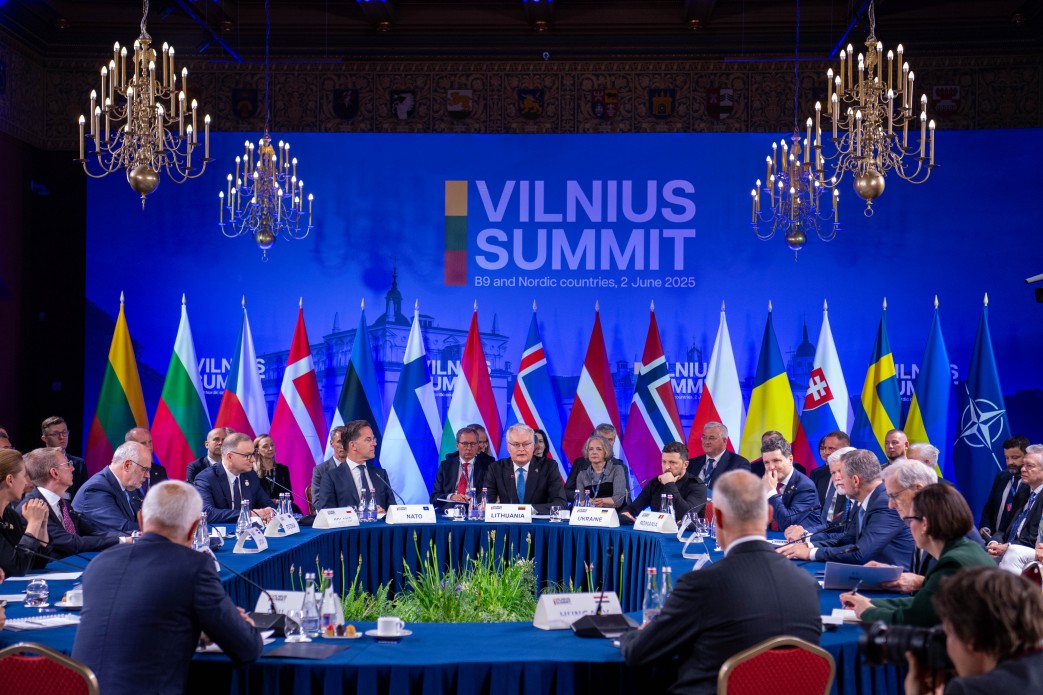
Participation of the President of Ukraine in the Summit With the Bucharest Nine and the Nordic Countries in Vilnius
Moscow/Kyiv: In the early hours of 1-2 June 2025, Russia launched its most extensive air assault of the conflict with Ukraine, deploying several hundred drones and multiple missiles across various Ukrainian regions, including Dnipropetrovsk, Kyiv, and Kharkiv, according to Ukraine’s Air Force. This formidable attack was a direct retaliation for Ukraine’s strategic drone strikes on Russian air bases, which exposed critical vulnerabilities in Russia’s military infrastructure. The assault struck a military training facility in Dnipropetrovsk, resulting in the deaths of at least twelve Ukrainian service members and injuries to over sixty others, as confirmed by Ukraine’s General Staff. The severity of the attack led Major General Mykhailo Drapatyi, commander of the affected unit, to resign, highlighting the profound impact on Ukraine’s military leadership.
Ukraine’s operation, codenamed “Web” by the Security Service of Ukraine, targeted Russian air bases in Murmansk and Irkutsk on June 1, 2025, destroying numerous strategic aircraft, including Tupolev-95 and Tupolev-22M3 bombers, with estimated damages in the billions of pounds, according to the Security Service of Ukraine. Planned over eighteen months, the operation utilised over one hundred drones launched from sites near the airfields to maximise precision and impact, as detailed by Ukrainian military sources. The Institute for the Study of War noted that the strikes, targeting facilities over four thousand three hundred kilometres from Ukraine, underscored significant gaps in Russia’s air defence systems. Russia’s Ministry of Defence acknowledged fires at the Murmansk and Irkutsk airfields but claimed other attacks were repelled with minimal losses, a statement lacking independent corroboration. In his address at the Summit with the Bucharest Nine and Nordic Countries in Vilnius on 2 June 2025, President Volodymyr Zelenskyy described the operation as a demonstration of Ukraine’s superior tactical solutions, emphasising that inflicting losses on Russia is essential to compel Moscow towards meaningful diplomacy.
The Russian counterattack placed immense pressure on Ukraine’s air defence systems, with many drones intercepted, though precise figures remain unconfirmed due to the operation’s complexity. The strikes further devastated Ukraine’s energy infrastructure, exacerbating the impact of prior attacks and severely disrupting civilian life. In Vilnius, Zelenskyy highlighted Russia’s ongoing summer offensive, noting it as both a challenge and an opportunity for diplomacy to end the war. He expressed gratitude for international support packages and investments in weapons production, both in Ukraine and partner countries, asserting that Europe and the United States possess superior weaponry compared to Russia. Zelenskyy stressed that Ukraine’s ability to hold the line against Russia protects not only itself but all of Europe. He urged increased weapons production, particularly drones, stating that Ukraine could meet forty per cent of its weapons requirements through domestic manufacturing with consistent financial support from international partners. He also made an urgent appeal for advanced air defence systems, specifically Patriot systems and their missiles, to counter Russia’s intensified aerial campaigns.
Zelenskyy raised concerns about Russia potentially planning attacks from Belarus, calling for enhanced intelligence cooperation among allies to assess and counter this threat. He emphasised that making Russia feel the weight of its losses is critical to pushing Moscow towards diplomacy, a point he reiterated in the context of Ukraine’s defensive efforts. The Russian offensive coincided with peace negotiations in Istanbul on June 2, 2025, mediated by Turkey, where Ukraine, represented by Defence Minister Rustem Umerov, advocated for an immediate ceasefire, the release of prisoners, and the return of abducted children. Russia, led by diplomat Vladimir Medinsky, demanded territorial concessions and restrictions on Ukraine’s military capabilities, terms Ukraine rejected outright, according to official Ukrainian statements. The talks achieved a significant prisoner exchange, with one thousand combatants swapped between the two sides, marking a tangible step forward despite the absence of a ceasefire agreement. Zelenskyy warned in Vilnius that diplomacy must not be empty, and if Russia undermines these initial steps, robust international sanctions are urgently needed, targeting Russia’s energy sector, particularly oil exports, tankers, and price caps, and its financial institutions. He specifically called for the European Union’s eighteenth sanctions package and stronger measures from the United States, as promised by President Donald Trump.
Ukraine’s incursion into Russia’s Kursk region, launched on August 6, 2024, continues to influence the conflict’s strategic dynamics. At its peak, Ukraine controlled significant territory, forcing Russia to redeploy thousands of troops, disrupting its broader military operations, as reported by the Institute for the Study of War. Russia responded with intensified offensives in Ukraine’s Donetsk region, achieving notable territorial gains in May 2025. The conflict’s human toll is immense, with Western intelligence estimates indicating Russian casualties in the hundreds of thousands since February 2022, though exact figures remain sensitive. Ukrainian losses are also significant but undisclosed by official sources. Ukraine’s defence relies heavily on Western assistance, particularly from the United States, while Russia’s increased military expenditure strains its economic resources, according to analytical reports.
Both nations are prioritising advancements in drone warfare, with Ukraine significantly expanding its domestic production and Russia planning thousands of Shahed drones by September 2025, as noted by the Institute for the Study of War. In Vilnius, Zelenskyy underscored the importance of maintaining a strong Euro-Atlantic alliance, particularly ahead of the NATO Summit in June 2025, to counter Russian aggression. He insisted that Russia must not have veto power over NATO decisions or influence over the Alliance and its members, emphasising that Euro-Atlantic security is the responsibility of Euro-Atlantic nations. He thanked leaders for their efforts to maintain strong ties with the United States, urging continued support from President Trump, Congress, and the American people to uphold this bond. Zelenskyy also expressed his intent to discuss security guarantees and the Coalition of the Willing in private sessions, aiming to strengthen this framework. As military escalation overshadows diplomatic efforts, Zelenskyy’s Vilnius address highlighted the critical need for unified international support to protect Ukraine and prevent further regional destabilisation, with civilians bearing the conflict’s heaviest burden.
– global bihari bureau