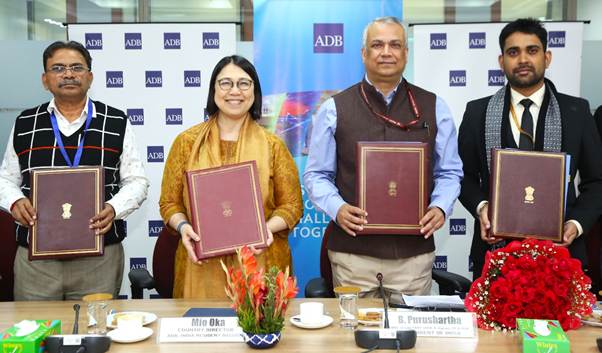
The GoI-ADB team after signing the $109.97 million loan for the Gujarat Skills Development Programme.
$800M ADB Package for Maharashtra, Madhya Pradesh, Gujarat
New Loans for Farmers’ Solar, Indore Metro
New Delhi: The Government of India and the Asian Development Bank (ADB) have signed agreements for three loans totalling more than $800 million to support infrastructure, urban transport, and skills development projects in Maharashtra, Madhya Pradesh, and Gujarat, along with a $1 million Technical Assistance (TA) grant for an environmental initiative in Assam.
The agreements were signed by Saurabh Singh, Deputy Secretary in the Department of Economic Affairs, Ministry of Finance, on behalf of the Government of India, and Mio Oka, Country Director of ADB’s India Resident Mission, on behalf of the multilateral lender, on November 28, 2025, the Finance Ministry stated today. The process was overseen by the Joint Secretary (ADB and Japan) in the Department of Economic Affairs.
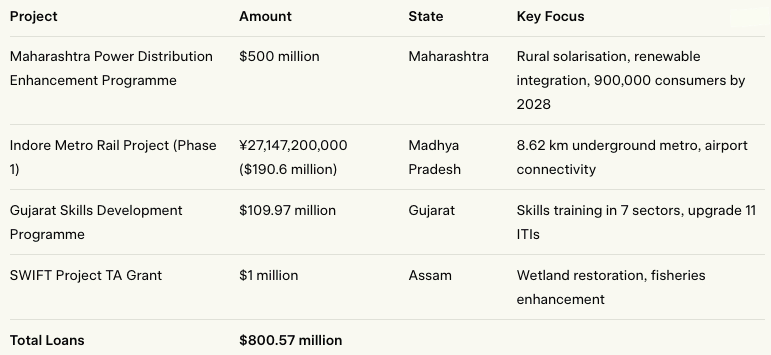
The largest tranche, a $500 million loan for the Maharashtra Power Distribution Enhancement Programme for Agricultural Solarisation, targets the modernisation of rural electricity networks to integrate renewables and ensure reliable daytime solar power for irrigation. By 2028, it aims to reach at least 900,000 agricultural consumers through upgrades to substations, installation of transformers and high- and low-tension lines, and deployment of 500 megawatt-hours of battery storage.
A Japanese Yen-denominated loan of ¥27,147,200,000 (equivalent to $190.6 million) will fund Phase 1 of the Indore Metro Rail Project in Madhya Pradesh, constructing an 8.62-kilometre underground line with seven stations to link congested city areas to the airport. The project, to be implemented by the Madhya Pradesh Metro Rail Corporation Limited, includes multimodal integration with buses and feeder services for better access to schools and markets, with operations slated to begin by January 2030.
In Gujarat, a $109.97 million loan under the Gujarat Skills Development Programme seeks to align workforce training with demands in high-growth sectors such as logistics, automotive, manufacturing, information technology, renewable energy, healthcare, and agri-technology. Led by the state’s Labour, Skill Development and Employment Department in partnership with Kaushalya: The Skill University (KSU), it will upgrade 11 mega Industrial Training Institutes (ITIs) into centres of excellence via a hub-and-spoke model involving private providers.
Additionally, the $1 million TA grant will offer implementation support for the forthcoming Sustainable Wetland and Integrated Fisheries Transformation (SWIFT) Project in Assam, focused on restoring wetland ecosystems and boosting fisheries productivity.
Loan and grant details (signed on November 28, 2025):
These agreements represent a routine infusion of multilateral financing into India’s development pipeline, with ADB’s involvement underscoring the country’s continued access to concessional loans amid domestic fiscal pressures. The $800 million-plus package—spread thinly across power, transport, skills, and ecology—addresses immediate sectoral gaps but reveals a scattershot approach: Maharashtra’s solar push, while ambitious in reach, hinges on execution in a state where rural distribution losses still exceed 20 % in many circles; Indore’s metro extension, at roughly $22 million per kilometre, aligns with urban rail costs elsewhere in India but carries the same risks of multi-year delays that have plagued every underground metro project in the country.
Gujarat’s skills programme, targeting “industry-aligned” training, sounds progressive on paper, yet similar past initiatives have consistently delivered placement rates below 50 % because curricula remain disconnected from actual employer needs—there is little evidence the new hub-and-spoke arrangement with KSU will break that pattern without far stronger private-sector control over course content and certification.
The Assam grant, at a token $1 million, is explicitly preparatory rather than substantive: it will fund studies and workshops ahead of a much larger loan expected in a few years, while wetland shrinkage continues unchecked in the interim.
Overall, the deals advance the government’s infrastructure agenda under the ₹111 lakh crore National Infrastructure Pipeline, but their impact will turn almost entirely on state-level delivery rather than on the signing ceremony itself. With ADB’s active India portfolio already topping $15 billion, this tranche adds useful capital yet remains marginal against the scale of the challenges—urban congestion, rural power theft, youth skilling mismatches, and ecological degradation—all of which have resisted decades of similar funding injections. Private investment and genuine execution reform, not another round of loans, are what would actually move the needle.
– global bihari bureau