AI generated image.
Jamaica Rising: Rebuilding After the Hurricane
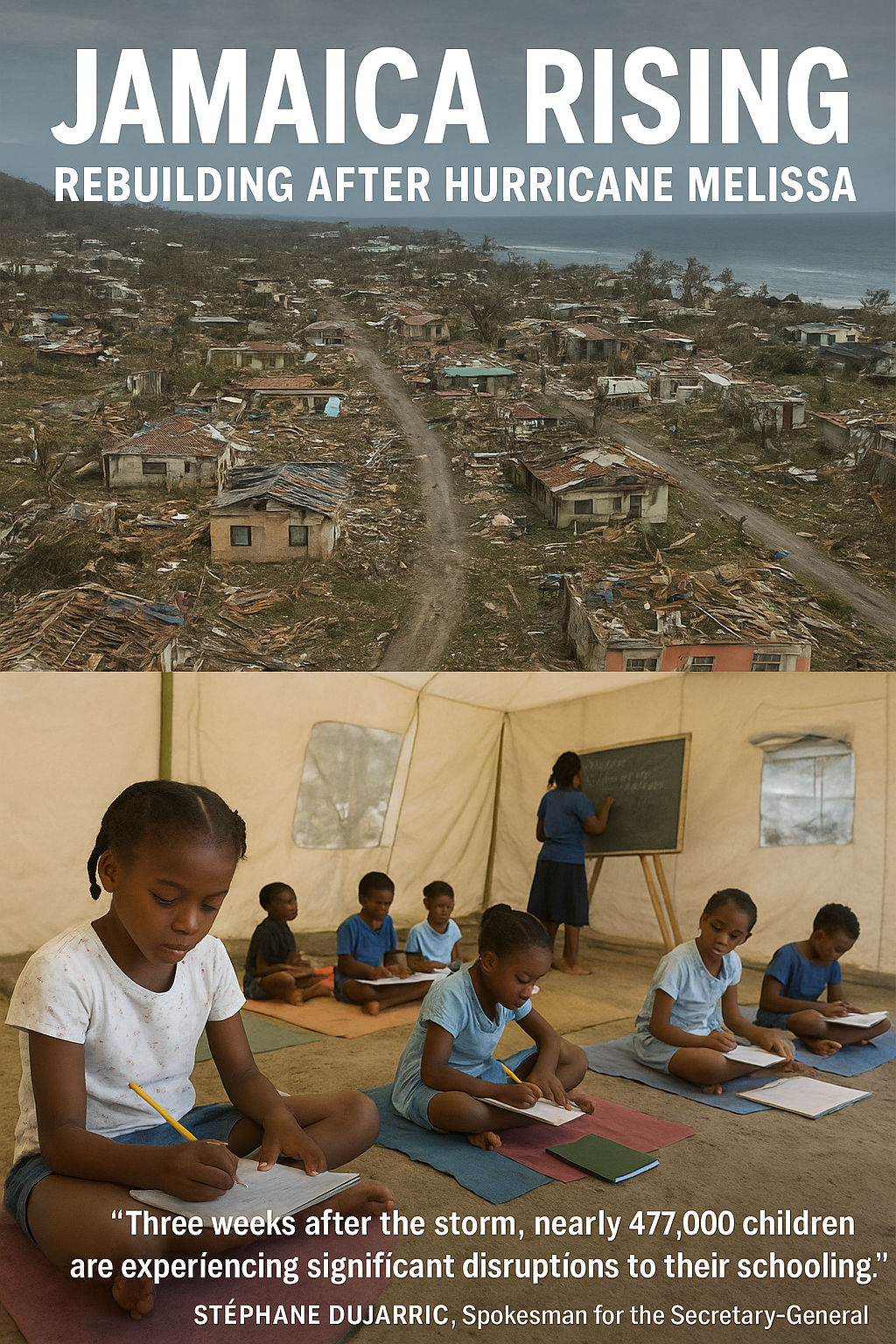
Kingston: Three weeks after Hurricane Melissa tore through western Jamaica as a Category 5 storm, the scale of the devastation is becoming painfully clear. Nearly 1.5 million people were affected, at least 32 lives were lost, and more than 100,000 homes were damaged or destroyed. Economic losses are estimated at roughly 30 per cent of Jamaica’s GDP, and five million tonnes of debris—nearly 500,000 truckloads—still block roads, isolate communities, and delay the restoration of basic services. Schools remain shuttered or damaged, leaving children adrift in temporary learning spaces. “Three weeks after the storm hit the Caribbean, nearly 477,000 children are experiencing significant disruptions to their schooling,” UN Spokesman Stéphane Dujarric said in a briefing, highlighting the cascading impact on education across Jamaica, Haiti, and Cuba.
International support has been swift and substantial. The U.S. deployed a Disaster Assistance Response Team to Jamaica on October 29, with urban search and rescue teams from Fairfax County, Virginia, and Los Angeles County, California, assisting with debris clearance and search operations. Senior official Jeremy Lewin met with Prime Minister Andrew Holness to coordinate efforts. According to a U.S. Department of State fact sheet, “The United States continues to stand by the people of Cuba, Haiti, Jamaica, and The Bahamas as they recover from the devastation caused by Hurricane Melissa.” Nearly $37 million in aid has been mobilised, including the airlifting of 530,000 pounds of food, water, and shelter supplies, and the delivery of 12,000 tarps, 12,000 shelter kits, and hygiene packages for 12,000 families. Relief has been extended to other affected countries, including funding to the Bahamas Red Cross for water, sanitation, and shelter support, as well as assistance to Caritas in Cuba.
In Jamaica, the government claimed it is moving rapidly from emergency response to climate-resilient reconstruction. Drone and satellite surveys have assessed over 428,000 buildings, identifying approximately 116,000 as severely or catastrophically damaged. Prefabricated and containerised housing options are being explored for fast deployment, alongside stricter building codes to enhance flood and wind resilience. Roads linking hospitals, water treatment plants, and emergency shelters are being prioritised for repair, while electricity and telecommunications systems are being reinforced with solar and battery storage. Health facilities damaged by Melissa are being renovated, supported by mobile hospitals providing surgical care, emergency services, and psychosocial support.
The financial challenge remains immense. The Jamaican government has requested $9.5 billion in external support to bridge the recovery gap, emphasising grants over commercial loans. This plea, presented at COP30, frames the rebuilding effort as both a moral and political imperative. The immediate payout from Jamaica’s World Bank catastrophe bond provided $150 million, yet even this substantial sum only scratches the surface of the recovery challenge.
Beyond numbers and logistics, the human toll is vivid. In the parish of Trelawny, residents wade through waist-high debris to salvage belongings. Makeshift classrooms hum with activity as children use donated school kits, blackboards, and crayons to reclaim their education. Teachers trained in psychosocial support work alongside UNICEF staff to help students process trauma while continuing lessons. The sense of determination is palpable: one mother in western Jamaica carried her youngest child through the flooded streets to reach a temporary learning centre, stating simply, “We will rebuild, even if it takes everything we have.”
Melissa’s aftermath is not just a national crisis; it is a test of global solidarity. The United States’ response demonstrates the significance of international partnerships, but the rebuilding effort also underscores the urgent need for climate finance that acknowledges the disproportionate vulnerability of small island states. Dujarric’s statement on the ongoing disruption to children’s lives and the U.S. Department of State’s commitment to sustained support reflect the intertwined humanitarian, political, and diplomatic dimensions of this crisis.
As Jamaica clears rubble, restores classrooms, and rebuilds homes, the country faces the dual challenge of immediate recovery and long-term resilience. Each repaired road, reopened school, and reconnected household is both a practical necessity and a symbol of determination. Hurricane Melissa may have left a trail of destruction, but the ongoing recovery is a testament to human resolve and the critical role of international cooperation. For a world increasingly at the mercy of climate extremes, Jamaica’s journey is both a warning and an example: resilience must be built not after the storm, but in anticipation of it, and global solidarity must match the scale of the disaster.
– global bihari bureau