 By Deepak Parvatiyar*
Ditwah, Senyar, Melissa: Lives in the Aftermath
Sequential Storms Expose Global Infrastructure Fragility
Extreme Weather Highlights Gaps in Resilience Planning
The last two months have offered a stark lesson in the interconnected fragility of our planet. Across the Indian Ocean rim, Southeast Asia, and the Caribbean, a chain of storms and deluges has battered communities, claiming lives, displacing millions, and leaving recovery as an uncertain horizon.
Ditwah to Melissa: The Cost of Endless Storms
Cyclone Ditwah, originating in the Indian Ocean, swept moisture-laden winds across southern India and Sri Lanka, triggering landslides, floods, and transport paralysis. Thailand endured monsoon-amplified deluges, while Indonesia faced repeated flooding and landslides from West Java to Central Sulawesi and Sumatra, culminating in localised disasters when Cyclone Senyar, only the second recorded cyclone in the Strait of Malacca, intensified rainfall in Aceh and North Sumatra on November 26.
Meanwhile, in the Caribbean, Hurricane Melissa, a Category 5 system making landfall in Jamaica on October 28, displaced tens of thousands and decimated staple crops. Verified tallies as of 30 November report roughly 510–520 deaths, 370 missing, and more than 5.2 million affected or displaced, translating abstract numbers into submerged villages, isolated families, schools repurposed as shelters, and livelihoods extinguished almost overnight. The storms have moved on, yet the aftermath persists, dense with human and infrastructural vulnerability.
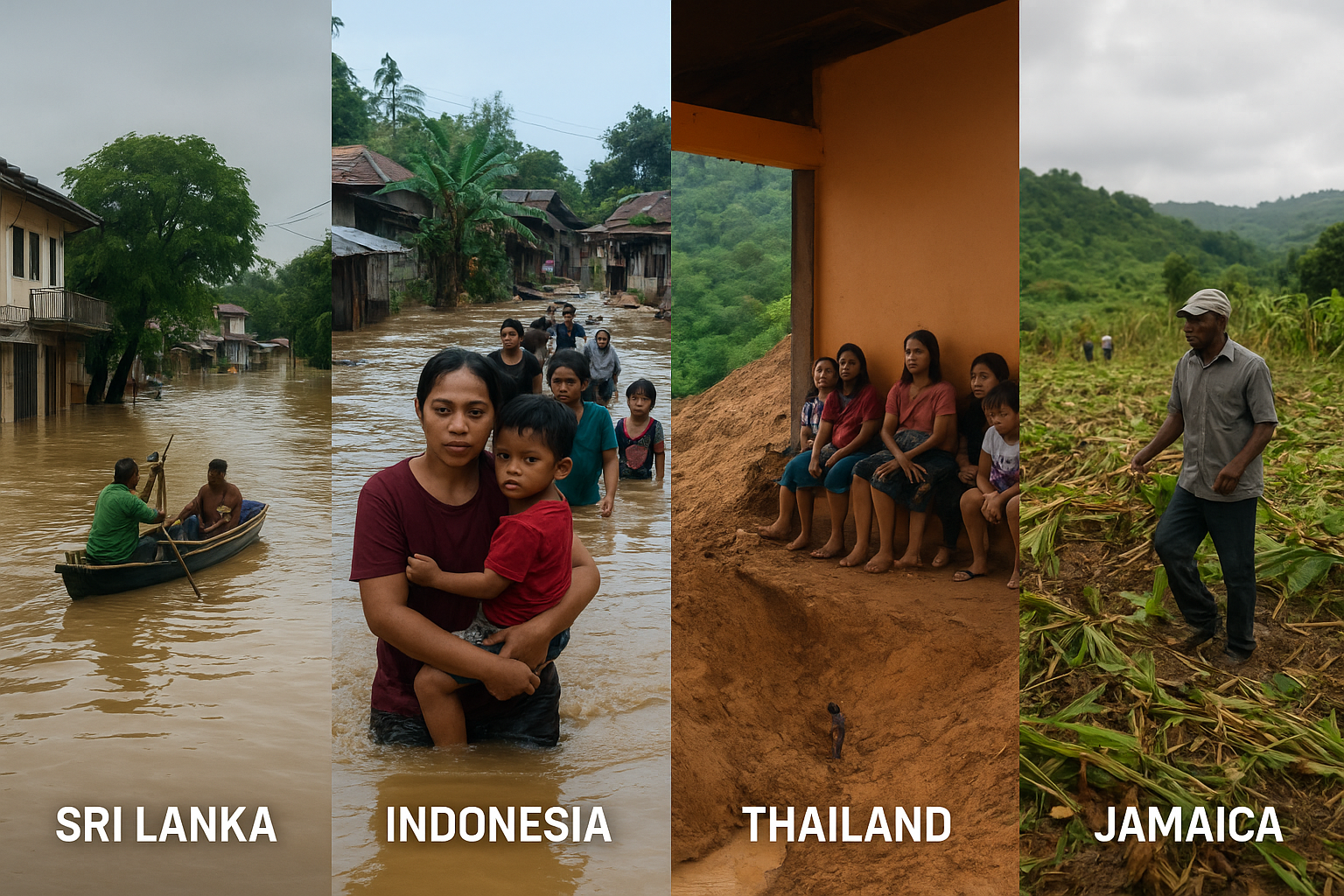
Sri Lanka presents the clearest portrait of this devastation. In districts like Ratnapura, Kalutara, and Deniyaya, fractured roads, collapsed bridges, and submerged neighbourhoods slowed relief delivery. Military and police units, nearly twenty thousand strong, navigated isolated areas by boat to deliver food, water, and medical aid, though coverage remained partial. Verified reports from the National Disaster Management Centre confirm 153–159 deaths and 176–191 missing, with approximately 3.2 million people affected across nine districts. Some 45,000 individuals remain in improvised shelters. Mothers queue for rations while children huddle beneath plastic sheeting. Pregnant women and infants face intermittent access to healthcare, and thousands of smallholder farmers confront total crop loss. Landslides—around 2,800 in number—block roads and endanger settlements. The disaster exposes the fragile intersection of hilly terrain, deforestation, and underdeveloped infrastructure, vulnerabilities mirrored elsewhere in South and Southeast Asia.
Southern India, spared the cyclone’s direct landfall, felt Ditwah’s reach through outer bands, causing evacuations of nearly forty-five thousand across Cuddalore, Nagapattinam, and Villupuram. Nine to eleven fatalities occurred, primarily through drowning or electrocution. Airports suspended over fifty flights, while fallen trees and power outages hindered transportation. National Disaster Response Force teams restored services in most affected areas, yet agriculture and salt pans suffered localised damage, illustrating that indirect exposure carries economic consequences.
Indonesia endured the cumulative effects of monsoon saturation, repeated flooding, and the late-November arrival of Cyclone Senyar. In West Java, Central Sulawesi, and Sumatra, saturated soils triggered flash floods and landslides, submerging thousands of homes, isolating villages, and devastating rice paddies. Official Badan Nasional Penanggulangan Bencana reports confirm 303 deaths, 79–100 missing, and approximately 900,000–1,000,000 affected, including 75,000 displaced. Relief teams, combining military units and local volunteers, struggled to reach areas with washed-out roads, while sanitation in over 3,000 shelters remained critical. More than 3,200 homes were submerged, with another 17,000 flooded. Families recount possessions, livestock, and crops swept away in pre-dawn waters, underscoring the scale and immediacy of disaster on human life and the economy.
Thailand, with northern and southern provinces like Songkhla, Hat Yai, Chiang Rai, Lamphun, and Tak, recorded 162 deaths, 30 missing, and over 3.8 million affected. Approximately 50,000 were evacuated to improvised shelters. Landslides and blocked roads hindered relief delivery, while medical facilities struggled to maintain services amid flooding. Verified data indicate the sequential impact of Ditwah’s residual moisture combined with heavy monsoon rainfall, saturating slopes weakened by deforestation and development, triggering landslides and harvest losses. Elderly residents remained isolated, and children spent prolonged periods in temporary shelters.
Hurricane Melissa in Jamaica made landfall on October 28, 2025, near New Hope as a Category 5 system, displacing roughly 80,000 people into 50 operational shelters. St. Elizabeth Parish, the agricultural hub, lost nearly 35 per cent of staple output. Reconstruction in rural parishes has progressed slowly, at roughly 20–30 per cent, while urban power grids have largely been restored. Verified interventions from the United States Agency for International Development and the United Nations World Food Programme have provided emergency assistance, yet long-term rebuilding, especially for smallholder farms, remains constrained by budgetary and logistical limitations. Jamaica’s experience underscores the acute vulnerability of island economies dependent on both subsistence and export-oriented agriculture to extreme weather.
Disasters Reveal Intersections of Poverty, Policy, and Climate
Across these regions, vulnerability is rarely determined by storm intensity alone. Socioeconomic factors—poverty, rural isolation, dependence on rain-fed agriculture, limited early-warning systems—interact with environmental fragility to magnify impact. Hilly terrain in Sri Lanka and Thailand contributes to landslide susceptibility, while Indonesia’s riverine settlements amplify flood risks. Jamaica’s reliance on high-value crops and historical land-use patterns intensifies economic shocks. Verified data confirm that children, women, smallholder farmers, and marginalised communities bear a disproportionate share of both physical and economic losses, even when mortality is avoided.
Human stories bring these numbers into focus. In Sri Lanka’s hills, children measure their futures against doorframes they may never reach due to stunting. In Indonesia, families salvage crops while wading through mud-laden rivers. In Jamaica, smallholder farmers recount post-harvest losses threatening months of labour and income. Thailand’s shelters, overflowing with evacuees, reveal the challenge of managing both immediate emergency and prolonged displacement. Across regions, displaced individuals face prolonged disease exposure, inconsistent nutrition, and interrupted schooling.
Verified interventions exist and demonstrate the potential to reduce future disaster risk. Community-managed hydrological restoration in Mizoram and Nagaland shows that landslides can be prevented, agriculture stabilised, and water supplies restored at low cost. Techniques such as contour trenches, percolation pits, replanting native species, and protecting recharge zones have revived over 65 per cent of treated springs during dry seasons. These methods can be adapted for Sri Lanka’s hilly districts, Indonesia’s flood-prone river basins, and southern India’s slopes, complementing centralised infrastructure investments.
Financial strategies validated by case studies include ring-fenced disaster funds, empowered block-level officers for coordination, zero-interest climate credit, and temporary moratoria on mining and high-risk construction. Jamaica illustrates the importance of integrating agricultural recovery with microfinance and technical assistance to accelerate recovery and reduce vulnerability. Verified evidence underscores that nutrition programs, vaccination campaigns, and mental health services in shelters buffer the human toll of displacement. Early-warning systems tailored to local languages and community networks prevent mortality and safeguard livelihoods, as evidenced by pre-emptive evacuations in southern India and Thailand.
Sequential Disasters Leave Millions Homeless and Struggling
The sequential nature of these disasters underscores a verified inference: climate hazards are increasingly interconnected, capable of compounding pre-existing social and infrastructural vulnerabilities. Verified data from the Indian Meteorological Department, Thailand Meteorological Department, BNPB Indonesia, Jamaica Meteorological Service, and UN agencies demonstrate that residual moisture from Ditwah, amplified by heavy equatorial rainfall, intensified monsoon rainfall in Southeast Asia, while Melissa’s impacts prolonged agricultural disruption and displacement in the Caribbean. Disaster preparedness, adaptation, and resilient governance must evolve faster than the hazards themselves.
Policy implications are immediate and compelling. Effective mitigation requires granular vulnerability mapping at block, district, and village levels; investment in proven low-cost interventions such as watershed restoration; early-warning and rapid-response mechanisms; equitable access to financial and material resources; and community engagement with clear responsibilities. Governments must prioritise both immediate humanitarian assistance and medium- to long-term resilience strategies. Coordination across agriculture, disaster management, health, and infrastructure ministries is essential, alongside transparent monitoring and accountability for fund utilisation. International aid and technical support should complement local initiatives, ensuring interventions are culturally appropriate, technically sound, and locally scaled.
Human-centric evidence reinforces urgency. Verified reports indicate that children in Sri Lanka’s hills experience stunting from prolonged food insecurity, Indonesia reports rising disease incidence in shelters, and Jamaica’s smallholder farmers confront sustained losses months after Melissa. Repeated patterns across regions underscore that effective disaster management is both technical and social, requiring investments targeting vulnerable populations alongside infrastructure.
Extreme Weather Highlights Gaps in Resilience Planning
The sequence of disasters also illuminates gaps between assessment and action. Damage assessments, early-warning alerts, and meteorological data exist, but funding bottlenecks, bureaucratic delays, and uneven community engagement limit implementation. Recovery depends not just on forecasts, but on political will, coordination, and sustained oversight. Verified statistics show that timely, targeted, and well-managed interventions can dramatically reduce mortality and economic loss, yet delays continue to cost lives and livelihoods.
As 2025 draws to a close, the lesson is evident and verified: storms may recede, but structural weaknesses, social inequities, and environmental degradation remain. Verified, low-cost, community-centred interventions exist and are replicable. The choice is clear: proactive, coordinated action informed by local knowledge and scientific assessment, or repeated cycles of loss, displacement, and human suffering. The aftermath has begun, and the next phase will determine whether communities recover only to face the next storm or whether actionable adaptation finally secures safety and stability for millions.