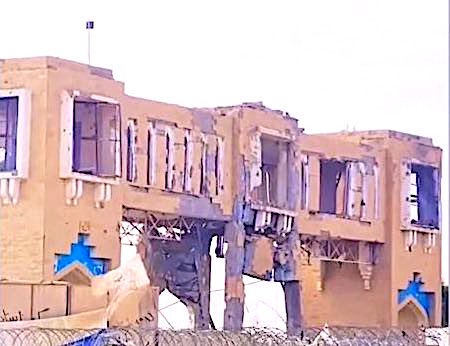
Durand Inferno: Afghanistan-Pakistan Friendship Gate Bombed to Rubble by Taliban.
5 Killed, Friendship Gate Destroyed in 5-6 December Spin Boldak Clash
Kabul/Islamabad: Intense cross-border shelling on the night of December 5-6, 2025, has left the Pakistan-Afghanistan Friendship Gate in ruins and shattered a two-month-old ceasefire, with Afghan authorities reporting five deaths, including four civilians.
The firing erupted shortly after 10 pm on 5 December along the busy Chaman-Spin Boldak crossing linking Balochistan with Kandahar, triggered by what Afghan border police described as an initial Pakistani hand grenade lobbed across the line. For nearly two hours, mortar shells, artillery rounds and small-arms fire rained across the frontier, forcing families to flee into the freezing night. Tracer rounds streaked overhead as panicked residents escaped on motorbikes, tractors and foot while explosions rocked homes on both sides, damaging a motorcycle and setting border outposts ablaze.
When the guns finally fell silent before dawn on 6 December, Afghan authorities confirmed five dead — three children, one woman and one Taliban fighter — with five more civilians wounded by shrapnel. Pakistan reported no fatalities, but three civilians received minor injuries in Chaman; all were treated and discharged from the local hospital. The Friendship Gate, opened in 2017 as a symbol of goodwill, was reduced to rubble by direct hits, leaving the crossing sealed and dozens of trucks carrying fruit and other perishables stranded.
Taliban spokesman Zabihullah Mujahid accused Pakistani forces of launching an unprovoked attack, forcing a defensive response. His deputy, Hamdullah Fitrat, and Spin Boldak governor Abdul Karim Jahad echoed the charge. Islamabad countered that Afghan Taliban troops fired first, with local police official Mohammad Sadiq claiming the shooting originated from the Afghan side. Pakistan’s military said it delivered an immediate, calibrated reply. An informal agreement to stop firing was reached by the morning of 6 December, yet the border remains closed — an extension of the shutdown imposed since 11 October.
The clash, the worst since October, came only hours after Field Marshal Asim Munir formally took charge as Pakistan’s first Chief of Defence Forces on 4 December. The new post, created by the 27th Constitutional Amendment, gives him unified command over the army, navy and air force until 2030, enabling faster coordinated responses to perceived threats from the Tehrik-i-Taliban Pakistan (TTP). Islamabad blames Kabul for sheltering TTP militants responsible for over 1,180 attacks inside Pakistan in the first eleven months of 2025 — a 25 per cent rise year-on-year.
The violence followed the collapse of the fourth round of Saudi-mediated talks on 3 December and has buried hopes raised by the Qatar-Turkey ceasefire in October. Pakistan continues to demand the dismantling of TTP sanctuaries and extradition of wanted commanders; the Taliban call these conditions unrealistic while protesting continued border fencing and the expulsion of more than 800,000 Afghans since 2023. The incident also unfolded a day after Pakistan announced it would partially reopen the frontier for UN relief supplies through Chaman and Torkham, a move now jeopardised by the renewed hostilities.
The root of the bitterness lies in the Durand Line itself — the 2,640-km boundary drawn in 1893 by British diplomat Sir Mortimer Durand and Afghan Amir Abdur Rahman Khan under colonial pressure. No Afghan government, from the Amir’s time to the present Taliban administration, has ever formally accepted it as the international border, viewing it as an artificial division of Pashtun lands. Pakistan, inheriting the line at independence in 1947, insists it is final and has spent years erecting double fencing and forts. Kabul tears down sections whenever it can, calling the line “imaginary” and refusing to recognise any structure on what it claims is Afghan soil — a 132-year-old dispute that continues to turn the frontier into a zone of fire rather than peace.
As families in Spin Boldak grapple with the aftermath, funerals for at least one victim were held on 6 December, with photographs of mourners praying over graves circulating widely. The United Nations warned of worsening conditions as winter deepens and trade worth millions of rupees remains frozen, with potential spillover risks from prolonged closures at key crossings like Chaman and Torkham.
Unverified social media claims on 6 December alleged heavy Taliban casualties — up to 16 killed and 32 wounded across multiple posts — and the deaths of specific militants or a Pakistani border guard, but these remain unconfirmed by official sources and appear to stem from partisan accounts.
With no fresh talks scheduled and rhetoric on both sides hardening, residents along the Durand Line fear the debris-strewn Friendship Gate is only the latest casualty in a conflict that shows little sign of abating.
– global bihari bureau