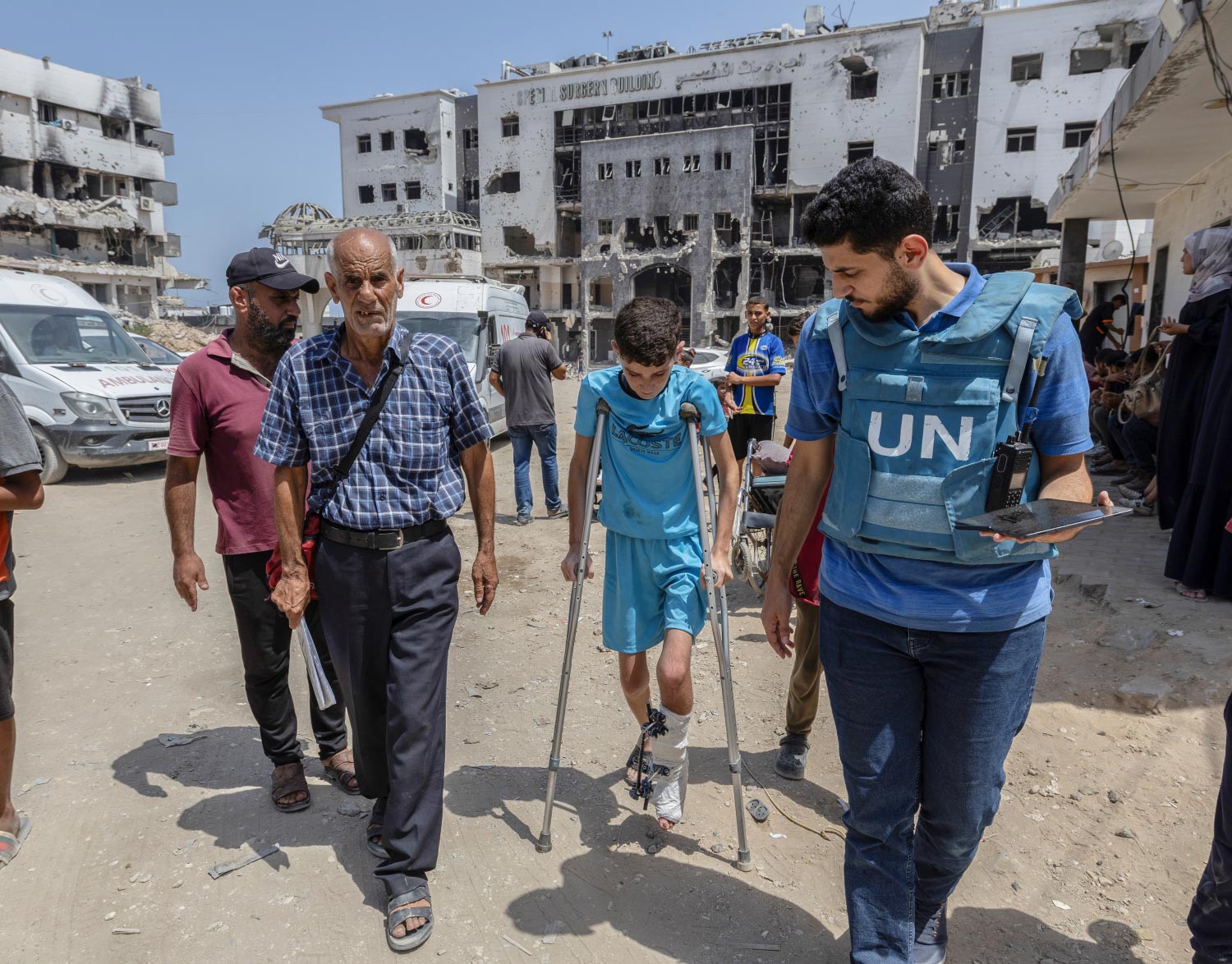
Many injured will need rehabilitation care and support for years to come: WHO-report. Photo: WHO
Kids in Pain: Aya Dies in Al Aqsa’s Chaos
Gaza City/Geneva: The United Nations aid teams highlighted the disturbing situation at Gaza’s Al Aqsa Hospital in Deir Al-Balah today. Premature babies cry for scant oxygen. Medics try to save child survivors hit by airstrikes in their tents. Others were shot by quadcopters while fetching bread.
UNICEF spokesperson James Elder spoke from the war-shattered enclave. Israel’s military push to take full control of Gaza City continues. Elder described a 30-minute hospital visit. Youngsters were suffering or dying everywhere he looked. Six-year-old Aya, injured by an airstrike, lay on a bed. Her hair had colourful bobs. They showed a parent’s care before the airstrike. “I’m really noticing not just the wound, but the attention that the bobs in her hair, the care that a parent’s given before the airstrike,” Elder said. As he talked to the surgeon, Aya died on the bed in front of them.
That’s 30 minutes in a hospital. At the same hospital, Elder saw three children “all shot by quadcopters.” Reports say people are injured seeking aid from controversial non-UN relief distribution hubs run by the Gaza Humanitarian Foundation (GHF). “It’s a war zone, children on the floor, there’s a boy who’d been shot at GHF was bleeding out on the floor,” Elder said. Others were wounded by shooting, shrapnel, or burns. Elder underscored that 1,000 infants have been killed in Gaza in the last two years since Hamas-led terror attacks on Israel triggered the war. “We have no idea how many more have died from preventable illnesses,” he continued.
Only around 14 of Gaza’s 36 hospitals are still open and partially functional after almost two years of war. They are often “absolutely packed” with people needing help, Elder stressed. He turned and saw Sham, a little girl just pulled from the rubble. She was covered in dust and smoke with a terrified expression on her face. An aunt or uncle held her. Sham had no broken bones nor internal injury. She was not told that her mother and sister were both killed in that attack.
In Gaza City, tens of thousands of children remain. They are unable to leave amid continuing Israeli evacuation orders. Airstrikes leave children shuddering. They gaze skywards to track the fire from helicopters and quadcopters. Shoeless children push grandparents in wheelchairs around the rubble. Amputee children struggle through the dust. Mothers carry exhausted children whose skin is literally bleeding because of the severity of rashes.
Elder warned of “continued indiscriminate attacks in densely populated civilian areas despite official statements.” He said people ask him everywhere in Gaza City—women, the elderly, children—“Where can I go that will be safe?” His answer: “Nowhere. Nowhere is safe in the Gaza Strip.”
A further 200,000 civilians were warned to leave Gaza City today. Over 400,000 have been forced south. The Patient Friendly Hospital in Gaza City, where Elder was yesterday, admits 60 to 80 children daily for malnutrition and other illnesses.
At Al Helou Hospital, the Intensive Care Unit (ICU) for infants and newborns is overflowing. It was shelled last week.
Elder said the north is declared hostile ground. Those who stay are branded suspects. He stressed, “The issuance of a general or blanket evacuation order to civilians does not mean that those who remain behind lose their protection as civilians.”
The south, called “safe zones,” is deadly too. Al-Mawasi is grotesquely overcrowded, one of the most densely populated places on earth. It lacks survival essentials. Eighty-five per cent of families live within ten meters of open sewage, animal waste, piles of garbage, stagnant water, or rodent infestations. Two-thirds have no access to soap.
Elder spoke to dozens in Gaza City. They said they have no money to move, no space or tent to move into, and the south is dangerous. Bombs drop in the south with chilling predictability. Schools used as shelters are reduced to rubble. Tents in empty lots offer no protection from shrapnel. They are often engulfed in fire from air attacks. Two days ago at Nasser Hospital, Elder met children paralysed, burnt, or with amputated limbs after direct hits on tents at 2 a.m. Days earlier, at Al Aqsa, he met many children shot by quadcopters.
At Nasser Hospital, corridors are lined with women who have just given birth. Elder said in six missions to Gaza, he never saw it like this. New mothers and vulnerable newborns lie on the floor. Three premature babies share one oxygen source. Each breathes for 20 minutes before the next. A premature baby, Nada, was in intensive care for 21 days. She was discharged and now lies on the corridor floor with her mother. Nada weighs two kilograms, less than half what she should.
Women have miscarriages on the exhausting trek from north to south. Doctors fear winter viruses have arrived early. Elder said the logic imposed on Gaza is brutal and contradictory. When the world normalises this violence and deprivation, something is profoundly broken. He said the strength of international law lies not in words but in countries’ resolve to uphold it.
Aid workers face deadly risks. Yesterday, the Non-Governmental Organisation Médecins Sans Frontières (MSF) confirmed the killing of its 14th medical worker in Gaza. Occupational therapist Omar Hayek died in an attack in Deir Al-Balah. Four colleagues were injured. He worked at an MSF clinic in Gaza City until 13 September. He evacuated amid “relentless attacks and forced displacement from Israeli forces,” MSF said.
A World Health Organization (WHO) report released yesterday in Jerusalem reveals that nearly 42,000 people in Gaza, including one in four children, have sustained life-changing injuries since October 2023, totalling a quarter of the 167,376 reported injuries. These include over 5,000 amputations, 22,000 severe limb injuries, 2,000 spinal cord injuries, 1,300 brain injuries, and more than 3,300 major burns, with complex facial and eye injuries prevalent among those listed for medical evacuation, often leading to disfigurement, disability, and social stigma.
The data, drawn from 22 WHO-supported Emergency Medical Teams, Gaza’s Ministry of Health, and health partners, highlights the dire need for specialised surgical and rehabilitation services. Yet, less than one-third of pre-conflict rehabilitation services remain operational, with several facing imminent closure. Gaza’s rehabilitation workforce, once 1,300 physiotherapists and 400 occupational therapists, has been devastated, with many displaced and at least 42 killed by September 2024, including one rehabilitation worker killed and another injured yesterday.
With only eight prosthetists to serve thousands of amputees, the shortage is critical. Dr Rik Peeperkorn, WHO Representative in the Occupied Palestinian Territory, said, “People are scared and rightly so. Rehabilitation is vital not only for trauma recovery but also for chronic conditions and disabilities, which carry a profound mental health toll as survivors struggle with trauma, loss, and daily survival with scarce psychosocial services.” He added, “If you ask me now, can we do our work? I say no, of course, we cannot do our work in the north.” He fears, “What is happening in the north, I fear it will be very difficult to bounce back if this is continuing.”
Christian Cardon from the International Committee of the Red Cross (ICRC) said the level of violence makes nowhere safe, including field hospitals. They offer no protection from stray bullets. “We had several occasions of people being injured, brought to the hospital, and while they were being treated, were wounded again because of stray bullets coming into the hospital,” he said. Another incident happened on Thursday.
Frontline workers do the impossible. UNICEF and partners supply Ready-to-Use-Therapeutic-Food (RUTF) for malnourished babies in Gaza City. They repair water lines, deliver cash assistance, provide trauma support, supply lifesaving equipment for babies in hospitals, offer mental health sessions, and collect waste across Gaza.
But restrictions on humanitarian aid entry and delivery make aid woefully inadequate. WHO and health partners call for urgent protection of healthcare facilities, unhindered access to fuel, supplies, and essential medical items like assistive devices, and an immediate ceasefire to scale up rehabilitation and psychosocial services, giving Gaza’s people a chance to heal physically and mentally.
Elder said the media have heard UNICEF brief dozens of times since the carnage began. They reported on a war on children, a famine, and a polio outbreak with data and testimonials. Yet things are worse now. “Everyone bares some responsibility for this, but there is only one victim,” Elder said. “Yesterday, today, and without meaningful action, tomorrow. Palestinian children.”
Just 30 minutes at Al Aqsa shows medics’ bravery and kids like Sham’s strength. Their stories beg for peace where no bed is safe.
– global bihari bureau