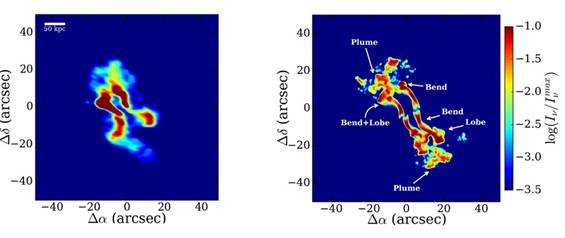
Left: The color-coded uGMRT radio image of TRG J104454+354055 at 1.4 GHz. Right: Simulated radio synchrotron intensity map of the TRG at 1.4 GHz. Different structures (bends, lobes, and plumes) are marked within the image.
How Twin Black Holes Twisted Their Cosmic Jets
India Recreates Twisting Jets of Twin Radio Galaxy
Bengaluru: Astronomers in India have taken one of the universe’s rarest and most puzzling objects—two supermassive black holes each throwing out its own pair of giant radio jets—and recreated its twisting shape using advanced computer simulations. Their work helps explain how these enormous jets behave, why they bend and wobble, and how they carve out vast structures in space over nearly 200 million years. For scientists trying to understand how galaxies grow and evolve, this marks an important step.
To appreciate why this is special, it helps to know that almost every large galaxy, including our Milky Way, contains a supermassive black hole at the centre. When these black holes actively pull in gas and dust, they can also eject a tiny fraction of that material at near-light speeds in two opposite directions. These jets travel millions of light-years through space and shine brightly in radio waves. Usually, a galaxy hosts only one such jet-producing black hole. But in extremely rare cases—only three have been found so far—a galaxy merger leaves behind two active supermassive black holes, both launching jets at the same time. These rare systems are called Twin Radio Galaxies, or TRGs.
The third known TRG, named TRG J104454+354055, was discovered only in 2022 using India’s Upgraded Giant Metrewave Radio Telescope near Pune. Radio images showed two enormous sets of jets stretching roughly three lakh light-years each, with the two black holes themselves separated by about one lakh light-years. But the most intriguing feature was the shape of the jets: instead of being straight, they twist, bend, and form helical patterns, almost as if they were gently corkscrewing through space. Understanding why the jets look this way has become a major scientific challenge.
A team at the Indian Institute of Astrophysics (IIA) decided to tackle the problem using three-dimensional hydrodynamical simulations—computer models that mimic the movement of plasma and gas under extreme conditions. Led by Ramanujan Fellow Dr Santanu Mondal, the researchers created multiple possible scenarios, adjusting environmental conditions around the black holes and introducing a phenomenon known as precession. Precession is a slow wobble in the direction of the jet, similar to the way a spinning top slowly changes its pointing direction as it loses speed.
When the team ran their simulations, a clear pattern emerged. The twin jets could remain separate and nearly parallel while developing helical twists only when both black holes were launching precessing jets. This wobble turned out to be the key that reproduced the real radio images. The simulations also allowed the researchers to look deep into the past and reconstruct about 190 million years of the system’s evolution, offering a kind of time-lapse view of how the jets developed their present shape.
The cause of the wobbling lies in the gravitational tug-of-war between the two black holes. When the disk of matter falling into a black hole is slightly misaligned with the black hole’s own spin, gravity twists the disk—and in turn the jet—over long time scales. Surprisingly, the team found that this effect remains strong even when the two black holes are as far apart as a million light-years. The result is a slow, graceful rotation in the jet direction, which explains the wiggles and bends that astronomers see today.
Dr Ravi Joshi, a member of the original discovery team at IIA, said the simulations “matched the observed structure for a specific range of physical conditions,” confirming that precession is essential to explaining the unusual jet shapes. The team also observed that while the jets move steadily in one direction, they show noticeable side-to-side motion caused entirely by this wobble.
Beyond solving the puzzle of one strange galaxy, the work has larger implications. Jet activity from supermassive black holes plays a major role in shaping the galaxies around them. By understanding how jets behave when two black holes are involved, scientists can better understand how mergers fuel or suppress galaxy growth. With the upcoming Square Kilometre Array—set to be the world’s most powerful radio telescope—astronomers expect to find more systems like this, and the methods developed in this study will help decode them.
The findings have been published in The Astrophysical Journal and involve collaboration across India, South Africa, China, and the United States, with authors Santanu Mondal and Ravi Joshi from IIA, Gourab Giri, Paul J. Wiita, Gopal-Krishna, and Luis Ho contributing to the research.
– global bihari bureau