Bus Ignites After Hitting a Bike in Kurnool
Kurnool: The tragic bus fire near Kurnool, which reportedly claimed 20 lives and injured 21 others, four of the injured were in critical condition at Kurnool Government General Hospital and nearby facilities, has once again exposed critical vulnerabilities in India’s bus safety infrastructure, prompting a renewed examination of national and global standards. As investigations reveal lapses such as jammed emergency exits and fuel tank ruptures—issues that could have been mitigated by stricter adherence to fire-resistant materials and advanced monitoring systems—this incident serves as a stark reminder of the gap between India’s evolving regulations and the robust frameworks in regions like Europe and the United States, where fatality rates from similar accidents are significantly lower due to mandatory advanced technologies and rigorous enforcement.
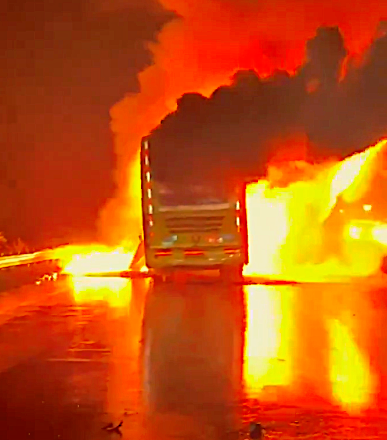
The private luxury sleeper bus operated by V Kaveri Travels, travelling from Hyderabad to Bengaluru, caught fire after colliding with a motorcycle near Chinnatekuru village in Kallur mandal, Kurnool district, Andhra Pradesh, along National Highway 44, approximately 20 km from Kurnool town, at around 3:30 AM on October 24, 2025. While the incident resulted in 19 confirmed deaths and 12 confirmed injuries, some reports suggest the death toll may be 20, and injuries may range up to 21. The deceased included four members of the same family from Nellore district – Golla Ramesh (35), Anusha (30), Manvitha (10), and Manish (12).
Many victims, burned beyond recognition, require DNA sampling for identification. The deceased included 13 from Telangana (including four from Hyderabad), and six from Andhra Pradesh, including two children and the motorcyclist.
The bus carried 41 passengers and two drivers, totalling 43 people on board. The two bus drivers escaped unharmed. Survivor Jayant Kushwaha, aged 27, escaped through an emergency window, crediting it for his survival. Some earlier reports suggested one additional death and up to nine more injuries.
The collision occurred during heavy rainfall, which reduced visibility. Police reports indicate the motorcycle suddenly swerved into the bus’s path, leading to a rear-end collision. The motorcycle was lodged beneath the bus, rupturing its fuel tank and spilling petrol, which ignited due to a spark. The fire spread rapidly, intensified by the explosion of brand-new mobile phones stored in the baggage compartment under the rear seats. Most passengers were asleep, and survivors reported that emergency windows failed to open properly, hindering escapes. Local residents, including one named Naveen who broke windows to rescue six people, attempted to aid, but heavy rain and the fire’s intensity delayed efforts. Fire tenders arrived, but the bus was fully charred.
The bus, acquired in 2018 and first registered in Daman and Diu, was re-registered in Rayagada, Odisha, on April 29, 2025. It held valid documentation: an All-India Tourist Permit (August 1, 2025–July 31, 2026), a fitness certificate (valid until March 31, 2027), road tax paid until March 31, 2026, and insurance until April 20, 2026. The vehicle had 16 traffic challans from January 2024 to October 9, 2025, for overspeeding, rash driving, and nine no-entry zone violations, with fines totalling over ₹23,120.
Andhra Pradesh Chief Minister N. Chandrababu Naidu expressed grief, directing senior officials to coordinate relief efforts. He announced ₹5 lakh ex gratia for each deceased’s family and full medical support for the injured, and formed a high-level committee to investigate causes and safety lapses. Telangana Transport Minister Ponnam Prabhakar, noting four Hyderabad victims, ordered a separate inquiry to prevent future incidents and sent transport officials to assist. Prime Minister Narendra Modi condoled the loss of lives, stating on the PMO India handle on X: “Extremely saddened by the loss of lives due to a mishap in Kurnool district of Andhra Pradesh. My thoughts are with the affected people and their families during this difficult time. Praying for the speedy recovery of the injured. An ex gratia of Rs. 2 lakh from the Prime Minister’s National Relief Fund (PMNRF) would be given to the next of kin of each deceased. The injured would be given Rs. 50,000: PM @narendramodi.”
The bus driver and motorcyclist are in custody for questioning, with a negligence case filed against them, including charges of overspeeding. Forensic teams from Andhra Pradesh and Telangana collected DNA samples and debris for analysis. Helplines in Kurnool and Gadwal assist families, and a state control room supports queries. Road transport unions in Kakinada demanded ₹50 lakh per victim and seizure of the operator’s fleet, citing repeated violations. A seven-member Karnataka team arrived to aid affected residents. The investigation will examine weather conditions, vehicle speed, fuel system integrity, and emergency exits, referencing a 2013 Palem bus fire with similar issues.
The Kurnool tragedy underscores ongoing challenges in bus safety, prompting scrutiny of recent reforms. The Ministry of Road Transport and Highways (MoRTH), in October 2023, mandated that all new buses comply with the Central Motor Vehicles Rules (CMVR) Bus Body Code by mid-2025. This requires certification from government-recognised agencies to ensure structural integrity, fire-resistant materials, accessible emergency exits, and secure fuel tanks. MoRTH also mandated ‘indirect vision’ devices like closed-circuit television (CCTV) cameras for blind-spot monitoring to reduce collisions. The ministry’s iRASTE (Intelligent Solutions for Road Safety Through Technology and Engineering) scheme, expanded in 2024, employs artificial intelligence (AI)-based telematics for real-time monitoring of commercial buses, alongside stricter fitness checks and driver training to curb overspeeding, a factor in 75% of bus-related fatalities.
Judicial interventions have further shaped safety standards, particularly for school buses. In 2023, the Supreme Court issued 17-point guidelines, upheld in 2024, requiring yellow-painted buses with “School Bus” markings, speed governors capped at 40 km/h, fire extinguishers, global positioning system (GPS) tracking, and CCTV cameras. Drivers need five years of heavy vehicle experience and police verification, while female attendants are mandatory for co-education buses. These rules, enforced by the Central Board of Secondary Education (CBSE) for affiliated schools, aim to prevent tragedies like the 2024 Indore school bus crash. In December 2024, the Madhya Pradesh High Court ordered annual audits and ₹5 lakh compensation per victim, aligning with Chhattisgarh’s framework.
State-level measures reflect local priorities. West Bengal, post a 2024 child fatality, abolished its bus commission system and introduced standard operating procedures (SOPs) for private buses, including panic buttons linked to police and traffic education in schools. Maharashtra, after the 2024 Kurla Brihanmumbai Electric Supply and Transport (BEST) bus crash, mandated brake checks every 3,000 km and AI dashcams. Karnataka and Delhi have pushed GPS-CCTV integration and ethanol-blended fuel to reduce fire risks. Despite these efforts, the 2024 India Status Report on Road Safety notes a 5% rise in bus-related deaths, highlighting uneven implementation and funding gaps, particularly in rural areas. MoRTH’s ₹12,000 crore allocation for 2025 aims to bridge these gaps through safety tech advancements.
The Kurnool incident also highlights gaps in global bus safety standards, which India is striving to align with. The United Nations Economic Commission for Europe (UNECE) sets benchmarks adopted by over 50 countries, including UN Regulation No. 66 for rollover protection, ensuring bus roofs withstand a 360-degree roll at 48 km/h, and UN Regulation No. 107, mandating emergency exits (one per 12 seats), fire-resistant materials, and secure seat anchorages. Amendments effective 2023 require child seats with 3-point belts or International Standards Organisation FIX (ISOFIX), with phase two by December 2025, adapting 2-point belts for older fleets. UN Regulation No. 127 mandates pedestrian detection systems, while No. 152 enforces advanced emergency braking (AEB) to mitigate collisions. In the United States (U.S.), Federal Motor Vehicle Safety Standards (FMVSS) like No. 217 require one emergency exit per 12 seats with easy-release windows, and No. 227 ensures rollover integrity for large buses. The European Union’s (EU’s) General Safety Regulation (2019/2144), phased in since 2022, mandates AEB, lane departure warnings, and blind-spot detection, with reversing detection due by 2029. International Organisation for Standardisation (ISO) standards, such as 39001:2012 for road safety management and 26262:2018 for advanced driver assistance systems (ADAS) reliability, complement these by guiding operator practices. These global standards, reducing bus fatalities by 25% in adopting regions since 2010, underscore the need for India to strengthen compliance, particularly for fuel tank safety and emergency exits, as exposed by the Kurnool fire.
India’s bus safety framework, while advancing, trails global leaders in enforcement and outcomes. India’s bus-related fatalities (8-10% of ~180,000 total road deaths, or ~14,000-18,000 annually) exceed the EU’s 2-5% (1.5 per 100,000 population) and the US’s ~0.8 per 100,000 for transit buses. India’s per capita road death rate (11-12 per 100,000) is below the global average (17.4) but higher than developed nations.
| Aspect | India (2025) | Global (UNECE/EU/US) |
|---|---|---|
| Certification | CMVR Bus Body Code by 2025; voluntary New Car Assessment Programme (NCAP). | UNECE 107, FMVSS, EU General Safety Regulation (GSR): mandatory approval. |
| Exits/Structure | 1 exit/12 seats; weak Automotive Industry Standard (AIS)-029 enforcement. | 1 exit/12 seats; 45N release; 1.5x weight roll. |
| ADAS | iRASTE AI, CCTV pilot; limited adoption. | AEB, lane warning, and blind-spot by 2024-2029. |
| Driver Rules | 3+ yrs license; school bus SOPs (40 km/h). | ISO 39001; vulnerable road user (VRU) training; commercial driver’s license (CDL) medicals. |
| Fire Safety | CMVR fuel rules; ethanol pilots; fire risks. | UNECE 118, FMVSS 301: fire suppression. |
| Fatality Rates | ~14,000-18,000 (8-10%); 11-12/100k. | 2-5% of 1.19M; EU: 1.5/100k; US: 0.8/100k. |
India’s ₹12,000 crore 2025 safety budget and MoRTH’s UNECE alignment aim to close gaps, but uneven compliance and rural funding shortages hinder progress toward the United Nations’ (UN’s) 50% fatality reduction goal by 2030.
– global bihari bureau