Hunger Hotspots: Millions Teeter on Famine’s Edge
Rome: In a world trembling on the edge of catastrophe, the FAO-WFP Early Warning on Acute Food Insecurity Report, funded by the European Union through the Global Network Against Food Crises, sounds a piercing alarm: 13 countries and territories teeter on the brink of worsening food crises through September 2025. Sudan, Palestine, South Sudan, Haiti, and Mali stand as harrowing epicentres where millions stare into the abyss of starvation and death, their survival hanging by a fragile thread.
Unveiled today by the Food and Agriculture Organization (FAO) and the World Food Programme (WFP), this forward-looking analysis is a clarion call to action, painting a heart-wrenching portrait of communities ensnared by the merciless grip of conflict, economic collapse, and natural hazards, beckoning the world to act swiftly with coordinated resolve to snatch these populations from the jaws of disaster.
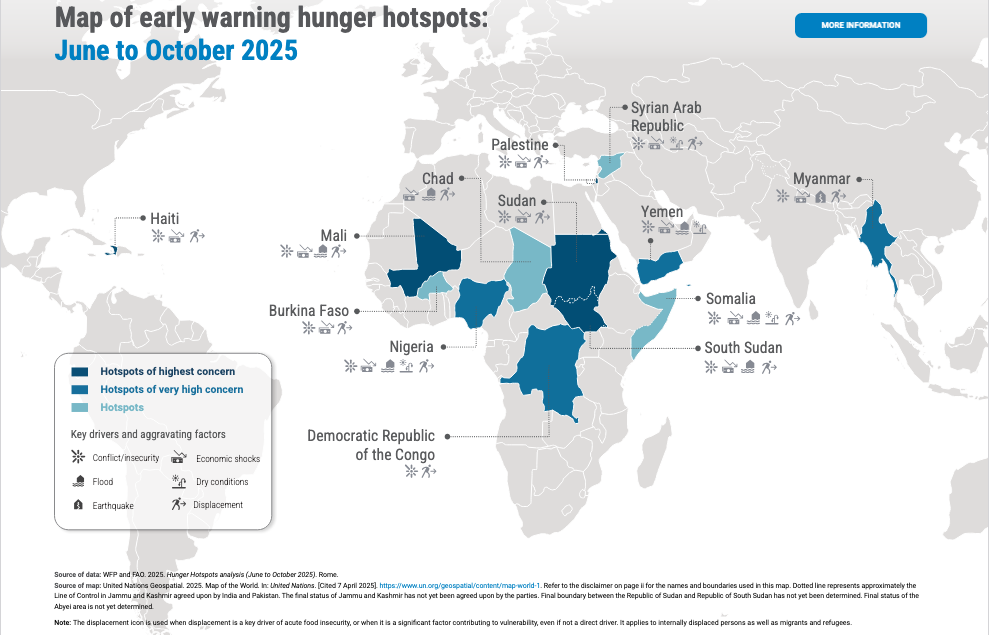
In Sudan, the wounds of famine confirmed in 2024 fester, raw and unrelenting, as a brutal civil war rages fiercest in Greater Kordofan and Greater Darfur. Millions are uprooted, supply chains shattered, and humanitarian aid barricaded from those gasping for survival. The report projects a staggering 24.6 million people—half of Sudan’s population—will grapple with acute food insecurity at crisis or worse levels (IPC Phase 3 or above) through May 2025, with 637,000 souls enduring Catastrophe conditions (IPC Phase 5), where extreme food shortages, acute malnutrition, and the specter of starvation loom large. Skyrocketing inflation, a relentless predator, is gutting the economy, rendering food a luxury beyond reach, while displacement surges, piling unbearable pressure on crumbling resources.
Across the Mediterranean, the Gaza Strip in Palestine descends into a nightmare of equal horror. Relentless military operations choke off food and aid, thrusting all 2.1 million residents toward acute food insecurity at Crisis or worse levels through September 2025. Of these, 470,000 face Catastrophe conditions, their survival tethered to the fragile hope of immediate aid. A commercial blockade, coupled with soaring food prices and collapsing livelihoods, fuels an economic maelstrom that strips families bare. Unyielding conflict and throttled aid access conspire to ignite a famine, forging a humanitarian disaster that screams for urgent intervention.
In South Sudan, a young nation battered by political strife, economic despair, and the relentless threat of flooding, the outlook is equally dire. From April to July 2025, 7.7 million people—57 per cent of the population—are expected to face acute food insecurity, with 63,000 in Catastrophe conditions. A recent Integrated Food Security Phase Classification update, released post-report, confirmed a risk of famine in two areas, spotlighting the knife-edge on which the nation teeters. Political and environmental stressors erode the resilience of communities reliant on subsistence farming and aid, making timely action a matter of life and death.
Haiti, reeling from unprecedented gang violence, presents a gut-wrenching tableau. In the Port-au-Prince metropolitan area, over 8,400 displaced souls are projected to face Catastrophe levels of acute food insecurity by June 2025. Insecurity shatters markets, severs livelihoods, and blocks aid from reaching those in desperate need, trapping communities in a merciless cycle of violence and hunger, where the absence of safe routes and stable governance leaves families defenceless against starvation’s advance.
In Mali, the crisis burns with equal urgency. Soaring grain prices and persistent conflict in the northern and central regions dismantle the fragile coping mechanisms of vulnerable households. The report warns that 2,600 people risk catastrophic conditions (CH Phase 5) from June to August 2025 without immediate aid. Economic pressures and insecurity push families to the brink, with dwindling food stocks and scarce market access threatening to plunge them into famine-like despair.
The report’s gaze sweeps wider, spotlighting Yemen, the Democratic Republic of the Congo, Myanmar, and Nigeria as regions demanding immediate action. In Yemen, unending conflict and economic decay fuel hunger’s relentless march. The Democratic Republic of the Congo, re-entering the hotspot list, grapples with escalating violence that displaces thousands and disrupts food systems. Myanmar’s plight, already dire, deepens with a recent earthquake, piling misery atop conflict, displacement, and soaring food costs. Nigeria, alongside Burkina Faso, Chad, Somalia, and Syria, wrestles with a lethal cocktail of insecurity, economic shocks, and climate challenges threatening millions.
Yet, amid this bleak panorama, faint glimmers of hope flicker. Countries like Ethiopia, Kenya, Lebanon, Lesotho, Malawi, Mozambique, Namibia, Niger, Zambia, and Zimbabwe have been struck from the hotspot list, buoyed by better harvests, fewer weather extremes, and, in Lebanon’s case, a lull in military activity. But the FAO and WFP warn these gains are fragile, vulnerable to reversal by new shocks like conflict or climate disruptions. Humanitarian access, often stymied by insecurity, bureaucracy, or isolation, remains a formidable barrier. Funding shortages force aid agencies to slash food rations and scale back life-saving nutrition and agricultural support, kindling fears of backsliding.
Global Hunger Alarm: Act Now to Save Lives
FAO Director-General QU Dongyu casts the crisis as a daily emergency for millions, urging collective action to protect farms and livestock, empowering communities to produce food against all odds. WFP Executive Director Cindy McCain brands the report a red alert, affirming that while the tools and expertise to respond exist, funding and access are critical chokepoints. The Hunger Hotspots report, part of the Global Network Against Food Crises’ analytical arsenal, complements the 2025 Global Report on Food Crises, which reflects on 2024’s hunger levels. Together, they guide decision-makers in deploying resources and pre-emptive interventions that save lives at a fraction of the cost of delay.
As the world faces this escalating crisis, the report’s message rings clear: global solidarity is not merely a moral duty but a practical necessity. With sustained investment in food aid, agricultural support, and recovery, the window to avert catastrophic hunger remains open—but it is closing fast. The international community must act now to bridge the chasm between warning and action, ensuring millions do not plummet into starvation’s abyss.
– global bihari bureau