Degraded Farmland Endangers Future Harvests: FAO
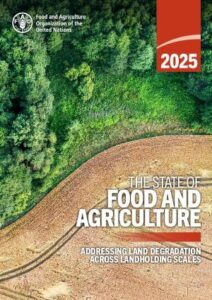
Rome: A slow-moving crisis is reshaping the planet’s farmland. Around 1.7 billion people now live in areas where crop yields have fallen as human activities steadily erode the land’s natural productivity. The new State of Food and Agriculture 2025 report depicts land degradation not as a remote environmental issue but as a structural challenge to food security, rural livelihoods, and ecological stability.
Land degradation is defined as the long-term decline in the land’s capacity to provide essential ecosystem functions such as water retention, nutrient cycling, and carbon storage. While it can occur through natural processes, it is now overwhelmingly human-driven. Centuries of cultivation have altered landscapes, but modern pressures—deforestation, excessive tillage, monocropping, and overextraction of groundwater—have deepened the scars. In many places, soil exhaustion, salinisation, and erosion proceed invisibly until yields collapse and farmers are forced to abandon their fields.
The latest evidence quantifies this loss as a form of “debt”: the discrepancy between current soil conditions and their natural baselines before human interference. By comparing data on soil organic carbon, erosion, and water levels, researchers estimate that croplands in degraded regions produce about ten per cent less than they otherwise would. For those who live off these lands, the consequences are immediate. Nearly 47 million children under five are growing up stunted in areas where poor soils and chronic undernutrition overlap.
Behind the numbers lies a complex geography of vulnerability. In Asia, degradation coincides with high population density, compounding food and livelihood pressures. In sub-Saharan Africa, yield gaps are shaped not only by land decline but also by limited access to fertiliser, irrigation, and credit. In industrialised economies, intensive input use conceals degradation for now, sustaining yields through chemicals and machinery even as the underlying ecological balance deteriorates. The report cautions that these compensatory strategies may offer only temporary relief; they heighten pollution, accelerate biodiversity loss, and lock farmers into costly cycles of dependence on external inputs.
Globally, agriculture remains the largest single force reshaping land cover. Between 2001 and 2023, cropland expanded by 78 million hectares while permanent meadows and pastures shrank by twice that amount. Nearly ninety per cent of deforestation worldwide was directly linked to agriculture—half of it to new cropland, much of the rest to grazing. In Africa, Latin America, and parts of Asia, the clearing of forests for crops continues to outpace afforestation efforts, exposing vast areas to soil erosion and declining water availability. In contrast, parts of Europe and North America have seen cropland contraction and limited forest recovery, but these gains are offset by degradation elsewhere. More than 130 countries have pledged to achieve “land-degradation neutrality” under the United Nations Convention to Combat Desertification (UNCCD), reflecting a broad international consensus now echoed in the findings of this report.
The world’s farms—numbering roughly 570 million—are highly unequal in both scale and capacity. About 85 per cent are smaller than two hectares, yet together they till less than a tenth of global farmland. Meanwhile, the 0.1 per cent of holdings larger than 1,000 hectares control almost half. Medium-sized farms between two and fifty hectares, which dominate much of Asia and Africa, remain pivotal but under pressure from fragmentation and inheritance laws. This imbalance shapes not only the flow of food but also the possibilities for restoring degraded land. Smallholders, constrained by credit and insecure tenure, find it difficult to invest in long-term soil improvement, while large operations, though better equipped, often pursue short-term profitability that can intensify degradation.
Despite this uneven landscape, smaller farms remain vital for local diets and crop diversity. Those under five hectares supply almost half the world’s spices, stimulants, and aromatic crops, and up to a third of fruits and vegetables. They are the custodians of biodiversity and seed varieties that industrial farming often sidelines. Larger farms, meanwhile, dominate globally traded commodities—cereals, pulses, oils, and sugar—that underpin both national food supplies and international markets. Their management decisions carry global consequences: a shift toward sustainable practices in this small segment could alter the trajectory of land degradation worldwide.
Land degradation has also reshaped migration and rural economies. As soils lose fertility, families abandon marginal land, joining the flow toward cities or new agricultural frontiers. An estimated 3.6 million hectares of cropland are abandoned each year, a trend that reflects both environmental decline and changing labour dynamics. The report links such land abandonment to rising rural outmigration in parts of Africa and Asia, where failing yields make small-scale farming increasingly untenable. Restoration of such land offers one of the most efficient paths to expand food production without further deforestation. The report estimates that reviving even a fraction of abandoned cropland could feed hundreds of millions of people while reducing pressure on natural ecosystems.
Economically, the cost of inaction is rising. Degraded soils yield less and require more inputs to maintain production, increasing the burden on farmers and public budgets. Yet the benefits of restoration—improved food security, better water regulation, and carbon sequestration—are widely shared and often delayed. This mismatch between private costs and public benefits explains why land degradation persists even where the solutions are known. The report argues for targeted public investment and regulatory frameworks that align farmers’ incentives with environmental outcomes.
Policy responses are uneven across regions. High-income countries have increasingly adopted agri-environmental measures that link subsidies or payments to conservation goals. These include soil protection standards, cross-compliance mechanisms, and payments for ecosystem services. Such schemes, though costly to administer, have shown measurable improvement in land conditions. In contrast, low-income countries often lack the institutional capacity or financing to roll out similar programs. The result is a widening gap in the ability to prevent or reverse degradation precisely where it affects the most people. Rising biofuel demand, particularly in major grain-exporting regions, has also intensified land conversion pressures, often pushing large farms toward monocultures that accelerate soil depletion. The tension between energy security and sustainable land use is emerging as a new policy fault line in global agriculture.
Underlying every intervention is the question of land rights. Where farmers hold secure tenure—individually or collectively—they are far more likely to invest in long-term productivity. The link is especially evident among women: in countries where women enjoy equal land rights, households are more likely to diversify crops, conserve soil, and achieve food security. However, data show that women remain less likely than men to own or control agricultural land in most regions, a structural inequality that weakens the effectiveness of sustainability policies.
Climate change compounds these pressures, amplifying degradation through rising temperatures, erratic rainfall, and extreme weather. Smaller farms in tropical regions face the greatest exposure to heat and water stress. Medium-sized holdings often endure the sharpest economic impacts, while large operations in temperate zones may temporarily benefit from milder winters and longer growing seasons. Over time, however, climatic shifts will reduce the resilience of all farming systems unless soils and ecosystems are restored.
Drawing on the most recent global data on farm distribution, sizes, and crop production, the report outlines actionable opportunities for integrated sustainable land-use and management practices, alongside tailored policies. These measures aim to avoid, reduce, and reverse land degradation while improving food production and farmers’ livelihoods. “To seize these opportunities, we must act decisively. Sustainable land management requires enabling environments that support long-term investment, innovation and stewardship,” FAO Director-General QU Dongyu wrote in the report’s Foreword.
The report’s broader message is that land degradation is not inevitable. The trajectory can be altered if agriculture itself becomes regenerative—avoiding further depletion, reducing ongoing damage, and reversing past losses. The recommended “avoid–reduce–reverse” hierarchy prioritises prevention as the most effective and least costly path, followed by measures to limit active degradation and, where necessary, large-scale ecological restoration. Successful models already exist, from China’s Loess Plateau rehabilitation to the Great Green Wall initiative in the Sahel, which have combined policy support, local engagement, and sustained funding to reclaim vast degraded areas.
The transformation of agriculture into a restorative force, the report concludes, requires integrated land-use planning, coherent policies, and international cooperation. Over 130 countries have pledged to achieve “land-degradation neutrality” under the UN Convention to Combat Desertification, but progress depends on turning commitments into sustained action on the ground. Secure tenure, inclusive financing, and strong institutions remain indispensable. Without them, the world risks trading short-term food gains for long-term ecological loss.
At its heart, the document is a reminder that the planet’s most fundamental asset—its soil—is finite and non-substitutable. More than 95 per cent of food still comes from land, yet the very resource that sustains humanity is being quietly depleted. The challenge, the report suggests, is no longer only to feed a growing population but to do so in a way that allows the land itself to recover. The choices made in the coming years will determine whether agriculture continues as a force of depletion or becomes, once again, a source of renewal.
– global bihari bureau