FAO Hails Young Agri-Change Makers
 Rome: The Food and Agriculture Organization of the United Nations (FAO) today launched its groundbreaking report, “The Status of Youth in Agrifood Systems,” spotlighting how 1.3 billion young people aged 15 to 24 globally can transform agrifood systems by driving innovation, entrepreneurship, and digital adoption to boost food security, combat hunger, and unlock a $1.5 trillion economic surge, provided policies expand economic opportunities, modernize infrastructure, and enhance access to resources.
The report underscores the critical role of youth, with 85 per cent residing in low- and lower-middle-income countries where agrifood systems are economic lifelines. FAO Director-General QU Dongyu declared, “Youth need agrifood systems and agrifood systems need youth,” emphasising their potential as change agents to boost food production, replace an ageing workforce, and adapt to climate shocks.
Yet, daunting challenges—unemployment, limited access to land and credit, and climate-driven productivity declines—restrict youth, particularly rural youth in sub-Saharan Africa, to low-paid, precarious jobs.
In sub-Saharan Africa, where youth populations are projected to surge by 65 per cent by 2050, 395 million rural youth face declining agricultural productivity due to climate extremes, water scarcity, and soil degradation, particularly in traditional agrifood systems. With African youth disproportionately affected, exacerbating vulnerabilities in regions reliant on agriculture, globally too, food insecurity among youth has surged from 16.7 per cent in 2014–16 to 24.4 per cent in 2021–23.
The share of working youth in agrifood systems has declined from 54 per cent in 2005 to 44 per cent in 2021, compared to 38 per cent for adults, with a wide range from 82 per cent in protracted crisis areas to 23 per cent in industrialised systems, per FAO data. The report calls for urgent policy interventions to empower youth, amplify their voices, and drive investments to ensure sustainable food security for a growing global population.
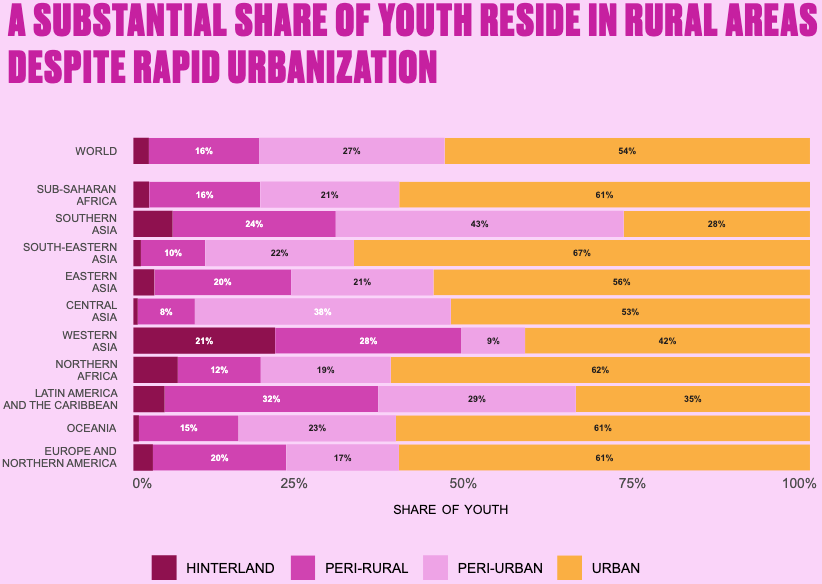
The report reveals stark demographic and economic realities shaping youth engagement. Globally, 54 per cent of youth live in urban areas, with Eastern Asia hosting the highest concentrations, while rural youth constitute just 5 per cent of the population in industrial agrifood systems, raising concerns about future labour shortages unless agriculture is made more appealing.
Economic opportunities hinge on addressing youth unemployment and exclusion. Over 20 per cent of youth globally are not in employment, education, or training (NEET), with young women twice as likely to fall into this category, deepening gender disparities. Eliminating unemployment for youth aged 20 to 24 could boost global gross domestic product by 1.4 per cent, adding $1.5 trillion, with 45 per cent from agrifood systems, the report estimates. In low-income countries, persistent low-productivity, labour-intensive agriculture, coupled with resource constraints, limits youth to low-paid, precarious jobs. In advanced economies, agrifood jobs remain seasonal, low-paying, and vulnerable, while young entrepreneurs face high land prices and stringent sustainability regulations. Rural youth, compared to urban peers, face 12 per cent lower literacy rates and lower returns to education, hindering their transition to decent livelihoods. The report highlights that youth aged 15–24 constitute 16.2 per cent of international migrants from sub-Saharan Africa and 15.2 per cent from Latin America and the Caribbean, often driven by limited opportunities in agrifood systems.
The FAO proposes three core strategies to harness youth potential: bridging knowledge gaps with robust data, amplifying diverse youth voices in policy-making, and driving targeted investments in infrastructure, digital tools, and training. To operationalise these, the report outlines specific actions: expanding economic opportunities through skills and resource access, investing in modernisation to make agrifood careers appealing, facilitating youth-targeted land and credit schemes, promoting orderly migration to address labour shortages, and enhancing digital access to connect young farmers to markets. Successful initiatives demonstrate these strategies’ impact. The Opportunities for Youth in Africa (OYA) programme has supported over 1,700 youths in agribusiness and reached 4,000 through platforms like the African Youth Agripreneurs (AYA) network. In Senegal and Uganda, programmes such as MIJA and Youth Inspiring Youth in Agriculture (YIYA) have incubated over 270 agribusinesses, fostering entrepreneurship and sustainable practices. The Junior Farmer Field and Life Schools (JFFLS) have trained over 25,000 youth in 20 countries, equipping them with agricultural and business skills to build resilient communities. The FAO’s Digital Villages Initiative, showcased in a July 2024 webinar, empowers young farmers with digital tools to modernise practices, enhancing market access and productivity.
Climate challenges pose a formidable barrier, with 395 million rural youth in areas at risk of productivity declines, particularly in sub-Saharan Africa, where extreme weather threatens traditional agrifood systems. The report advocates youth-targeted land and credit schemes, social protection programs, and safe migration pathways to address labour shortages and enhance engagement. The FAO’s Strategic Framework 2022–2031 aligns these efforts with Sustainable Development Goals (SDGs), notably SDG 2 (Zero Hunger) and SDG 8 (Decent Work and Economic Growth).
Kazuki Kitaoka, Global Coordinator of the World Food Forum (WFF), emphasised during the launch that youth must be active policy participants, with the WFF’s October 10–17, 2025, event in Rome set to advance youth-led innovation. The report cites successful regulatory measures, such as youth-inclusive policies in Rwanda, which increased agricultural productivity by 12 per cent through targeted training, and digital platforms in Kenya that connected 10,000 young farmers to markets.
With global hunger affecting 713–757 million people in 2023, per the FAO’s 2024 Statistical Yearbook, empowering youth is critical to transforming agrifood systems for a resilient, food-secure future.
– global bihari bureau